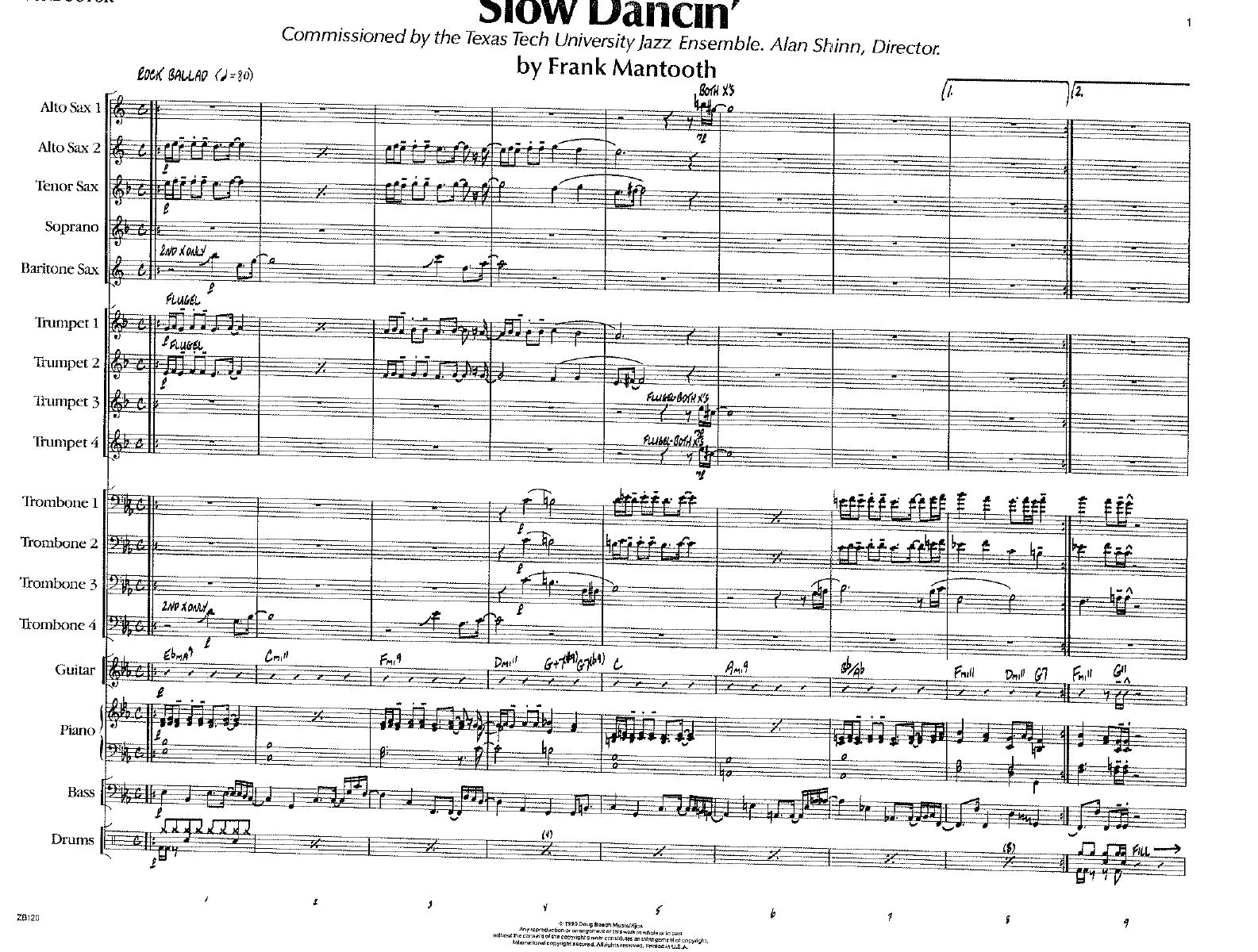
Slow Dancin' (F.Mantooth) sheet music preview

Slow Dancin' (F.Mantooth)

Composed by Frank Mantooth

Arranged by Frank Mantooth

  • Ensemble: Big Band
  • Pages: 46
  • Instruments (17): Alto Sax 1, Alto Sax 2, Tenor Sax 1, Soprano (Solo), Baritone Sax, Trumpet 1, Trumpet 2, Trumpet 3, Trumpet 4, Trombone 1, Trombone 2, Trombone 3, Trombone 4, Guitar, Piano, Bass, Drums
  • Difficulty: medium
  • Content: Individual Parts
  • Format: PDF Download (Instant)
  • Price: $24.99

Frank Mantooth’s "Slow Dancin'" stands as a masterclass in contemporary big band writing, capturing the sophisticated, harmonically rich aesthetic that defined the composer and arranger's seminal works during the late 20th century. Emerging from an era where modern jazz pedagogy and progressive big band composition intersected brilliantly, Mantooth’s writing reflects the polished, studio-slick sensibilities of contemporary jazz while maintaining deep roots in traditional expressive forms. Known for his dense, lush chord clusters and unexpected harmonic turns, Mantooth crafted this chart to explore the expressive boundaries of the modern jazz orchestra, making it a revered staple for advanced ensembles seeking to stretch their dynamic and tonal palette. Driven by a sultry, relaxed groove, "Slow Dancin'" unfolds at a unhurried tempo that demands exceptional control, exquisite intonation, and a mature sense of time from every section. The mood is introspective yet undeniably hip, evoking the late-night atmosphere of a smoke-filled jazz club through shimmering brass voicings and cascading woodwind lines. Rather than a traditional slow ballad, the chart utilizes a undulating, contemporary groove that allows the rhythm section to lay down a spacious, interactive foundation. The harmonies are unmistakably Mantooth—featuring signature suspended voicings, upper-structure triads, and chromatic inner-voice movements that create a sense of suspended motion and emotional yearning. The arrangement brilliantly distributes melodic material across the ensemble, avoiding predictable scoring by utilizing rich sax solis and counterpoint between the brass and reeds. The saxophone section—utilizing the versatile doubling requirements of two altos, tenor, soprano, and baritone—serves as the primary lyrical voice, weaving intricate lines that demand nimble fingerwork and seamless blend. Featured solo space allows an expressive soloist to stretch out over sophisticated changes, supported by a rhythm section that must balance transparency with harmonic depth. The technical challenges lie less in sheer velocity and much more in breath control, subtle dynamic shading, and the precise execution of close-interval harmony where any slight pitch deviation instantly alters the intended color. Advanced high school, collegiate, and professional big bands will find "Slow Dancin'" to be an immensely rewarding vehicle for developing ensemble maturity. Because the chart relies heavily on listening across sections and maintaining a delicate balance within thick chordal textures, it serves as an exceptional pedagogical tool for teaching modern big band literacy. Performers and audiences alike are drawn to its cinematic sweep and sophisticated harmonic language, ensuring that a performance of Mantooth's work leaves a lasting impression of elegance and modern jazz artistry. Achieving success with "Slow Dancin'" requires meticulous attention to blend, balance, and intonation, particularly within the brass and saxophone sections. The conductor must ensure that the dense, extended chord voicings characteristic of Mantooth's writing never sound muddy; inner voices must be balanced carefully to let the primary melody cut through naturally. The tempo should remain steady and relaxed, avoiding any tendency to rush the syncopated figures or drag the back-beat. Rhythm section players need a high degree of interactive maturity, treating the accompaniment as a fluid tapestry rather than a rigid time-keeping exercise. Pianists should voice chords cleanly, often omitting roots to leave space for the bass, while guitarists can utilize light, shimmering chord comping to complement the overall texture. Horn players must pay close attention to dynamic markings, executing crescendos and decrescendos smoothly to enhance the yearning, vocal quality of the piece. Q: What instruments and parts are included in this big band arrangement? A: The 17-instrument instrumentation features Alto Saxophone 1, Alto Saxophone 2, Tenor Saxophone, Soprano Saxophone, Baritone Saxophone, standard brass and rhythm sections, and includes a comprehensive 46-page conductor score. Q: What is the difficulty level of this arrangement? A: This chart is written at an advanced level, best suited for collegiate, professional, and elite high school big bands due to its complex harmonic language, intricate section work, and demands for mature intonation. Q: What is the musical style and historical context of "Slow Dancin'"? A: Composed in the contemporary jazz idiom by renowned arranger Frank Mantooth, the piece reflects the sophisticated, harmonically progressive big band style of the late 20th-century modern jazz scene. Q: What makes this specific arrangement unique? A: The arrangement is distinct for Mantooth's signature dense chord clusters, upper-structure triads, subtle woodwind doublings, and a sultry, relaxed groove that prioritizes lush harmonic color over high-energy pyrotechnics. Q: What is the expected performance duration and tempo feel? A: The piece is built around a relaxed, unhurried groove designed to be performed at a slow, expressive tempo, allowing the ensemble to fully explore the rich dynamic landscape and spacious harmonies.

Questions and answers

What is included in the Slow Dancin' (F.Mantooth) PDF?
The verified current file contains a conductor score and individual parts across 46 pages.
How many instruments or parts are listed for Slow Dancin' (F.Mantooth)?
The verified instrumentation list contains 17 entries for this Big Band arrangement.
Who is credited for Slow Dancin' (F.Mantooth)?
Composer: Frank Mantooth. Arranger: Frank Mantooth.
What difficulty is listed for Slow Dancin' (F.Mantooth)?
The verified difficulty level is medium.
Can I preview Slow Dancin' (F.Mantooth) before buying?
Yes. The product page provides a preview generated from the current PDF file.
How is Slow Dancin' (F.Mantooth) delivered?
After successful payment, the digital PDF is made available for download. The displayed price is $24.99.

Musicians Also Search For

Slow Dancin' Frank Mantooth PDFSlow Dancin' Frank Mantooth sheet musicSlow Dancin' arranged by Frank MantoothFrank Mantooth big band chartsFrank Mantooth jazz arrangements PDFSlow Dancin' Frank Mantooth big band arrangementsSlow Dancin' big band arrangementsSlow Dancin' big band PDF downloadSlow Dancin' jazz sheet musicbig band sheet music downloadSlow Dancin' conductor score PDFSlow Dancin' individual parts downloadSlow Dancin' sheet music PDFbuy Slow Dancin' sheet musicdownload Slow Dancin' PDFSlow Dancin' jazz chartsbest Frank Mantooth big band arrangementsSlow Dancin' printable sheet musicbig band repertoire PDF

All arrangements by Frank Mantooth All Frank Mantooth sheet music