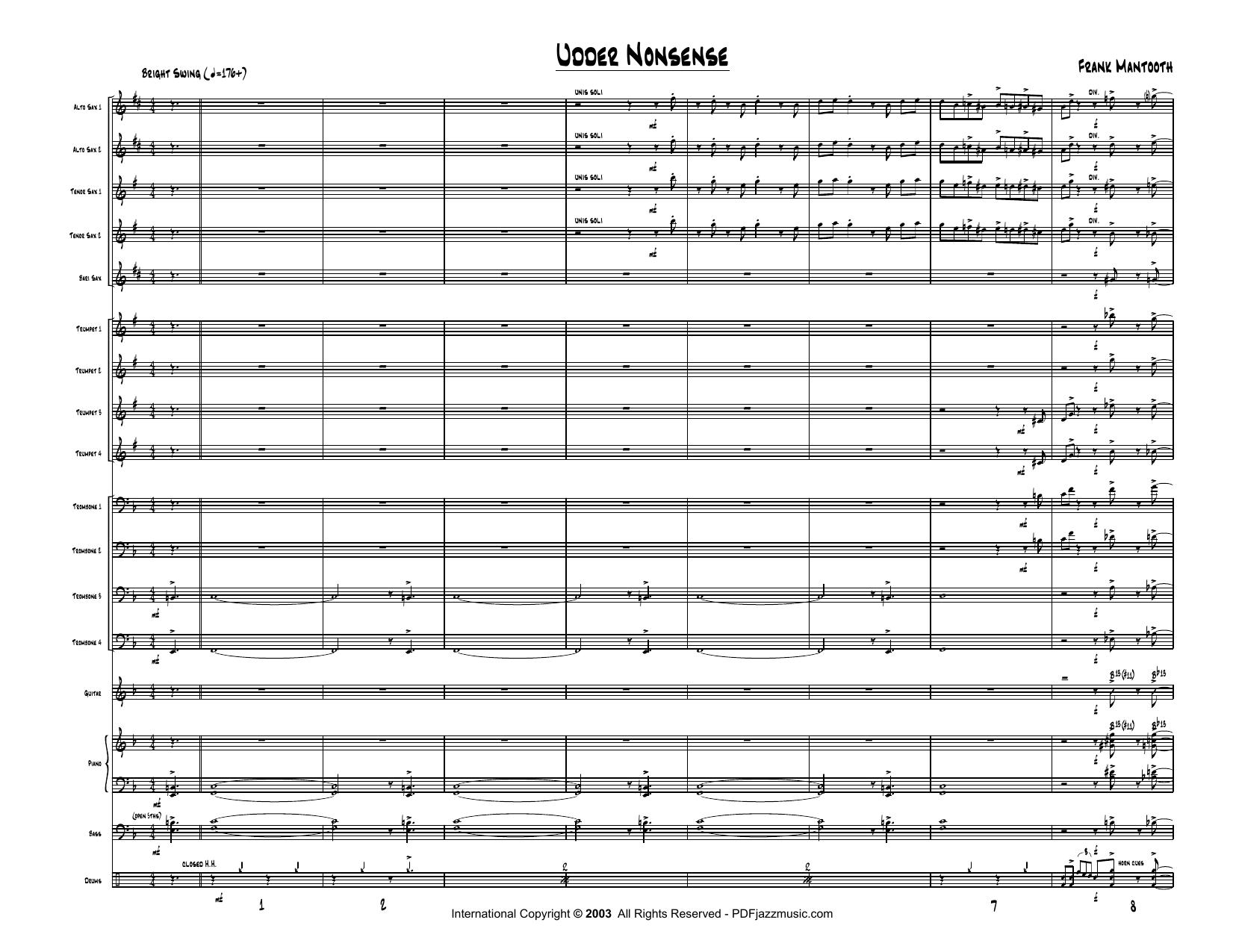
Udder Nonsense (F.Mantooth)
Composed by Frank Mantooth
Arranged by Frank Mantooth
- Ensemble: Big Band
- Pages: 96
- Instruments (17): Alto Sax 1, Alto Sax 2, Tenor Sax 1, Tenor Sax 2, Bari Sax, Trumpet 1, Trumpet 2, Trumpet 3, Trumpet 4, Trombone 1, Trombone 2, Trombone 3, Trombone 4, Guitar, Piano, Bass, Drums
- Difficulty: advanced
- Content: Individual Parts
- Format: PDF Download (Instant)
- Price: $24.99
Emerging from the vibrant contemporary big band movement of the late 20th century, "Udder Nonsense" stands as a brilliant showcase of the compositional and arranging genius of Frank Mantooth. Mantooth, a multiple Grammy-nominated artist, educator, and titan of modern jazz writing, crafted this chart to challenge traditional harmonic boundaries while keeping ensemble engagement remarkably high. Representing the pinnacle of post-fusion, contemporary big band literature, the work captures the witty, high-energy spirit that characterized Mantooth’s signature writing style—blending intricate, modern chord structures with an undeniable sense of swing groove and accessibility. Driven by an infectious, medium-to-up-tempo swing feel, the piece operates in a bright, energetic sonic landscape filled with unexpected harmonic detours and sophisticated voice-leading. The mood is playfully mischievous yet intensely driving, combining tongue-in-cheek thematic material with serious compositional rigor. Listeners will encounter a rich tapestry of sound where rich polychords, angular lines, and biting brass interjections create a sense of perpetual motion. The emotional arc moves effortlessly from cheeky syncopated head statements to explosive, wide-open developmental sections that demand complete command of the instrument from every player on the bandstand. Mantooth’s approach here relies heavily on his masterclass-level understanding of sectional interplay, utilizing dense cluster voicings, cascading woodwind solis, and tightly knit brass punches that explode into dynamic shout choruses. His signature writing treats the rhythm section not merely as timekeepers, but as co-conspirators in shaping the shifting tonal centers and rhythmic displacement. The counterpoint is meticulously crafted, giving inner voices distinct melodic movement rather than locking them into static pad roles. This creates a transparent yet powerful sound where complex altered dominants and suspension-heavy resolutions sound entirely natural and organic. Melody and thematic development are shared generously across the ensemble, though the saxophone and trumpet sections frequently carry the heavy lifting of the primary motifs. Featured solo spaces allow standout improvisers to stretch out over sophisticated, modern chord changes that will test the metalty of advanced players. Technical challenges abound in the precision required for rapid-fire unison lines, wide dynamic contrasts, and split-second articulation shifts. Yet, the reward lies in the sheer kinetic thrill of performing a chart that rewards precise execution with an unforgettable sonic payoff. Advanced high school groups with strong section leaders, collegiate jazz orchestras, and professional big bands will find this chart an ideal centerpiece for festival performances or formal concerts. The combination of dense contemporary harmonies and traditional big band drive requires an ensemble with mature intonation, agile reading skills, and a strong sense of internal time. Conductors tackling this arrangement should prioritize precision in articulation and balance, as Mantooth’s dense chord structures depend on crystal-clear intonation to sound clean. The tempo should be kept steady and buoyant; dragging will dilute the playful, driving energy required to make the syncopated figures pop. Pay special attention to the dynamic markings, particularly the sudden sub-ito pianos and explosive sforzandos that punctuate the arrangement. Saxophone woodwind doubles, if utilized, must blend seamlessly with the brass during layered soli sections. Horn players should approach accented notes with a sharp, clean front edge, while maintaining a flowing, horizontal line through the longer phrases. Rehearsal strategy should focus first on sectional isolation of complex rhythmic unisons before bringing the full ensemble together. Rhythm section players must lock in tightly, keeping the ride cymbal pulse crisp and the comping transparent enough to let the inner-voice harmonies breathe without cluttering the texture. Q: What instruments and parts are included in this arrangement? A: This 96-page big band publication includes a full conductor score and individual parts for a 17-piece standard jazz orchestra, featuring two alto saxophones, two tenor saxophones, baritone saxophone, four trumpets, four trombones, and a full four-piece rhythm section. Q: What is the difficulty level of this chart? A: This arrangement is graded as advanced, making it best suited for top-tier high school jazz ensembles, college studio orchestras, and professional big bands capable of navigating complex contemporary harmonies and rapid unisons. Q: What style and historical era does this piece represent? A: Composed in the late 20th century by Frank Mantooth, this piece represents contemporary post-fusion big band jazz, combining traditional swing grooves with advanced modern chord voicings and a witty, high-energy aesthetic. Q: What makes this Mantooth arrangement unique? A: The chart showcases Mantooth’s signature writing style, defined by clever thematic development, dense cluster voicings, shifting tonal centers, and intricate rhythmic displacement that keeps both performers and audiences thoroughly engaged. Q: What is the performance duration and tempo feel? A: The piece is set in a driving, medium-to-up-tempo swing feel that demands strong technical agility and rhythmic stamina, typically resulting in a performance duration of approximately four to six minutes depending on solo choruses.
Questions and answers
- What is included in the Udder Nonsense (F.Mantooth) PDF?
- The verified current file contains a conductor score and individual parts across 96 pages.
- How many instruments or parts are listed for Udder Nonsense (F.Mantooth)?
- The verified instrumentation list contains 17 entries for this Big Band arrangement.
- Who is credited for Udder Nonsense (F.Mantooth)?
- Composer: Frank Mantooth. Arranger: Frank Mantooth.
- What difficulty is listed for Udder Nonsense (F.Mantooth)?
- The verified difficulty level is advanced.
- Can I preview Udder Nonsense (F.Mantooth) before buying?
- Yes. The product page provides a preview generated from the current PDF file.
- How is Udder Nonsense (F.Mantooth) delivered?
- After successful payment, the digital PDF is made available for download. The displayed price is $24.99.
Musicians Also Search For
Udder Nonsense Frank Mantooth PDF • Udder Nonsense Frank Mantooth sheet music • Udder Nonsense arranged by Frank Mantooth • Frank Mantooth big band charts • Frank Mantooth jazz arrangements PDF • Udder Nonsense Frank Mantooth big band arrangements • Udder Nonsense big band arrangements • Udder Nonsense big band PDF download • Udder Nonsense jazz sheet music • big band sheet music download • Udder Nonsense conductor score PDF • Udder Nonsense individual parts download • Udder Nonsense sheet music PDF • buy Udder Nonsense sheet music • download Udder Nonsense PDF • Udder Nonsense jazz charts • best Frank Mantooth big band arrangements • Udder Nonsense printable sheet music • big band repertoire PDF