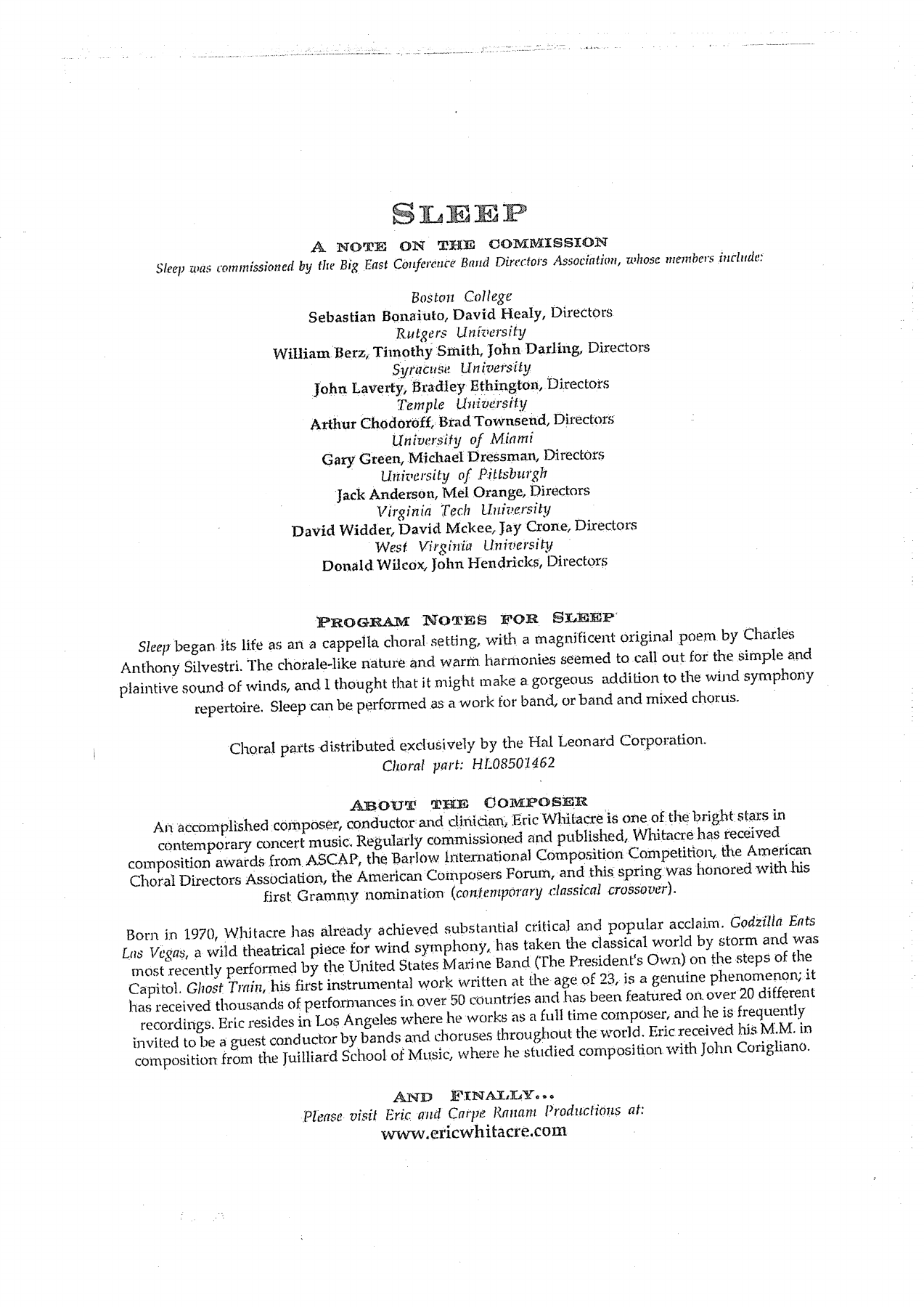
Sleep (E.Whitacre)
Composed by Eric Whitacre
Arranged by E.Whitacre
- Ensemble: Concert Band
- Style: Ballad
- Pages: 45
- Instruments (25): Flute 1-2, Oboe 1-2, Clarinet in Bb 1, Clarinet in Bb 2, Clarinet in Bb 3, Bass Clarinet 1-2, Alto Saxophone 1-2, Tenor Saxophone, Baritone Saxophone, Bassoon, Soprano, Alto, Tenor, Bass, Trumpet 1 in Bb, Trumpet 2-3 in Bb, Horn in F 1-2, Horn in F 3-4, Trombone 1-2, Bass Trombone, Baritone 1-2, Tuba 1-2, Timpani, Percussion 1 (Tubular Bells, Bass Drum, Marimba), Percussion 2-3 (Vibraphone, Suspended Cymbal, Crash Cymbals)
- Difficulty: medium
- Content: Individual Parts
- Format: PDF Download (Instant)
- Price: $22.99
Eric Whitacre's "Sleep" is a modern choral masterpiece, originally composed in 2000, known for its ethereal beauty and intricate harmonic language. While not a traditional jazz standard, its profound emotional depth and unique textural qualities have inspired countless interpretations across various genres. This particular arrangement, crafted by Whitacre himself, reimagines his iconic work for concert band, translating its signature blend of lush harmonies and soaring melodic lines into a compelling instrumental ballad. The original choral piece gained widespread recognition for its innovative use of vocal layering and its capacity to evoke a sense of profound peace and introspection, making it a staple in contemporary choral repertoire. This concert band arrangement of "Sleep" maintains the original's deeply meditative and introspective character. Set in a slow, sustained tempo, likely around quarter note = 50-60 bpm, it unfolds with a hushed reverence, primarily in E-flat major, though it navigates through rich, often suspended, harmonic landscapes. The mood is one of serene contemplation, evoking a sense of drifting, dreaming, and quiet wonder. Whitacre's signature use of extended harmonies, including added ninths and elevenths, is meticulously preserved, creating dense, shimmering chords that resonate with warmth and complexity. The energy is not one of overt power, but rather of sustained, delicate intensity, building through carefully orchestrated crescendos and decrescendos that mirror the ebb and flow of a gentle breath. E. Whitacre's approach to arranging his own work for concert band is characterized by an exceptional understanding of instrumental color and balance. He masterfully distributes the original vocal lines across the wind and brass sections, often featuring woodwind choirs (flutes, clarinets, oboes) carrying the primary melodic material, supported by rich brass textures and sustained low strings (if applicable to the specific instrumentation). There are no improvised solo sections in the jazz sense; instead, the "solos" are often lyrical, exposed lines passed between instruments, requiring exceptional blend and intonation. The arrangement is a study in texture, with specific attention paid to dynamic shaping and the subtle interplay of instrumental timbres. Whitacre avoids traditional concert band clichés, opting instead for a transparent, nuanced orchestration that allows the inherent beauty of the harmonies to shine through. The piece culminates in a breathtaking, expansive climax before receding into a peaceful, unresolved cadence, leaving the listener in a state of quiet reflection. Performing this arrangement is an immensely rewarding experience, though it presents unique challenges. The primary melodic lines are often shared and interwoven, requiring all sections to maintain a consistent, lyrical tone quality and precise intonation, particularly in sustained passages. Technical challenges lie less in rapid finger work and more in breath control, dynamic subtlety, and the ability to contribute to a unified, resonant ensemble sound. The piece demands a high level of musical maturity and sensitivity, making it appropriate for advanced high school, collegiate, community, and professional concert bands. Its profound emotional impact and sophisticated harmonic language offer a unique opportunity for ensembles to explore expressive playing beyond typical technical demands. Conductors should emphasize a deeply sustained, legato approach throughout "Sleep," focusing on breath support and seamless phrase connections, especially in the woodwind sections where melodic lines are often exposed. The tempo, while slow (quarter note = 50-60 bpm), should never drag; maintain a consistent internal pulse to prevent rhythmic disintegration. Intonation is paramount, particularly in the extended, often dissonant, harmonies; encourage musicians to listen vertically within chords and horizontally across their lines. Dynamic control, from pianissimo to forte, must be meticulously observed, with crescendos and decrescendos executed gradually and expressively. No special techniques like plunger mutes or falls are required; the focus is on pure, blended tone. Rehearsal time should be dedicated to slow, sectional work on challenging harmonic passages and to developing a unified ensemble sound that breathes together. Q: What instruments and parts are included in this concert band arrangement? A: This arrangement for concert band typically includes full instrumentation for woodwinds (flute, oboe, bassoon, clarinet, bass clarinet, saxophone), brass (trumpet, horn, trombone, euphonium, tuba), and percussion (mallets, timpani, suspended cymbal, etc.), with specific part details outlined in the score. Q: What is the difficulty level of "Sleep (E.Whitacre)" for concert band? A: This arrangement is considered advanced (Grade 5-6), requiring highly developed musicianship, excellent intonation, advanced breath control, and a sophisticated understanding of blend and balance from all sections. Q: What is the musical style and historical context of this piece? A: "Sleep" is a contemporary classical ballad, originally a choral work composed by Eric Whitacre in 2000. This concert band arrangement maintains its ethereal, introspective character, characterized by lush, extended harmonies and a deeply expressive mood. Q: What makes E. Whitacre's arrangement of "Sleep" unique for concert band? A: Whitacre's self-arrangement is unique for its faithful translation of the original choral work's intricate harmonies and emotional depth to instrumental textures, showcasing his mastery of orchestration and his ability to evoke profound serenity without relying on traditional concert band clichés. Q: What is the approximate performance duration and recommended tempo for this arrangement? A: The approximate performance duration for "Sleep (E.Whitacre)" is 4-5 minutes, and it should be performed at a slow, sustained tempo, typically around quarter note = 50-60 bpm, to allow its rich harmonies and lyrical lines to unfold fully.
Questions and answers
- What is included in the Sleep (E.Whitacre) PDF?
- The verified current file contains a conductor score and individual parts across 45 pages.
- How many instruments or parts are listed for Sleep (E.Whitacre)?
- The verified instrumentation list contains 25 entries for this Concert Band arrangement.
- Who is credited for Sleep (E.Whitacre)?
- Composer: Eric Whitacre. Arranger: E.Whitacre.
- What difficulty is listed for Sleep (E.Whitacre)?
- The verified difficulty level is medium.
- What style is listed for Sleep (E.Whitacre)?
- The catalog lists the style as Ballad.
- Can I preview Sleep (E.Whitacre) before buying?
- Yes. The product page provides a preview generated from the current PDF file.
- How is Sleep (E.Whitacre) delivered?
- After successful payment, the digital PDF is made available for download. The displayed price is $22.99.
Musicians Also Search For
Sleep E.Whitacre PDF • Sleep E.Whitacre sheet music • Sleep arranged by E.Whitacre • E.Whitacre concert band charts • E.Whitacre jazz arrangements PDF • Sleep Eric Whitacre sheet music • Sleep Eric Whitacre concert band arrangements • Eric Whitacre concert band charts • Sleep concert band arrangements • Sleep concert band PDF download • Sleep jazz sheet music • concert band sheet music download • Sleep conductor score PDF • Sleep individual parts download • Sleep sheet music PDF • Sleep Ballad charts • Ballad concert band arrangements • buy Sleep sheet music • download Sleep PDF • Sleep jazz charts • best E.Whitacre concert band arrangements • Eric Whitacre arranged by E.Whitacre • Sleep printable sheet music • concert band repertoire PDF