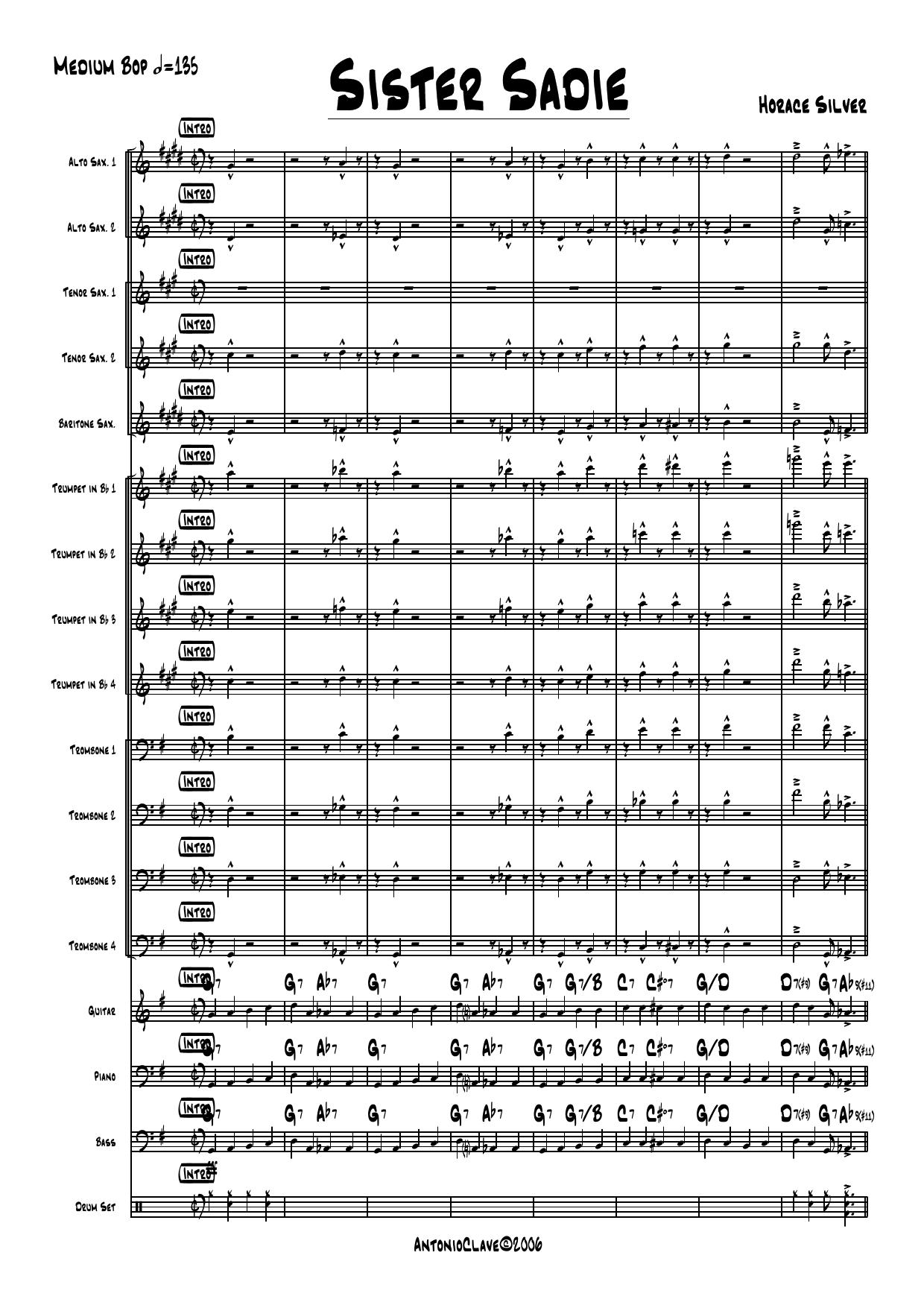
Sister Sadie (A.Clave) sheet music preview

Sister Sadie (A.Clave)

Composed by Horace Silver

Arranged by A.Clave

  • Ensemble: Big Band
  • Style: Jazz Standard
  • Pages: 40
  • Instruments (17): Alto Saxophone 1, Alto Saxophone 2, Tenor Saxophone 1, Tenor Saxophone 2, Baritone Saxophone, Trumpet in Bb 1, Trumpet in Bb 2, Trumpet in Bb 3, Trumpet in Bb 4, Trombone 1, Trombone 2, Trombone 3, Trombone 4, Guitar, Piano, Bass, Drum Set
  • Difficulty: medium
  • Content: Individual Parts
  • Format: PDF Download (Instant)
  • Price: $24.99

Horace Silver’s timeless hard bop composition "Sister Sadie," first recorded on his landmark 1959 Blue Note album *Blowin' the House Down*, stands as an enduring pillar of the jazz canon. Driven by an infectious, blues-infused gospel groove and a relentlessly catchy melody, the tune encapsulates the vibrant transition from 1950s bebop to the soul-jazz revolution. Silver’s original recording set a high-water mark for swinging camaraderie, and his piano-led quintet arrangements have inspired generations of horn players to dig deep into the blues tradition. This classic anthem provides an ideal springboard for a modern big band setting, carrying forward the exuberant spirit of the Blue Note era into a larger ensemble format. Propelled by an energetic, driving medium-up swing tempo in 4/4 time, this arrangement crackles with combustible energy and irrepressible forward motion. The musical character is bold, blues-drenched, and unapologetically joyful, evoking the smoky atmosphere of late-night jazz clubs where hard bop reigned supreme. Rich, punchy brass accents and cascading saxophone lines create a dense, highly textured sonic landscape. The mood shifts effortlessly from sophisticated sophistication during the head statements to unbridled euphoria during the ensemble climaxes, demanding both precision and a deep, visceral understanding of the jazz idiom from every player on the bandstand. Arranger A.Clave brings a fresh, contemporary ear to Silver’s classic blueprint while fiercely protecting its hard-swinging integrity. Rather than relying on standard stock voicings, A.Clave constructs intricate, harmonically rich soli sections that showcase the full dynamic spectrum of the 17-piece instrumentation. The chart features clever counterpoint in the reeds and razor-sharp stop-time figures that highlight the rhythm section's interaction with the horns. A towering shout chorus builds tension through cunning chromatic modulations and layered syncopation, ultimately releasing into a high-octane recapitulation of the head that leaves audiences breathless. The melody is primarily introduced by the saxophone section before being brilliantly tossed across the brass tiers, creating a vibrant dialogic texture. Featured open solo spaces are built into the form, providing ample room for your lead alto or tenor player and a standout brass soloist to stretch out over standard blues changes. Technical challenges center primarily on articulation uniformity—ensuring the eighth-note swing lines remain light, buoyant, and locked together across all five saxophones and four trumpets. The trombone section anchors the harmonic bottom end with robust, punchy voicings that require careful balance against the lead trumpet's soaring register. Advanced high school, collegiate, and professional big bands will find this arrangement an exhilarating centerpiece for festival performance or concert programming. It demands a mature rhythm section capable of driving the ensemble with an authentic, unhurried swing feel, yet its pedagogical rewards are immense, teaching young musicians the vital importance of articulation, section blend, and stylistic authenticity. Conductors should approach "Sister Sadie (A.Clave)" with a strict focus on a driving, triplet-based medium-up swing feel around quarter note = 192-200 BPM. The primary technical hurdle lies in executing the rapid-fire articulation markings; tongue placement must be crisp and uniform across the reed and brass sections to prevent the complex bebop lines from blurring. Ensure the rhythm section maintains an even, unhurried pulse—the drummer should ride the cymbal with a commanding, forward-leaning beat while keeping the hi-hat crisp on beats two and four. Pianists should comp sparsely, leaning into Silver's signature rootless, seventh-chord comping style rather than over-playing. In the shout chorus, dynamic restraint is essential in the initial measures to allow room for the climactic tier-by-tier crescendo. Horn players should utilize natural, unexaggerated jazz accents on offbeats, avoiding heavy slurs unless specifically indicated by the arranger. Rehearsal time is best spent isolating the stop-time measures and ensuring the ensemble breathes together as a single organism before unleashing the full-throttle swing of the final chorus. Q: What instruments and parts are included in this arrangement? A: This standard 17-instrument big band arrangement includes full scores and parts for 2 alto saxophones, 2 tenor saxophones, 1 baritone saxophone, 4 trumpets, 4 trombones, guitar, piano, bass, and drums (40 pages total). Q: What is the difficulty level of this arrangement? A: This chart is graded as advanced, making it best suited for college, advanced high school, community, and professional big bands that possess strong reading skills and a solid grasp of swing articulation. Q: What is the musical style and historical context of the piece? A: It is a hard bop jazz standard originally composed and recorded by pianist Horace Silver in 1959, arranged here to capture the soulful, blues-infused energy of the classic Blue Note era. Q: What makes A.Clave's arrangement unique? A: A.Clave infuses the classic Horace Silver theme with sophisticated modern harmonic voicings, intricate horn counterpoint, dynamic stop-time figures, and a powerhouse shout chorus featuring clever chromatic modulations. Q: What is the performance duration and tempo feel? A: The arrangement runs approximately 4 to 5 minutes at a driving, medium-up swing tempo of around 192 to 200 BPM, demanding stamina and precision from the entire ensemble.

Questions and answers

What is included in the Sister Sadie (A.Clave) PDF?
The verified current file contains a conductor score and individual parts across 40 pages.
How many instruments or parts are listed for Sister Sadie (A.Clave)?
The verified instrumentation list contains 17 entries for this Big Band arrangement.
Who is credited for Sister Sadie (A.Clave)?
Composer: Horace Silver. Arranger: A.Clave.
What difficulty is listed for Sister Sadie (A.Clave)?
The verified difficulty level is medium.
What style is listed for Sister Sadie (A.Clave)?
The catalog lists the style as Jazz Standard.
Can I preview Sister Sadie (A.Clave) before buying?
Yes. The product page provides a preview generated from the current PDF file.
How is Sister Sadie (A.Clave) delivered?
After successful payment, the digital PDF is made available for download. The displayed price is $24.99.

Musicians Also Search For

Sister Sadie A.Clave PDFSister Sadie A.Clave sheet musicSister Sadie arranged by A.ClaveA.Clave big band chartsA.Clave jazz arrangements PDFSister Sadie Horace Silver sheet musicSister Sadie Horace Silver big band arrangementsHorace Silver big band chartsSister Sadie big band arrangementsSister Sadie big band PDF downloadSister Sadie jazz sheet musicbig band sheet music downloadSister Sadie conductor score PDFSister Sadie individual parts downloadSister Sadie sheet music PDFSister Sadie Jazz Standard chartsJazz Standard big band arrangementsbuy Sister Sadie sheet musicdownload Sister Sadie PDFSister Sadie jazz chartsbest A.Clave big band arrangementsHorace Silver arranged by A.ClaveSister Sadie printable sheet musicbig band repertoire PDF

All arrangements by A.Clave All Horace Silver sheet music