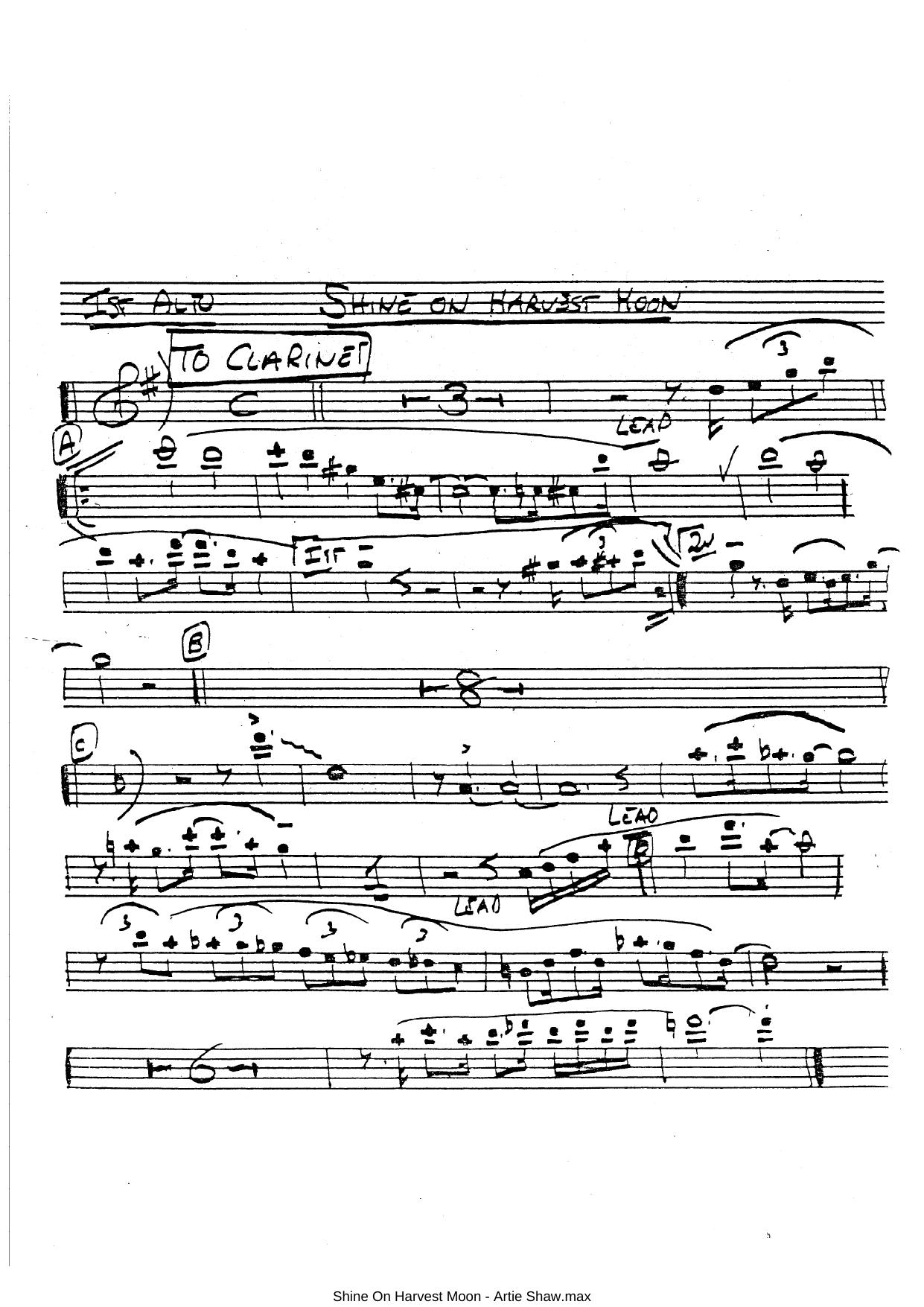
Shine On Harvest Moon (J.Farley) sheet music preview

Shine On Harvest Moon (J.Farley)

Composed by John Farley

Arranged by Glen Miller

  • Ensemble: Big Band
  • Pages: 17
  • Instruments (16): 1st Alto Saxophone (doubles Clarinet), 2nd Alto Saxophone, 1st Tenor Saxophone, 2nd Tenor Saxophone, Baritone Saxophone (doubles Alto Saxophone), 1st Trumpet, 2nd Trumpet, 3rd Trumpet, 4th Trumpet, 1st Trombone, 2nd Trombone, 3rd Trombone, 4th Trombone, Piano/Guitar, Bass, Drums
  • Difficulty: easy
  • Content: Individual Parts
  • Format: PDF Download (Instant)
  • Price: $24.99

Written by Nora Bayes and Jack Norworth in 1908, "Shine On Harvest Moon" stands as one of the definitive pop-standard gems of the early twentieth-century Tin Pan Alley era. Immortalized on the vaudeville stage and later adopted by generations of jazz and swing innovators, the tune possesses an inherently infectious, bouncy melody that translates brilliantly to the jazz idiom. While originally conceived as a sentimental turn-of-the-century waltz-adjacent popular song, mid-century jazz arrangers quickly realized its durable framework could be retrofitted with syncopated rhythms and driving harmonic counterpoint. It represents a fascinating bridge where parlor-style vocal harmony meets the burgeoning vernacular of American big band jazz. Glen Miller’s masterful big band treatment infuses the nostalgic melody with a swinging, forward-momentum groove anchored in classic 4/4 swing feel. Operating at a breezy, medium-up tempo, the arrangement radiates warmth, optimism, and sophisticated retro charm. Miller avoids heavy-handed modernisms, instead favoring crystalline clarinet-led voicings, lush saxophone block harmonies, and crisp brass stabs that evoke the golden age of the 1930s and 40s radio broadcasts. The harmonic palette stays true to traditional functional jazz harmony while introducing clever chromatic passing tones and sweet secondary dominants that keep the listener engaged through every chorus. Opening with a characteristic introductory vamp that sets a buoyant rhythmic pulse, the arrangement quickly transitions into a primary melody statement shared between the alto and tenor saxophones, cushioned by gentle brass punctuation. The 17-page full score balances ensemble solidity with smart scoring economy, tailored specifically for an 8-instrument ensemble format (Alto Sax, Tenor Sax, Trumpet, Trombone, Piano, and rhythm section components) that maximizes sonic fullness without requiring a massive 17-piece roster. A delightful, tightly-knit soli section highlights the reed voices in close-interval harmony before opening up into a vibrant, swinging shout chorus. Technical challenges here reside primarily in achieving pristine articulation, uniform swing eighth-note placement, and exact dynamic balance rather than extreme finger-buster passages. Advanced high school ensembles, collegiate jazz combos, and professional community big bands will find this chart exceptionally rewarding to rehearse and perform. It serves as an ideal concert programmer that offers instant audience appeal while demanding professional-level attention to style, section blending, and stylistic phrasing. Conductors will appreciate how naturally the chart lays under the fingers of younger players, yet offers enough subtle nuance in phrasing and dynamic contrast to satisfy seasoned jazz veterans looking for authentic vintage flavor. Achieving an authentic vintage jazz sound on this arrangement requires rigorous attention to articulation and stylistic consistency. Set the tempo at a comfortable, driving medium-swing groove (approx. 120–132 BPM)—avoid rushing, as the charm of this chart lies in its relaxed yet energetic forward momentum. Swing eighths must be played with a relaxed, triplet-based feel, ensuring that upbeat accents remain crisp without being over-articulated. The brass section should utilize subtle, warm cup or straight mutes where indicated to capture the quintessential 1930s radio aesthetic, keeping vibrato controlled and tasteful. Pay close attention to dynamic shading between the melody-carrying saxophones and the understated comping in the piano and rhythm section; the rhythm keys should lock tightly with the bass to maintain a steady, unyielding walking foundation. Rehearsals should initially focus on isolated section work for the reed soli to ensure flawless intonation and rhythmic synchronization before integrating the full ensemble. Q: What instruments and parts are included in this 17-page arrangement? A: The chart is scored for an 8-instrument ensemble comprising Alto Saxophone, Tenor Saxophone, Trumpet, Trombone, Piano, and standard rhythm section parts, providing a full, authentic big band texture tailored for smaller lineups. Q: What is the difficulty level of this arrangement? A: It is graded as medium-intermediate, making it exceptionally well-suited for advanced high school groups, college jazz ensembles, and professional community bands looking for quality vintage repertoire. Q: What historical style does this arrangement emulate? A: It draws heavily from the classic 1930s and 40s swing era traditions, blending Tin Pan Alley vocal nostalgia with polished, upbeat jazz band sensibilities popularized by bandleaders like Glen Miller. Q: What makes this specific Glen Miller arrangement unique? A: It cleverly adapts a massive, full-orchestra big band aesthetic into a streamlined 8-instrument format, utilizing signature close-interval reed voicings and crisp brass writing to maintain a rich, authentic sound without requiring a full 17-piece line-up. Q: What is the recommended performance duration and tempo for this piece? A: The arrangement runs approximately 3 to 4 minutes when performed at the recommended medium-swing tempo of roughly 120 to 132 beats per minute.

Questions and answers

What is included in the Shine On Harvest Moon (J.Farley) PDF?
The verified current file contains individual parts across 17 pages.
How many instruments or parts are listed for Shine On Harvest Moon (J.Farley)?
The verified instrumentation list contains 16 entries for this Big Band arrangement.
Who is credited for Shine On Harvest Moon (J.Farley)?
Composer: John Farley. Arranger: Glen Miller.
What difficulty is listed for Shine On Harvest Moon (J.Farley)?
The verified difficulty level is easy.
Can I preview Shine On Harvest Moon (J.Farley) before buying?
Yes. The product page provides a preview generated from the current PDF file.
How is Shine On Harvest Moon (J.Farley) delivered?
After successful payment, the digital PDF is made available for download. The displayed price is $24.99.

Musicians Also Search For

Shine On Harvest Moon Glen Miller PDFShine On Harvest Moon Glen Miller sheet musicShine On Harvest Moon arranged by Glen MillerGlen Miller big band chartsGlen Miller jazz arrangements PDFShine On Harvest Moon John Farley sheet musicShine On Harvest Moon John Farley big band arrangementsJohn Farley big band chartsShine On Harvest Moon big band arrangementsShine On Harvest Moon big band PDF downloadShine On Harvest Moon jazz sheet musicbig band sheet music downloadShine On Harvest Moon individual parts downloadShine On Harvest Moon sheet music PDFbuy Shine On Harvest Moon sheet musicdownload Shine On Harvest Moon PDFShine On Harvest Moon jazz chartsbest Glen Miller big band arrangementsJohn Farley arranged by Glen MillerShine On Harvest Moon printable sheet musicbig band repertoire PDF

All arrangements by Glen Miller All John Farley sheet music