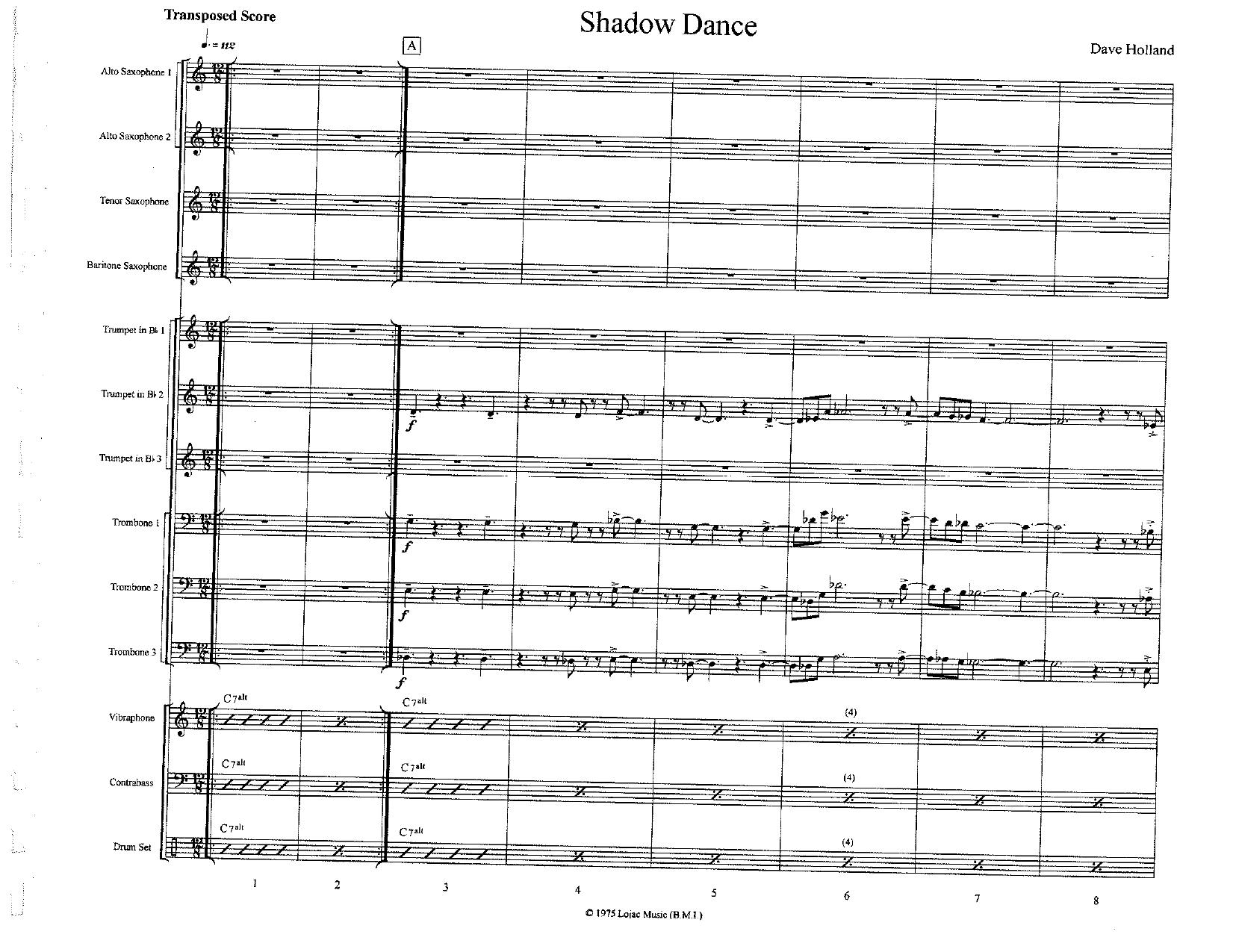
Shadow Dance (D.Holland)
Composed by Dave Holland
Arranged by Dave Holland
- Ensemble: Big Band
- Pages: 60
- Instruments (13): Alto Saxophone 1, Alto Saxophone 2, Tenor Saxophone, Baritone Saxophone, Trumpet in Bb 1, Trumpet in Bb 2, Trumpet in Bb 3, Trombone 1, Trombone 2, Trombone 3, Vibraphone, Contrabass, Drum Set
- Difficulty: advanced
- Content: Individual Parts
- Format: PDF Download (Instant)
- Price: $24.99
Dave Holland’s compositional voice occupies a rare and revered intersection in modern jazz, bridging the post-bop harmonic sophistication of his formative years with Miles Davis and Sam Rivers and the avant-garde rhythmic elasticity of his own legendary big bands and small groups. Originally conceived within Holland’s expansive compositional catalog, "Shadow Dance" captures the restless energy, intricate counterpoint, and deep groove that define his signature writing style. Though rooted in the modern jazz continuum, the piece draws on contemporary creative jazz sensibilities, favoring shifting metric pulses, linear independence among the horns, and a harmonic language rich in suspended voicings, modal interchanges, and chromatic mediants. At a driving, energetic medium-up tempo, "Shadow Dance" opens with an infectious, syncopated ostinato that immediately establishes a sense of suspense and momentum. The harmonic landscape is texturally dense yet remarkably transparent, allowing interlocking horn lines to weave seamlessly around a churning rhythm section foundation. The mood shifts fluidly between taut, breathless tension and explosive, brass-heavy release. Holland’s structural framework avoids predictable AABA or blues forms in favor of a through-composed narrative arc that continually recontextualizes the primary thematic material, evoking the agile, shadowy movements implied by its title through sudden dynamic drops and darting, asynchronous rhythmic figures. Translating his virtuosic small-group concepts to an eight-piece ensemble instrumentation (Alto Saxophone, Tenor Saxophone, Baritone Saxophone, Trumpet, Trombone, plus a robust rhythm section framework spanning 60 comprehensive pages), Holland utilizes the compact horn section with ingenious economy. Rather than relying on traditional, block-chord big band clichés, the arrangement treats the horns as independent voices in a chamber-jazz ensemble. Intricate counterpoint drives the front line, featuring dense programmatic solis where the tenor and trumpet lock into cascading linear passages, while the baritone saxophone and trombone anchor the sub-bass frequencies with punctuated, percussive counter-rhythms. The shout chorus is a masterclass in modern tension-and-release, building through overlapping metric modulations before erupting into a wide-open, harmonically expansive tutti statement. Navigating this chart demands exceptional rhythmic precision, particularly due to Holland's penchant for cross-rhythms, odd-meter phrasing disguised in standard time, and rapid unison lines that test the articulation capabilities of the entire horn section. Featured solo spaces are structurally integrated into the arrangement, providing ample runway for advanced improvisers to stretch out over modal vamps and sophisticated harmonic grids. Advanced university jazz orchestras, professional contemporary big bands, and ambitious top-tier community ensembles will find this chart an exhilarating vehicle. It offers a masterclass in modern ensemble interplay, rewarding groups willing to dig past the surface swing feel to master the intricate, conversational phrasing required by one of jazz's most visionary living composers and bassists. Success with "Shadow Dance" hinges on the rhythm section’s ability to anchor Holland’s shifting rhythmic frameworks while maintaining an unforced, forward-leaning groove. The conductor must ensure that the underlying pulse remains rock-solid, even when the horns are executing complex, syncopated cross-rhythms that obscure the bar lines. Horn players should prioritize clean, transparent articulation—light on the front of notes to allow the fast-moving counterpoint to speak clearly without muddying the ensemble texture. Pay close attention to dynamic markings; the dramatic contrasts between whispered, sub-tone passages and explosive, brass-forward climaxes are essential to capturing the piece's cinematic narrative. Rehearsals should begin section by section at a reduced tempo, locking in the unison lines before integrating the rhythm section's harmonic vamps. Soloists should approach the changes with a mix of linear modal exploration and motivic development that mirrors Holland's own compositional rigor. Q: What specific instruments and parts are included in this 60-page arrangement? A: This arrangement is scored for an eight-instrument ensemble featuring Alto Saxophone, Tenor Saxophone, Baritone Saxophone, Trumpet, and Trombone, alongside a complete rhythm section framework spanning 60 pages of fully realized scores and individual parts. Q: What is the difficulty level of this arrangement? A: This piece is tailored for advanced university ensembles, professional contemporary jazz orchestras, and elite high school big bands due to its complex counterpoint, demanding unison lines, and advanced harmonic language. Q: What is the musical style and historical context of "Shadow Dance"? A: Composed by master bassist and NEA Jazz Master Dave Holland, the piece represents the pinnacle of modern creative jazz, blending post-bop harmonic complexity with the rhythmic elasticity of contemporary chamber-jazz ensembles. Q: What makes this specific arrangement unique compared to standard big band charts? A: Rather than relying on traditional block-chord voicings, Holland treats the horn section as a collection of independent linear voices, utilizing intricate counterpoint, shifting metric pulses, and chamber-jazz transparency. Q: What is the performance duration and recommended tempo feel? A: The arrangement is built around a driving, energetic medium-up tempo feel with a performance duration averaging between 6 to 8 minutes, depending on the length of the open solo sections.
Questions and answers
- What is included in the Shadow Dance (D.Holland) PDF?
- The verified current file contains a conductor score and individual parts across 60 pages.
- How many instruments or parts are listed for Shadow Dance (D.Holland)?
- The verified instrumentation list contains 13 entries for this Big Band arrangement.
- Who is credited for Shadow Dance (D.Holland)?
- Composer: Dave Holland. Arranger: Dave Holland.
- What difficulty is listed for Shadow Dance (D.Holland)?
- The verified difficulty level is advanced.
- Can I preview Shadow Dance (D.Holland) before buying?
- Yes. The product page provides a preview generated from the current PDF file.
- How is Shadow Dance (D.Holland) delivered?
- After successful payment, the digital PDF is made available for download. The displayed price is $24.99.
Musicians Also Search For
Shadow Dance Dave Holland PDF • Shadow Dance Dave Holland sheet music • Shadow Dance arranged by Dave Holland • Dave Holland big band charts • Dave Holland jazz arrangements PDF • Shadow Dance Dave Holland big band arrangements • Shadow Dance big band arrangements • Shadow Dance big band PDF download • Shadow Dance jazz sheet music • big band sheet music download • Shadow Dance conductor score PDF • Shadow Dance individual parts download • Shadow Dance sheet music PDF • buy Shadow Dance sheet music • download Shadow Dance PDF • Shadow Dance jazz charts • best Dave Holland big band arrangements • Shadow Dance printable sheet music • big band repertoire PDF