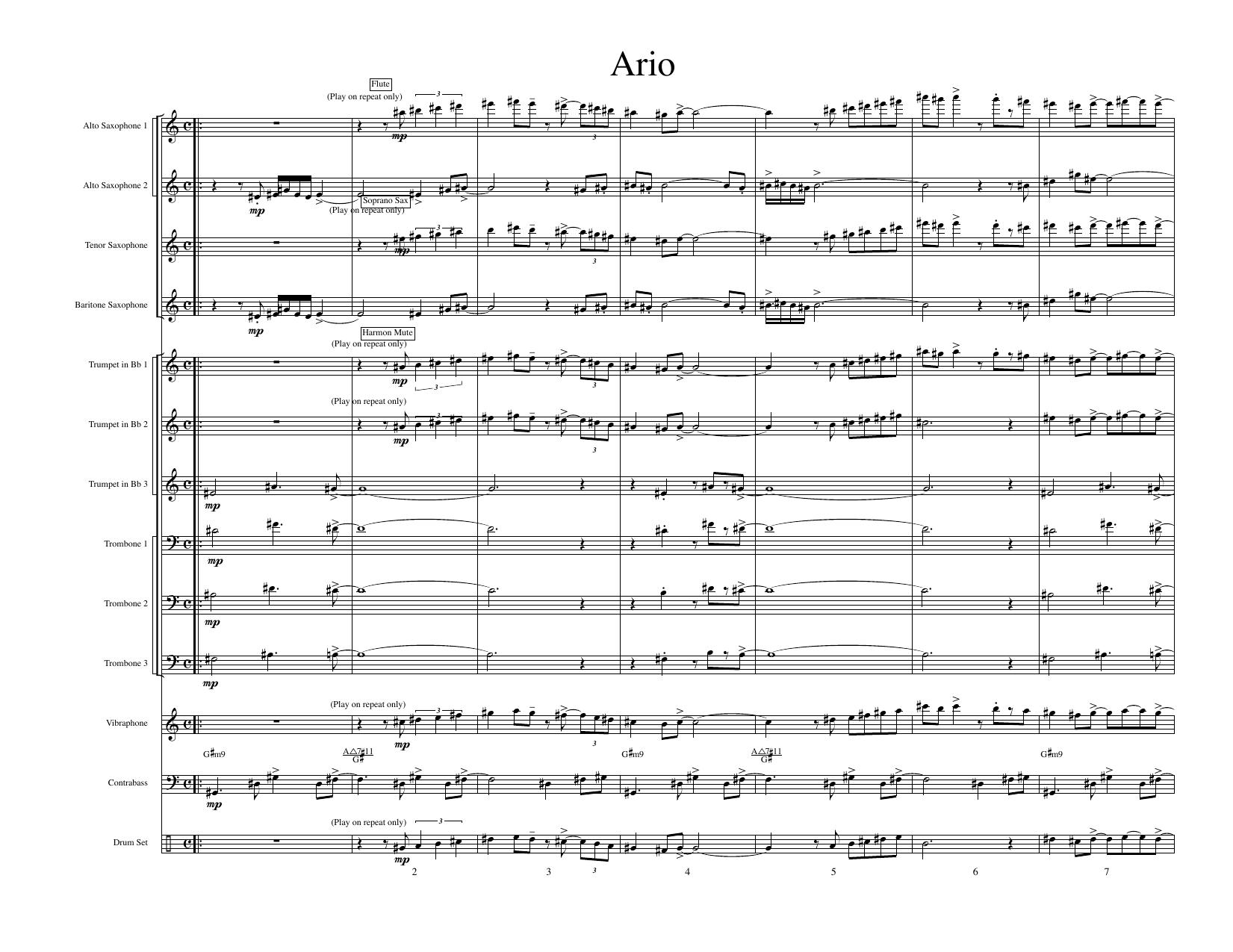
Ario (D.Holland) sheet music preview

Ario (D.Holland)

Composed by Dave Holland

Arranged by Dave Holland

  • Ensemble: Big Band
  • Pages: 28
  • Instruments (13): Alto Saxophone 1 (Flute), Alto Saxophone 2, Tenor Saxophone (Soprano Saxophone), Baritone Saxophone, Trumpet in Bb 1, Trumpet in Bb 2, Trumpet in Bb 3, Trombone 1, Trombone 2, Trombone 3, Vibraphone, Contrabass, Drum Set
  • Difficulty: medium
  • Content: Individual Parts
  • Format: PDF Download (Instant)
  • Price: $24.99

Dave Holland’s compositional masterpiece "Ario" bridges the gap between post-bop innovation and modern big band complexity, originally emerging from the bassist and composer’s acclaimed small-group and large-ensemble explorations of the late 20th century. Known for his tenure with Miles Davis and Sam Rivers, Holland developed a distinct compositional voice characterized by intricate metric modulations, labyrinthine melodic lines, and a robust rhythmic foundation that draws equally from modern jazz and contemporary classical traditions. "Ario" stands as a brilliant testament to this synthesis, capturing the adventurous spirit of modern creative jazz while maintaining an undeniable groove that challenges and electrifies contemporary large ensembles. Propelled by an infectious, driving contemporary jazz groove with shifting metric feels, "Ario" moves between spirited modal vamps and tightly wound, labyrinthine ensemble figures. The harmonic language is rich with extended and altered dominants, creating an atmosphere of perpetual motion and unresolved tension that resolves into moments of sheer, soaring liberation. Holland’s writing evokes a mood of intellectual curiosity blended with visceral energy; it is a piece that demands deep concentration from the performers while rewarding the listener with cascading textures and unexpected harmonic vistas. The dynamic range is wide, shifting seamlessly from intimate, transparent horn-section counterpoint to thunderous, rhythmically dense collective statements. In adapting his intricate compositional style for the 14-instrument big band, Holland utilizes a transparent, highly democratic approach to orchestration where the traditional boundaries between rhythm section and horns blur significantly. Rather than relying on standard block-chord voicings, Holland constructs counterpoint where individual sections weave independent melodic strands, creating a dense, linear texture reminiscent of chamber jazz expanded to big band dimensions. The arrangement features striking soli sections where the saxophones and brass interlock in complex rhythmic unison, as well as open spaces designed to showcase fearless improvisers. Holland’s signature writing for the low end—utilizing the baritone saxophone and bass trombone to anchor bubbling, asymmetric ostinatos—gives the chart a muscular, earth-bound foundation that contrasts sharply with the soaring upper-register voicings of the trumpets. Executing "Ario" successfully requires an advanced ensemble capable of navigating shifting meters, sophisticated syncopation, and dense harmonic landscapes. The melody is shared fluidly across the saxophone and trumpet sections, requiring pristine articulation and unified phrasing, particularly during rapid-fire unison lines. Featured solo space allows advanced improvisers to stretch over Holland's sophisticated harmonic framework, making strong demands on both technical facility and modal awareness. The rhythm section bears a heavy responsibility, acting as the engine that drives the polyrhythmic interplay while maintaining a supple, conversational groove. Because of its demanding metric interplay, advanced harmonic vocabulary, and requirement for mature stylistic cohesion, this arrangement is best suited for elite university jazz orchestras, top-tier youth ensembles, and professional big bands. Advanced groups looking to push their technical and intellectual boundaries will find "Ario" to be a profoundly rewarding centerpiece for a concert program, offering a masterclass in modern large-ensemble jazz composition. Achieving success with Dave Holland’s "Ario" begins with a rigorous approach to the rhythm section, which must anchor the ensemble's shifting metric feels with absolute authority. The drummer and bassist should spend dedicated rehearsal time locking in the underlying polyrhythms and asymmetric grooves before the horns are introduced, ensuring the underlying pulse remains rock-solid despite frequent accent shifts. Horn players must prioritize clean, articulate execution over sheer volume, treating complex unison lines with chamber-music precision. Pay close attention to dynamic markings within the inner voices; Holland’s counterpoint relies heavily on transparent balance so that secondary melodic lines can weave clearly through the texture. Conductors should use clear, decisive downbeats during transitions between rubato-sounding expressive passages and strict groove sections, ensuring the entire band transitions seamlessly without dragging or rushing. Q: What instruments and parts are included in this arrangement? A: This 28-page chart is scored for a 14-instrument big band ensemble, including Alto Saxophone 1, Alto Saxophone 2, Tenor Saxophone, Baritone Saxophone, Trumpet in Bb 1, and accompanying brass and rhythm section parts, complete with a full conductor score. Q: What is the difficulty level of this arrangement? A: This arrangement is designed for advanced performers, specifically tailored for elite university jazz orchestras, professional big bands, and top-tier community ensembles with strong technical proficiency. Q: What is the musical style and historical context of "Ario"? A: Composed by renowned bassist and NEA Jazz Master Dave Holland, "Ario" represents the pinnacle of modern creative big band jazz, blending post-bop complexity, intricate counterpoint, and contemporary groove. Q: What makes this Dave Holland arrangement unique? A: Unlike traditional big band charts that rely heavily on standard block-chord shout choruses, this arrangement utilizes linear counterpoint, asymmetric ostinatos, and a democratic distribution of melodic material across all sections. Q: What is the performance duration and tempo feel of the piece? A: The piece is built around an energetic, driving contemporary jazz groove with a medium-up tempo feel, requiring approximately 6 to 8 minutes of performance time depending on the length of the open improvised solos.

Questions and answers

What is included in the Ario (D.Holland) PDF?
The verified current file contains a conductor score across 28 pages.
How many instruments or parts are listed for Ario (D.Holland)?
The verified instrumentation list contains 13 entries for this Big Band arrangement.
Who is credited for Ario (D.Holland)?
Composer: Dave Holland. Arranger: Dave Holland.
What difficulty is listed for Ario (D.Holland)?
The verified difficulty level is medium.
Can I preview Ario (D.Holland) before buying?
Yes. The product page provides a preview generated from the current PDF file.
How is Ario (D.Holland) delivered?
After successful payment, the digital PDF is made available for download. The displayed price is $24.99.

Musicians Also Search For

Ario Dave Holland PDFArio Dave Holland sheet musicArio arranged by Dave HollandDave Holland big band chartsDave Holland jazz arrangements PDFArio Dave Holland big band arrangementsArio big band arrangementsArio big band PDF downloadArio jazz sheet musicbig band sheet music downloadArio conductor score PDFArio sheet music PDFbuy Ario sheet musicdownload Ario PDFArio jazz chartsbest Dave Holland big band arrangementsArio printable sheet musicbig band repertoire PDF

All arrangements by Dave Holland All Dave Holland sheet music