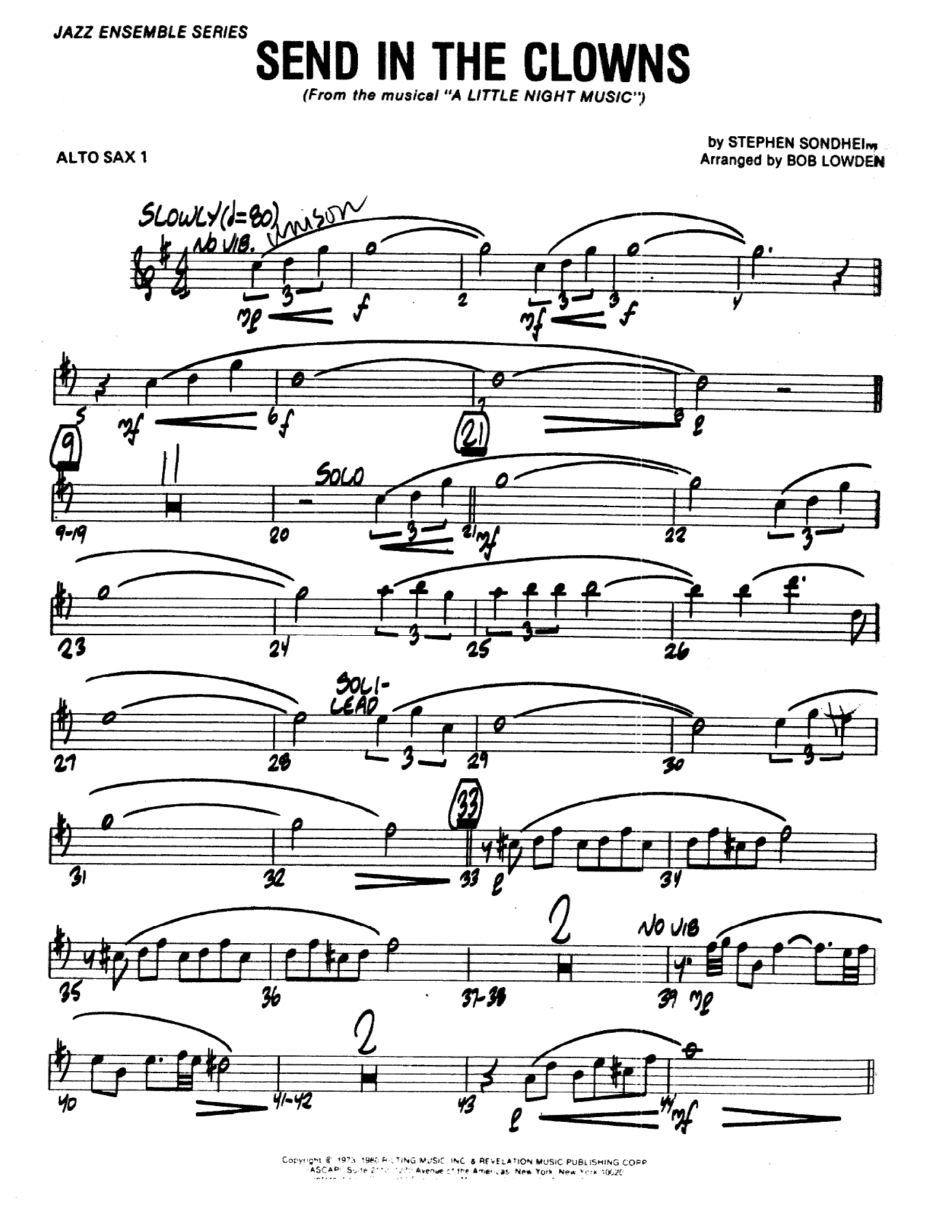
Send In The Clowns (B.Lowden) sheet music preview

Send In The Clowns (B.Lowden)

Composed by Stephen Sondheim

Arranged by Bob Lowden

  • Ensemble: Big Band
  • Style: Jazz Standard
  • Pages: 48
  • Instruments (18): Alto Sax 1, Alto Sax 2, Tenor Sax 1, Tenor Sax 2, Baritone Sax, Trumpet 1, Trumpet 2, Trumpet 3, Trumpet 4, Trombone 1, Trombone 2, Trombone 3, Trombone 4, Tuba (Optional), Guitar, Bass, Drums, Piano
  • Difficulty: medium
  • Content: Individual Parts
  • Format: PDF Download (Instant)
  • Price: $24.99

Stephen Sondheim's "Send In The Clowns," originally penned for his 1973 musical *A Little Night Music*, transcends its theatrical origins to stand as a poignant and enduring jazz standard. This melancholic ballad, famously introduced by Glynis Johns as Desirée Armfeldt, gained widespread recognition and a Grammy Award for Song of the Year in 1975 through Judy Collins' iconic rendition. Its sophisticated harmonic structure, characterized by a series of descending and ascending chromatic lines and unexpected chord changes, presents a compelling canvas for jazz interpretation. The song's introspective lyrics, exploring themes of missed opportunities and romantic regret, naturally lend themselves to a reflective, ballad-like treatment, making it a staple in the repertoire of vocalists and instrumentalists alike who seek to convey deep emotion through their performance. Bob Lowden's big band arrangement of "Send In The Clowns" masterfully captures the introspective essence of Sondheim's original while imbuing it with a lush, sophisticated jazz sensibility. Lowden, known for his ability to craft accessible yet musically rich charts, approaches this piece as a slow, expressive ballad, likely in a 4/4 time signature with a gentle swing or straight-eighth feel, allowing the inherent beauty of the melody and harmony to unfold deliberately. His signature style often includes rich, close voicings in the saxophone section, creating a warm, sustained harmonic bed, and carefully orchestrated brass figures that add depth without overpowering the delicate melodic lines. Expect subtle counter-melodies and interwoven textures that build the arrangement's emotional arc, rather than relying on explosive shout choruses. The arrangement is designed to evoke a mood of tender melancholy and introspection, inviting both performers and listeners into its reflective world. Performance of this arrangement centers on lyrical phrasing and dynamic control. The melody is typically carried by a lead alto saxophone or trumpet, often with harmonized support from other sections, allowing for expressive interpretation. While the arrangement is not explicitly designed as a solo feature vehicle, there may be opportunities for an improvised solo, perhaps over a chorus or two, likely for a tenor saxophone or trumpet, maintaining the ballad's reflective character. Technical challenges include achieving precise blend and balance within the ensemble, particularly in the sustained chordal passages, and navigating the nuanced dynamic shifts required to convey the song's emotional depth. The rewarding aspect lies in the collective ability to deliver a cohesive, heartfelt musical statement, where every note contributes to the overall narrative. This arrangement is ideally suited for college-level jazz ensembles, community big bands with strong lead players, and professional groups seeking a sophisticated and emotionally resonant ballad for their repertoire. Its detailed scoring and harmonic richness provide ample material for musical growth and expressive performance. Conductors should emphasize a unified, lyrical approach to phrasing throughout this ballad. The tempo should be slow and deliberate, allowing the rich harmonies and melodic contours to breathe; a metronome marking around quarter note = 60-68 would be appropriate, maintaining a gentle, sustained feel rather than a strict swing. Focus on achieving precise intonation and blend, especially in the sustained saxophone and brass voicings, which form the harmonic backbone. Dynamics are crucial for conveying the emotional arc; encourage musicians to play with expressive nuance, utilizing crescendos and diminuendos to shape phrases rather than relying on abrupt changes. Pay close attention to releases, ensuring they are unified and tapered. There are no specific extended techniques (like plunger mutes or falls) typically required for this arrangement, but a warm, sustained tone is paramount for all sections. Rehearsal time should be dedicated to listening across sections to ensure balance and to the expressive shaping of the melodic lines. Q: What instruments and parts are included in this arrangement? A: This arrangement is scored for a standard 18-instrument big band, including Alto Saxophone 1, Alto Saxophone 2, Tenor Saxophone 1, Tenor Saxophone 2, Baritone Saxophone, four Trumpets, four Trombones, Piano, Bass, Drums, and Guitar. It also includes a conductor's score, totaling 48 pages. Q: What is the difficulty level of Bob Lowden's "Send In The Clowns" arrangement? A: This arrangement is considered intermediate to advanced. While technically accessible for most college-level ensembles, it demands a high level of musical maturity, intonation control, and expressive phrasing from all sections to achieve its intended emotional depth. Q: What is the musical style and historical context of this piece? A: "Send In The Clowns" is a jazz standard derived from Stephen Sondheim's 1973 musical *A Little Night Music*. It is presented here as a slow, expressive big band ballad, reflecting its original melancholic and introspective character, famously popularized by Judy Collins. Q: What makes Bob Lowden's arrangement of "Send In The Clowns" unique? A: Lowden's arrangement distinguishes itself through its lush, sophisticated voicings, particularly in the saxophone section, and its emphasis on lyrical phrasing and dynamic nuance. It prioritizes the song's inherent emotional depth and harmonic beauty over overt jazz fireworks, creating a reflective and tender big band ballad. Q: What is the typical performance duration or tempo for this arrangement? A: As a slow ballad, the performance duration typically ranges from 4 to 5 minutes, depending on the chosen tempo and any improvised solo sections. The recommended tempo is a slow, sustained feel, around quarter note = 60-68.

Questions and answers

What is included in the Send In The Clowns (B.Lowden) PDF?
The verified current file contains a conductor score and individual parts across 48 pages.
How many instruments or parts are listed for Send In The Clowns (B.Lowden)?
The verified instrumentation list contains 18 entries for this Big Band arrangement.
Who is credited for Send In The Clowns (B.Lowden)?
Composer: Stephen Sondheim. Arranger: Bob Lowden.
What difficulty is listed for Send In The Clowns (B.Lowden)?
The verified difficulty level is medium.
What style is listed for Send In The Clowns (B.Lowden)?
The catalog lists the style as Jazz Standard.
Can I preview Send In The Clowns (B.Lowden) before buying?
Yes. The product page provides a preview generated from the current PDF file.
How is Send In The Clowns (B.Lowden) delivered?
After successful payment, the digital PDF is made available for download. The displayed price is $24.99.

Musicians Also Search For

Send In The Clowns Bob Lowden PDFSend In The Clowns Bob Lowden sheet musicSend In The Clowns arranged by Bob LowdenBob Lowden big band chartsBob Lowden jazz arrangements PDFSend In The Clowns Stephen Sondheim sheet musicSend In The Clowns Stephen Sondheim big band arrangementsStephen Sondheim big band chartsSend In The Clowns big band arrangementsSend In The Clowns big band PDF downloadSend In The Clowns jazz sheet musicbig band sheet music downloadSend In The Clowns conductor score PDFSend In The Clowns individual parts downloadSend In The Clowns sheet music PDFSend In The Clowns Jazz Standard chartsJazz Standard big band arrangementsbuy Send In The Clowns sheet musicdownload Send In The Clowns PDFSend In The Clowns jazz chartsbest Bob Lowden big band arrangementsStephen Sondheim arranged by Bob LowdenSend In The Clowns printable sheet musicbig band repertoire PDF

All arrangements by Bob Lowden All Stephen Sondheim sheet music