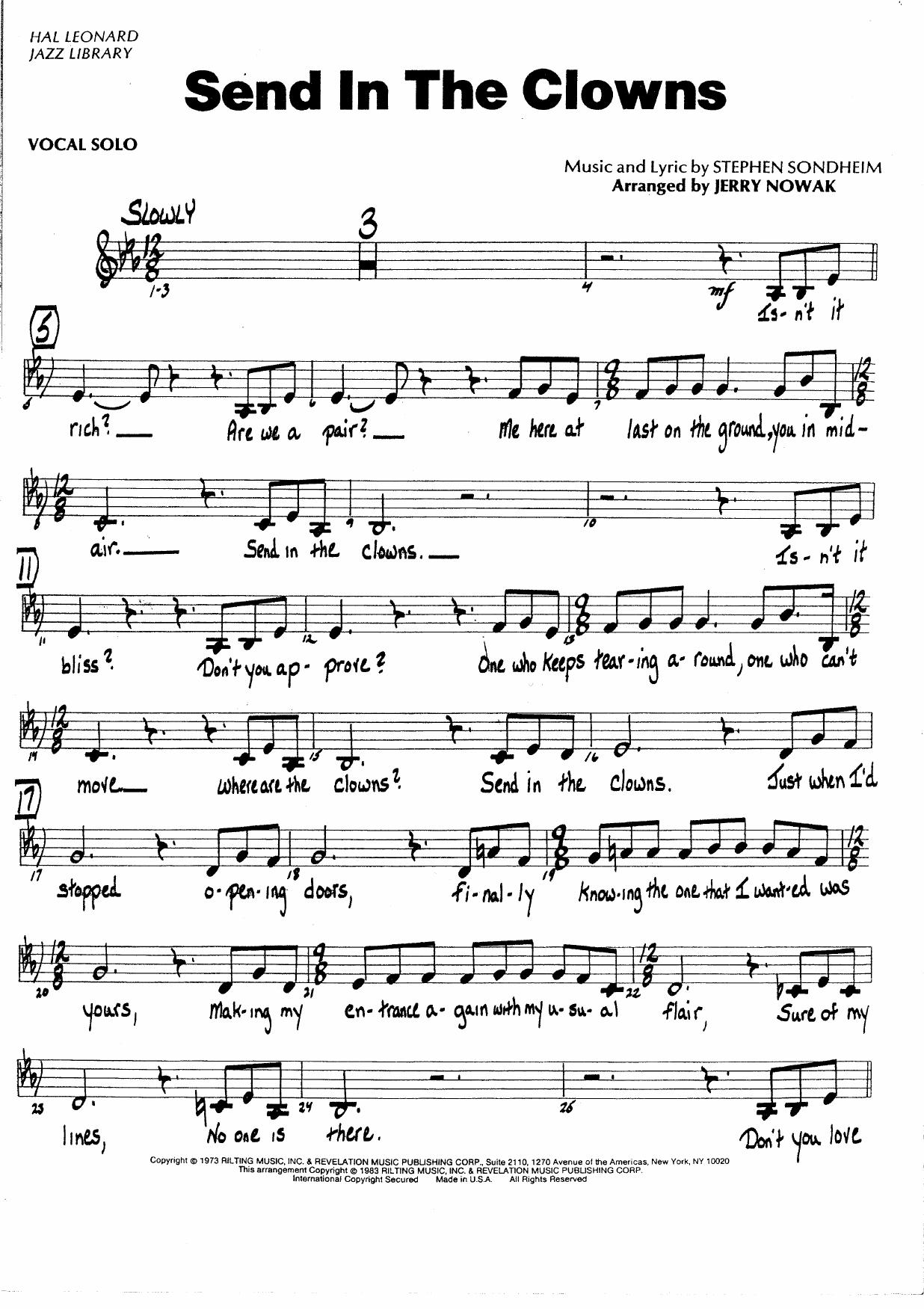
Send In The Clowns (J.Nowak) vocal
Composed by Stephen Sondheim
Arranged by Jerry Nowak
- Ensemble: Big Band
- Pages: 24
- Instruments (15): Vocal Solo, Alto Sax 1, Alto Sax 2, Tenor Sax 1, Tenor Sax 2 (Optional), Baritone Sax, Trumpet 2, Trumpet 3, Trombone 1, Trombone 2, Trombone 3, Trombone 4 (Bass), Guitar, Drums, Piano
- Difficulty: medium
- Content: Individual Parts
- Format: PDF Download (Instant)
- Price: $24.99
Stephen Sondheim’s haunting masterpiece "Send In The Clowns," introduced in the 1973 Broadway musical *A Little Night Music*, crossed over into the jazz canon almost immediately, most notably immortalized by Frank Sinatra on his 1973 album *Ol' Blue Eyes Is Back* and later by jazz luminaries like Sarah Vaughan and Judy Collins. Originally conceived as a reflective theatrical soliloquy in unconventional compound meter, the composition relies on poignant lyrical irony and a sophisticated harmonic framework that invites expressive jazz reharmonization. Jerry Nowak’s exquisite big band adaptation translates this theatrical tour de force into a lush, dynamic idiom tailored specifically for vocalists working with a standard instrumental complement. Unfolding as a deeply expressive, rubato-inflected ballad that settles into a gentle, flowing pulse, the arrangement creates an atmosphere of intimate melancholy and profound introspection. The harmonic language is rich with extended chord extensions, chromatic inner voices, and subtle modulation that mirrors the shifting emotional landscape of Sondheim's lyrics. Rather than relying on heavy percussive drives, Nowak utilizes the full color palette of the jazz orchestra—utilizing warm sax solis, transparent brass voicings, and delicate piano accompaniment—to cradle the vocal line. The emotional trajectory builds organically from quiet vulnerability toward a soaring, harmonically rich climax before gently subsiding into a tender, reflective resolution. Jerry Nowak approaches the material with a masterclass in economy and textural balance, ensuring the vocalist remains the undisputed focal point while giving the ensemble meaningful, texturally diverse counterlines. The arrangement eschews aggressive shout choruses in favor of sophisticated woodwind interludes and lush brass pads that evoke the twilight atmosphere of the original stage work. Alto and tenor saxophones weave delicate counter-melodies around the vocal phrases, while muted trumpets and warm trombone voicings provide a cinematic backdrop. The chart demands a high degree of dynamic control and rhythmic flexibility from the entire ensemble, particularly in maintaining a seamless rubato feel during the verse transitions. Advanced high school, collegiate, and community jazz ensembles will find this arrangement an exceptional vehicle for developing ballad-playing maturity, ensemble listening, and accompaniment sensitivity. While the technical demands on individual instrumentalists are moderate in terms of speed, the true challenge lies in blend, intonation, and emotional delivery—making it an ideal showcase for a talented guest vocalist. Performing this chart offers groups a rare opportunity to explore sophisticated theatrical jazz, providing audiences with a memorable, emotionally resonant focal point in any concert program. Achieving a successful performance of this arrangement hinges on the ensemble's ability to breathe together and listen closely to the vocalist. The conductor should approach the tempo flexibly, utilizing subtle rubato during the head and verse while establishing a steady, flowing pulse as the arrangement opens up. Balance is paramount: the 15-piece instrumentation requires the horns to back off significantly whenever the vocal is active, treating their parts as an ambient cushion rather than a competing voice. Woodwind players should ensure their double-reeds or saxophone doublings blend smoothly into a unified choir sound. Pay close attention to intonation on exposed, chordal passages, particularly in the muted brass sections where minor pitch fluctuations are easily exposed. Rehearsals should focus heavily on dynamic shading, ensuring that crescendos peak naturally without ever overpowering the soloist. Encourage the rhythm section—especially the pianist and guitarist—to voice chords sparsely, leaving plenty of sonic space for the rich harmonic colors written into the arrangement. Q: What instruments and parts are included in this arrangement? A: The 15-instrument instrumentation includes a Vocal part, Alto Saxophone 1, Alto Saxophone 2, Tenor Saxophone 1, Tenor Saxophone 2, and standard rhythm and brass sections tailored for a complete big band setup across a 24-page score and parts set. Q: What is the difficulty level of this arrangement? A: This arrangement is graded at a medium difficulty level, making it well-suited for advanced high school, collegiate, and community big bands looking to develop ballad playing and vocal accompaniment skills. Q: What is the musical style and historical context of the piece? A: Styled as a lush jazz ballad, the arrangement adapts Stephen Sondheim's 1973 Broadway theater standard from *A Little Night Music*, echoing the iconic vocal interpretation styles popularized by jazz and pop legends like Frank Sinatra. Q: What makes Jerry Nowak’s arrangement unique? A: Nowak's treatment avoids heavy big-band clichés, instead utilizing transparent voicings, warm saxophone counterlines, and sophisticated harmonic extensions that prioritize theatrical intimacy and vocal support over volume. Q: What is the approximate performance duration and tempo feel? A: The piece is performed at a slow, expressive ballad tempo with a flexible, flowing pulse that typically spans around 3 to 4 minutes depending on the rubato choices made by the conductor and vocalist.
Questions and answers
- What is included in the Send In The Clowns (J.Nowak) vocal PDF?
- The verified current file contains individual parts across 24 pages.
- How many instruments or parts are listed for Send In The Clowns (J.Nowak) vocal?
- The verified instrumentation list contains 15 entries for this Big Band arrangement.
- Who is credited for Send In The Clowns (J.Nowak) vocal?
- Composer: Stephen Sondheim. Arranger: Jerry Nowak.
- What difficulty is listed for Send In The Clowns (J.Nowak) vocal?
- The verified difficulty level is medium.
- Can I preview Send In The Clowns (J.Nowak) vocal before buying?
- Yes. The product page provides a preview generated from the current PDF file.
- How is Send In The Clowns (J.Nowak) vocal delivered?
- After successful payment, the digital PDF is made available for download. The displayed price is $24.99.
Musicians Also Search For
Send In The Clowns Jerry Nowak PDF • Send In The Clowns Jerry Nowak sheet music • Send In The Clowns arranged by Jerry Nowak • Jerry Nowak big band charts • Jerry Nowak jazz arrangements PDF • Send In The Clowns Stephen Sondheim sheet music • Send In The Clowns Stephen Sondheim big band arrangements • Stephen Sondheim big band charts • Send In The Clowns big band arrangements • Send In The Clowns big band PDF download • Send In The Clowns jazz sheet music • big band sheet music download • Send In The Clowns individual parts download • Send In The Clowns sheet music PDF • buy Send In The Clowns sheet music • download Send In The Clowns PDF • Send In The Clowns jazz charts • best Jerry Nowak big band arrangements • Stephen Sondheim arranged by Jerry Nowak • Send In The Clowns printable sheet music • big band repertoire PDF