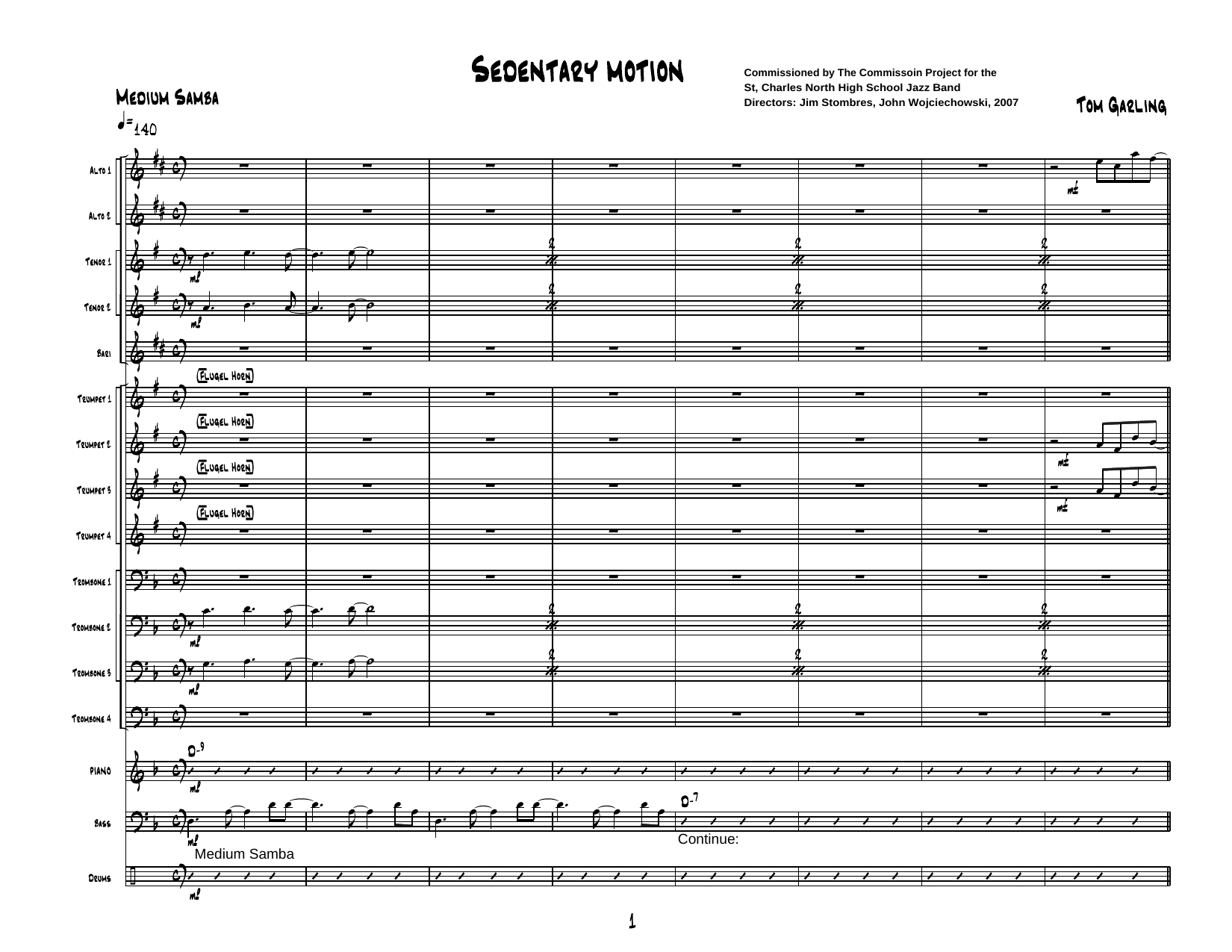
Sedentary Motion (T.Garling)
Composed by Tom Garling
Arranged by Tom Garling
- Ensemble: Big Band
- Pages: 88
- Instruments (17): Alto Sax 1, Alto Sax 2, Tenor Sax 1, Tenor Sax 2, Baritone Sax, Trumpet 1, Trumpet 2, Trumpet 3, Trumpet 4, Trombone 1, Trombone 2, Trombone 3, Trombone 4, Piano, Bass, Drums, Guitar
- Difficulty: advanced
- Content: Individual Parts
- Format: PDF Download (Instant)
- Price: $24.99
Tom Garling’s "Sedentary Motion" stands as a brilliant testament to contemporary big band writing, merging the sophisticated harmonic vocabulary of modern post-bop with the sheer driving momentum of a powerhouse jazz orchestra. Emerging from the vibrant tradition of Chicago-centric big band jazz and heavily influenced by Garling's extensive tenure with the Buddy Rich Band, this composition bridges traditional big band architecture with forward-thinking compositional devices. While not an archaic swing-era standard, "Sedentary Motion" has earned a stellar reputation in advanced academic and professional circles as a masterclass in contrasting rhythmic textures, shifting metrical feels, and dense, brass-forward orchestration. Propelled by an aggressive, relentless contemporary groove, the piece plays cleverly on its oxymoronic title—juxtaposing static, weighty harmonic plateaus with relentless linear motion. The tempo is a driving medium-up swing, establishing an atmosphere of controlled intensity and urban urgency. Garling exploits the full dynamic spectrum of the 17-piece ensemble, moving seamlessly from whisper-quiet, intricately voiced woodwind subtextures to explosive, wall-of-sound shout choruses. The harmonic landscape leans heavily into altered dominants, modal interchanging, and rich upper-structure triads, creating an edgy, sophisticated soundscape that immediately captivates modern jazz audiences. Garling’s arranging approach is distinctly sectional and collaborative, treating the big band not merely as a monolithic block, but as an interactive chamber orchestra of distinct choir voices. The melodic heavy lifting is shared dynamically; the saxophones often introduce jagged, bebop-infused heads before handing off developmental motifs to aggressive brass interjections. A standout feature of the arrangement is its meticulously crafted brass and saxophone soli sections, which demand absolute rhythmic unison and precise articulation control. The chart features open solo spaces—typically tailored for tenor saxophone and trombone, nodding to Garling's own virtuosic background on the instrument—backed by harmonically complex comping figures from the rhythm section that push soloists to stretch their improvisational boundaries. Advanced collegiate ensembles, top-tier high school jazz bands, and professional repertory orchestras will find "Sedentary Motion" an exhilarating challenge and a rewarding centerpiece for a concert program. The primary technical hurdles lie in the rhythm section's ability to anchor shifting syncopated figures and the horns' execution of rapid, articulated lines at high velocity. Achieving a balanced sound requires maturity, particularly in managing the dense vertical voicings during loud passages. For bands looking to showcase virtuosic ensemble precision, sophisticated harmonic taste, and a high-energy contemporary big band aesthetic, this chart delivers an unforgettable performance experience. Conductors tackling "Sedentary Motion" must prioritize internal rhythmic stability, as the chart relies heavily on punctuated syncopation and cross-rhythms between the brass and rhythm sections. Establish a rock-solid, driving medium-up swing tempo early, ensuring the rhythm section avoids rushing during unisons. Drummers should favor a crisp, interactive ride cymbal pattern that complements the aggressive horn punches without overplaying. In terms of articulation, clarity is paramount; light accents on off-beats and clean, clipped staccatos will define the modern post-bop style. Rehearsal should be sectionalized initially, specifically isolating the complex soli passages to lock in intonation across the saxophone and brass choirs. Horn players should carefully balance Garling’s dense chord clusters so that the inner voices of the harmony are audible beneath the primary melody. Encourage soloists to engage with the modal shifts in the background charts rather than leaning solely on conventional blues vocabulary. Q: What instruments and parts are included in this big band arrangement? A: The complete 88-page package includes a full conductor score and 17 individual instrumental parts: Alto Saxophone 1 & 2, Tenor Saxophone 1 & 2, Baritone Saxophone, 4 Trumpets, 4 Trombones, Piano, Guitar, Bass, and Drums. Q: What is the difficulty level of Tom Garling's "Sedentary Motion"? A: This arrangement is graded as advanced (Level 5/Professional), requiring high-level technical proficiency, precise articulation, and mature harmonic awareness from all sections, making it ideal for advanced collegiate and professional ensembles. Q: What is the musical style and historical background of this piece? A: Written in a contemporary post-bop and modern big band style, the piece reflects Tom Garling's sophisticated compositional voice and his extensive professional experience within elite large-ensemble traditions. Q: What makes this specific arrangement unique within big band literature? A: Its unique character stems from the clever juxtaposition of static harmonic structures with relentless linear momentum, coupled with dense, modern voicings and highly interactive scoring between sections. Q: What is the performance duration and tempo feel of the piece? A: "Sedentary Motion" is set at a driving, energetic medium-up swing tempo and typically runs between 6 to 7 minutes in performance, depending on the length of the open improvised solos.
Questions and answers
- What is included in the Sedentary Motion (T.Garling) PDF?
- The verified current file contains a conductor score and individual parts across 88 pages.
- How many instruments or parts are listed for Sedentary Motion (T.Garling)?
- The verified instrumentation list contains 17 entries for this Big Band arrangement.
- Who is credited for Sedentary Motion (T.Garling)?
- Composer: Tom Garling. Arranger: Tom Garling.
- What difficulty is listed for Sedentary Motion (T.Garling)?
- The verified difficulty level is advanced.
- Can I preview Sedentary Motion (T.Garling) before buying?
- Yes. The product page provides a preview generated from the current PDF file.
- How is Sedentary Motion (T.Garling) delivered?
- After successful payment, the digital PDF is made available for download. The displayed price is $24.99.
Musicians Also Search For
Sedentary Motion Tom Garling PDF • Sedentary Motion Tom Garling sheet music • Sedentary Motion arranged by Tom Garling • Tom Garling big band charts • Tom Garling jazz arrangements PDF • Sedentary Motion Tom Garling big band arrangements • Sedentary Motion big band arrangements • Sedentary Motion big band PDF download • Sedentary Motion jazz sheet music • big band sheet music download • Sedentary Motion conductor score PDF • Sedentary Motion individual parts download • Sedentary Motion sheet music PDF • buy Sedentary Motion sheet music • download Sedentary Motion PDF • Sedentary Motion jazz charts • best Tom Garling big band arrangements • Sedentary Motion printable sheet music • big band repertoire PDF