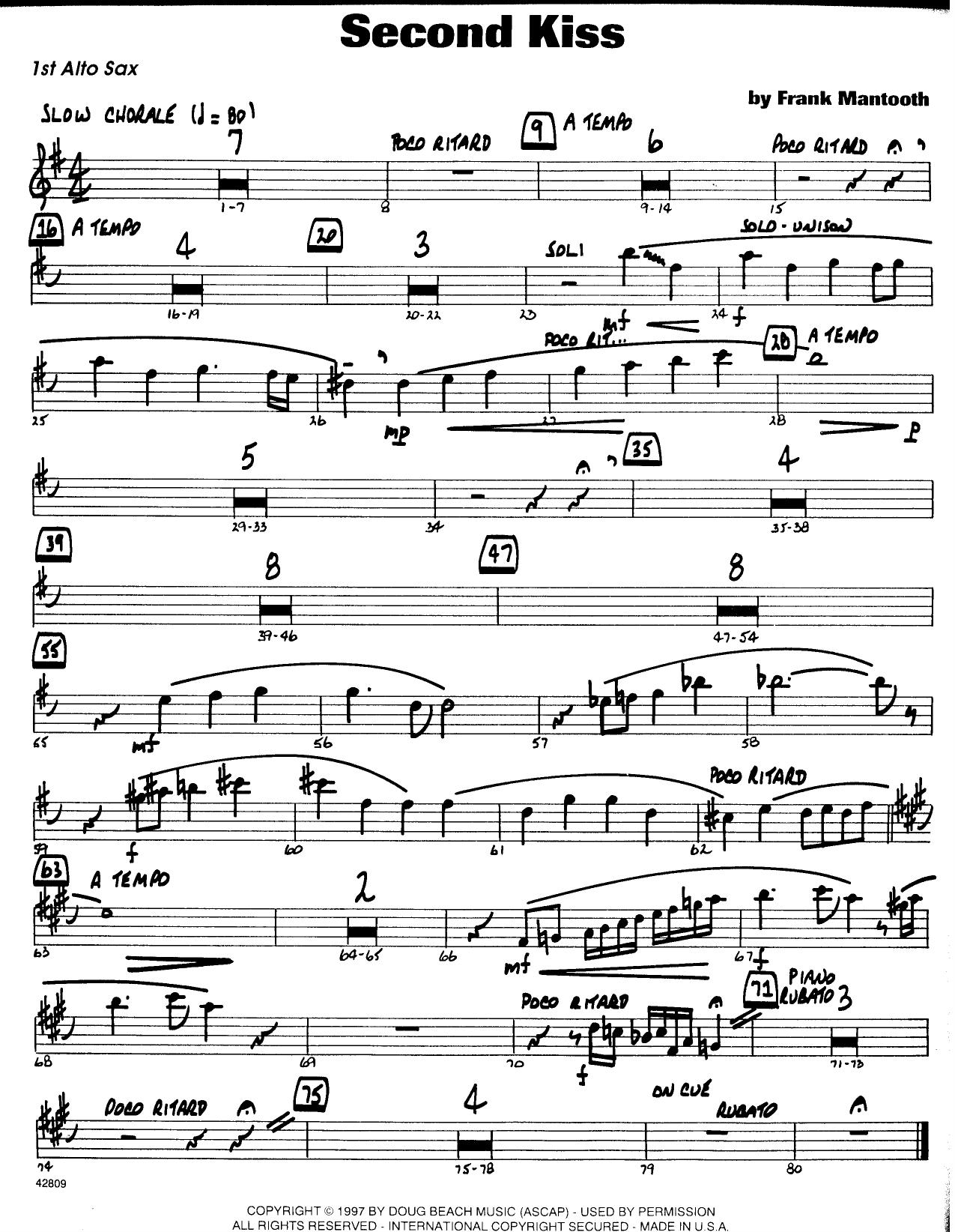
Second Kiss (F.Mantooth) sheet music preview

Second Kiss (F.Mantooth)

Composed by Frank Mantooth

Arranged by Frank Mantooth

  • Ensemble: Big Band
  • Pages: 34
  • Instruments (17): 1st Alto Sax, 2nd Alto Sax, 1st Tenor Sax, 2nd Tenor Sax, Baritone Sax, 1st Trumpet/Flugelhorn, 2nd Trumpet/Flugelhorn, 3rd Trumpet/Flugelhorn, 4th Trumpet/Flugelhorn, 1st Trombone, 2nd Trombone, 3rd Trombone, 4th Trombone, Guitar, Piano, Bass, Drums
  • Difficulty: medium
  • Content: Individual Parts
  • Format: PDF Download (Instant)
  • Price: $24.99

Frank Mantooth’s "Second Kiss" stands as a masterclass in contemporary big band writing, capturing the sophisticated, harmonically rich aesthetic that defined the composer and arranger’s legacy in modern jazz education and professional performance. Emerging from the vibrant late-20th-century contemporary big band movement—an era where traditional swing era idioms collided with fusion, lush modal harmonies, and intricate rhythmic displacement—this composition showcases Mantooth’s unmistakable sonic fingerprint. Known for his dense, coloristic chord voicings and razor-sharp dynamic contrasts, Mantooth crafted a repertoire staple that bridges the gap between cerebral modern jazz and high-octane ensemble accessibility, making it a revered fixture in advanced instrumental libraries. Stylistically, "Second Kiss" operates on a sophisticated medium-up groove that seamlessly blends contemporary straight-eighth-note feels with driving swing sections. The emotional landscape shifts dynamically from introspective, tension-building harmonic suspensions to explosive, brass-heavy release points that demand absolute precision. Mantooth’s compositional approach relies heavily on shifting tonal centers, unexpected chromatic mediant relationships, and rich block-chord saxophone solis that evoke the polished studio sounds of West Coast contemporary big bands. The harmonic language utilizes extended alt-dominant structures and shimmering upper-structure triads, creating a sophisticated sonic palette that sounds simultaneously lush and biting. Throughout the chart, instrumental roles are meticulously distributed to highlight ensemble interdependence. The woodwind section—featuring two altos, two tenors, and baritone saxophone—frequently functions as a unified choir, delivering intricate counterlines and harmonically dense solis that weave underneath the primary thematic material carried by the trumpets and trombones. Featured solo space allows improvisers to stretch over sophisticated harmonic progressions that reward modal exploration and chromatic line-playing. Technical challenges lie primarily in the ensemble's execution of tight syncopated figures, wide dynamic range requirements, and the necessity for pristine intonation within Mantooth's complex, closely voiced chord structures. The rhythmic section acts as the primary engine, requiring a drummer adept at navigating crisp metric modulations and subtle textural shifts behind the soloists. Advanced high school groups with exceptional section leaders, collegiate ensembles, and professional freelance big bands will find "Second Kiss" an immensely rewarding addition to their repertoire. The chart pushes developing players to refine their sight-reading and stylistic flexibility while offering seasoned professionals a deeply satisfying canvas for expressive nuance. Audiences and performers alike are consistently captivated by its ingenious architecture, memorable melodic motifs, and the sheer exhilaration of its climactic shout chorus. Navigating "Second Kiss" successfully requires meticulous attention to articulation balance and dynamic shaping from the very first rehearsal. The conductor should establish a crisp, communicative tempo framework early on, ensuring the rhythm section locks into the underlying groove without rushing the syncopated ensemble figures. - **Tempo & Feel:** Maintain a steady, forward-moving pulse. Avoid dragging the straight-eighth sections or over-swinging passages marked with a contemporary, even-eighth feel. - **Intonation & Balance:** Mantooth’s dense voicings demand hyper-sensitive listening across the saxophone and brass sections. Balance is critical; inner voices must project without masking the lead trumpet and primary melody carriers. - **Articulations:** Pay close attention to marked accents, ghost notes, and staccato markings. Short notes must be crisp and dry, while sustained lines require a warm, supported airflow to let the extended harmonies bloom. - **Rehearsal Strategy:** Isolate the complex metric shifts and rhythmic unisons first. Have the rhythm section practice independently to lock in the vamp patterns before layering in the horn sections. Q: What instruments and parts are included in this arrangement? A: This complete 17-instrument big band arrangement includes standard instrumentation: 2 alto saxophones, 2 tenor saxophones, baritone saxophone, standard brass sections, and a full rhythm section, accompanied by a 34-page conductor score. Q: What is the difficulty level of this arrangement? A: This piece is graded as advanced (Level 4–5), making it best suited for accomplished college ensembles, advanced high school jazz bands, and professional groups capable of handling complex harmonies and tight syncopations. Q: What style and historical era does "Second Kiss" represent? A: Composed by the late Frank Mantooth, this piece represents contemporary late-20th-century big band jazz, blending modern harmonic sophistication, modal exploration, and elements of fusion and advanced swing. Q: What makes Frank Mantooth’s arrangement style unique in this piece? A: The arrangement is characterized by Mantooth’s signature dense, coloristic chord voicings, unexpected chromatic shifts, intricate block-chord saxophone solis, and dynamic contrasts that create a lush, modern sonic landscape. Q: What is the approximate performance duration and tempo character? A: While performance time varies slightly based on soloist choruses and chosen tempo, the piece is written as a driving medium-up groove designed to sustain high energy and musical engagement from start to finish.

Questions and answers

What is included in the Second Kiss (F.Mantooth) PDF?
The verified current file contains a conductor score and individual parts across 34 pages.
How many instruments or parts are listed for Second Kiss (F.Mantooth)?
The verified instrumentation list contains 17 entries for this Big Band arrangement.
Who is credited for Second Kiss (F.Mantooth)?
Composer: Frank Mantooth. Arranger: Frank Mantooth.
What difficulty is listed for Second Kiss (F.Mantooth)?
The verified difficulty level is medium.
Can I preview Second Kiss (F.Mantooth) before buying?
Yes. The product page provides a preview generated from the current PDF file.
How is Second Kiss (F.Mantooth) delivered?
After successful payment, the digital PDF is made available for download. The displayed price is $24.99.

Musicians Also Search For

Second Kiss Frank Mantooth PDFSecond Kiss Frank Mantooth sheet musicSecond Kiss arranged by Frank MantoothFrank Mantooth big band chartsFrank Mantooth jazz arrangements PDFSecond Kiss Frank Mantooth big band arrangementsSecond Kiss big band arrangementsSecond Kiss big band PDF downloadSecond Kiss jazz sheet musicbig band sheet music downloadSecond Kiss conductor score PDFSecond Kiss individual parts downloadSecond Kiss sheet music PDFbuy Second Kiss sheet musicdownload Second Kiss PDFSecond Kiss jazz chartsbest Frank Mantooth big band arrangementsSecond Kiss printable sheet musicbig band repertoire PDF

All arrangements by Frank Mantooth All Frank Mantooth sheet music