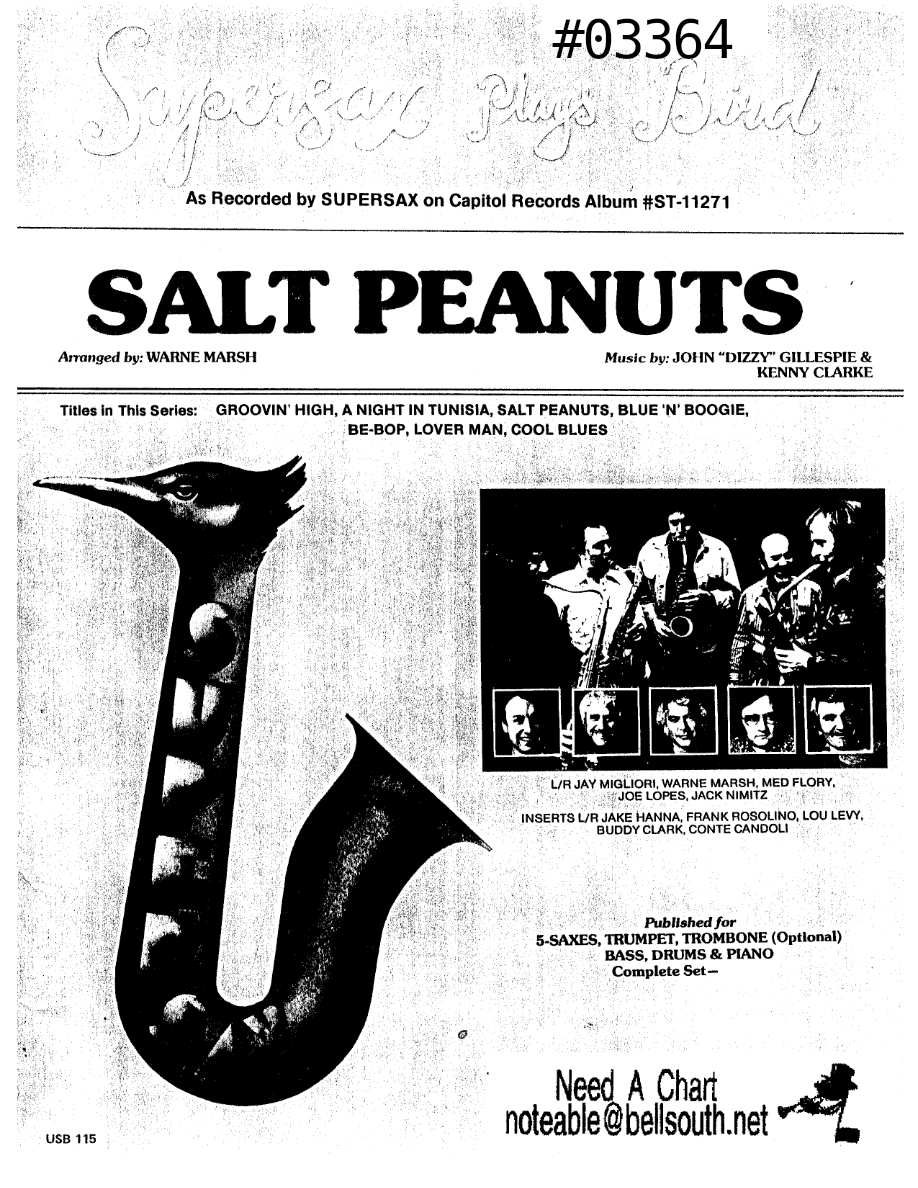
Salt Peanuts (W.Marsh)
Composed by Dizzy Gillespie, Kenny Clarke
Arranged by Warne Marsh
- Ensemble: Small Ensemble
- Style: Bebop
- Pages: 44
- Instruments (10): Bb Trumpet, Trombone, 1st Eb Alto Saxophone, 2nd Eb Alto Saxophone, 1st Bb Tenor Saxophone, 2nd Bb Tenor Saxophone, Eb Baritone Saxophone, Bass, Drums, Piano
- Difficulty: easy
- Content: Individual Parts
- Format: PDF Download (Instant)
- Price: $12.99
"Salt Peanuts," an electrifying bebop anthem co-composed by Dizzy Gillespie and Kenny Clarke, stands as a cornerstone of the jazz repertoire. Originally recorded in the mid-1940s, this tune epitomized the nascent bebop movement with its blistering tempo, intricate melodic lines, and harmonic sophistication. Gillespie's virtuosic trumpet playing and scat singing, often featuring the titular phrase, propelled "Salt Peanuts" into the jazz canon, making it an essential standard for any serious improviser or ensemble. Its high-energy character and challenging changes make it a perennial favorite for showcasing technical prowess and improvisational creativity, embodying the revolutionary spirit of bebop that redefined jazz. This particular arrangement, penned by the legendary cool jazz saxophonist Warne Marsh, offers a uniquely insightful perspective on the bebop classic. Marsh, known for his cerebral approach to improvisation and composition, applies his signature linear and contrapuntal sensibilities to Gillespie's fiery composition. Rather than a typical big band treatment, Marsh's arrangement for small ensemble retains the intimate, yet intensely demanding, nature of bebop's origins. Expect sophisticated voicings that often feature close-knit harmonies and interwoven melodic lines, characteristic of the Tristano school with which Marsh was closely associated. The arrangement maintains an unrelenting up-tempo bebop feel, typically in 4/4 time, demanding precision and agility from all players. While the original is often in F major, Marsh's harmonic explorations may introduce subtle reharmonizations or unexpected voice leading that add intellectual depth without sacrificing the tune's inherent drive. The arrangement features the melody primarily carried by the lead horn, often doubled or harmonized in Marsh's distinctive style, creating a lean yet full sound. Solo sections are clearly delineated, providing ample space for improvisation over the challenging chord changes. Technical challenges abound, particularly in the unison lines and the rapid-fire articulation required to execute the bebop language authentically. Players will need strong command of their instruments, excellent rhythmic precision, and a deep understanding of bebop harmony. The reward, however, is immense: performing Marsh's interpretation of "Salt Peanuts" offers a masterclass in linear improvisation and ensemble interplay, pushing musicians to their technical and intellectual limits. Specific moments, such as tightly voiced soli sections that dance across the rhythm section, are particularly exhilarating. This arrangement is ideally suited for advanced high school, college, community, and professional jazz ensembles. Its small ensemble format fosters a highly interactive and responsive performance environment, demanding individual excellence and collective cohesion. Bands seeking to delve into the intellectual rigor and technical demands of bebop, particularly through the lens of a master like Warne Marsh, will find this arrangement profoundly rewarding. It serves not only as a performance piece but also as a valuable educational tool for studying advanced harmony, counterpoint, and bebop articulation. Approaching Warne Marsh's "Salt Peanuts" requires meticulous attention to detail and a commitment to precision. The primary technical challenge lies in executing the rapid, often angular unison lines and complex voicings with rhythmic accuracy and clean articulation. Encourage players to practice these sections slowly, using a metronome, gradually increasing tempo while maintaining exact rhythmic placement and consistent tone. The tempo should be a bright, unyielding up-tempo bebop, typically around 240-280 BPM; establish a strong, driving swing feel from the outset, particularly in the rhythm section. There are no specific extended techniques like plunger mutes or falls indicated, but a strong, bright jazz articulation is crucial. Rehearsal should focus heavily on ensemble blend and balance, ensuring that the intricate inner voices of Marsh's harmonies are clearly audible without overpowering the lead. Emphasize listening across the ensemble, particularly during soli passages, to achieve the tight, interwoven sound characteristic of Marsh's aesthetic. Q: What instruments/parts are included in this arrangement? A: This small ensemble arrangement typically includes parts for lead trumpet, alto saxophone, tenor saxophone, trombone, piano, bass, and drums, though specific instrumentation may vary slightly based on the publisher's edition. Q: What is the difficulty level of this arrangement? A: This arrangement is rated as advanced, suitable for college, community, and professional jazz ensembles due to its demanding technical passages, intricate bebop harmonies, and requirement for advanced improvisational skills. Q: What makes Warne Marsh's arrangement of "Salt Peanuts" unique compared to other versions? A: Marsh's arrangement stands out for its sophisticated linear voicings, contrapuntal melodic treatments, and intellectual depth, reflecting his cool jazz sensibilities applied to a bebop classic, offering a more cerebral and intricate interpretation than typical big band charts. Q: What musical style and historical context does this arrangement represent? A: This arrangement firmly represents the bebop style of the mid-20th century, filtered through Warne Marsh's cool jazz arranging lens, showcasing the harmonic and melodic complexities that defined this revolutionary era in jazz. Q: What is the typical performance duration and tempo for this piece? A: The typical performance duration for "Salt Peanuts" is between 3-5 minutes, depending on the number and length of solos, and it should be performed at an unflagging up-tempo bebop feel, generally between 240-280 beats per minute.
Questions and answers
- What is included in the Salt Peanuts (W.Marsh) PDF?
- The verified current file contains individual parts across 44 pages.
- How many instruments or parts are listed for Salt Peanuts (W.Marsh)?
- The verified instrumentation list contains 10 entries for this Small Ensemble arrangement.
- Who is credited for Salt Peanuts (W.Marsh)?
- Composer: Dizzy Gillespie, Kenny Clarke. Arranger: Warne Marsh.
- What difficulty is listed for Salt Peanuts (W.Marsh)?
- The verified difficulty level is easy.
- What style is listed for Salt Peanuts (W.Marsh)?
- The catalog lists the style as Bebop.
- Can I preview Salt Peanuts (W.Marsh) before buying?
- Yes. The product page provides a preview generated from the current PDF file.
- How is Salt Peanuts (W.Marsh) delivered?
- After successful payment, the digital PDF is made available for download. The displayed price is $12.99.
Musicians Also Search For
Salt Peanuts Warne Marsh PDF • Salt Peanuts Warne Marsh sheet music • Salt Peanuts arranged by Warne Marsh • Warne Marsh small ensemble charts • Warne Marsh jazz arrangements PDF • Salt Peanuts Dizzy Gillespie, Kenny Clarke sheet music • Salt Peanuts Dizzy Gillespie, Kenny Clarke small ensemble arrangements • Dizzy Gillespie, Kenny Clarke small ensemble charts • Salt Peanuts small ensemble arrangements • Salt Peanuts small ensemble PDF download • Salt Peanuts jazz sheet music • small ensemble sheet music download • Salt Peanuts individual parts download • Salt Peanuts sheet music PDF • Salt Peanuts Bebop charts • Bebop small ensemble arrangements • buy Salt Peanuts sheet music • download Salt Peanuts PDF • Salt Peanuts jazz charts • best Warne Marsh small ensemble arrangements • Dizzy Gillespie, Kenny Clarke arranged by Warne Marsh • Salt Peanuts printable sheet music • small ensemble repertoire PDF