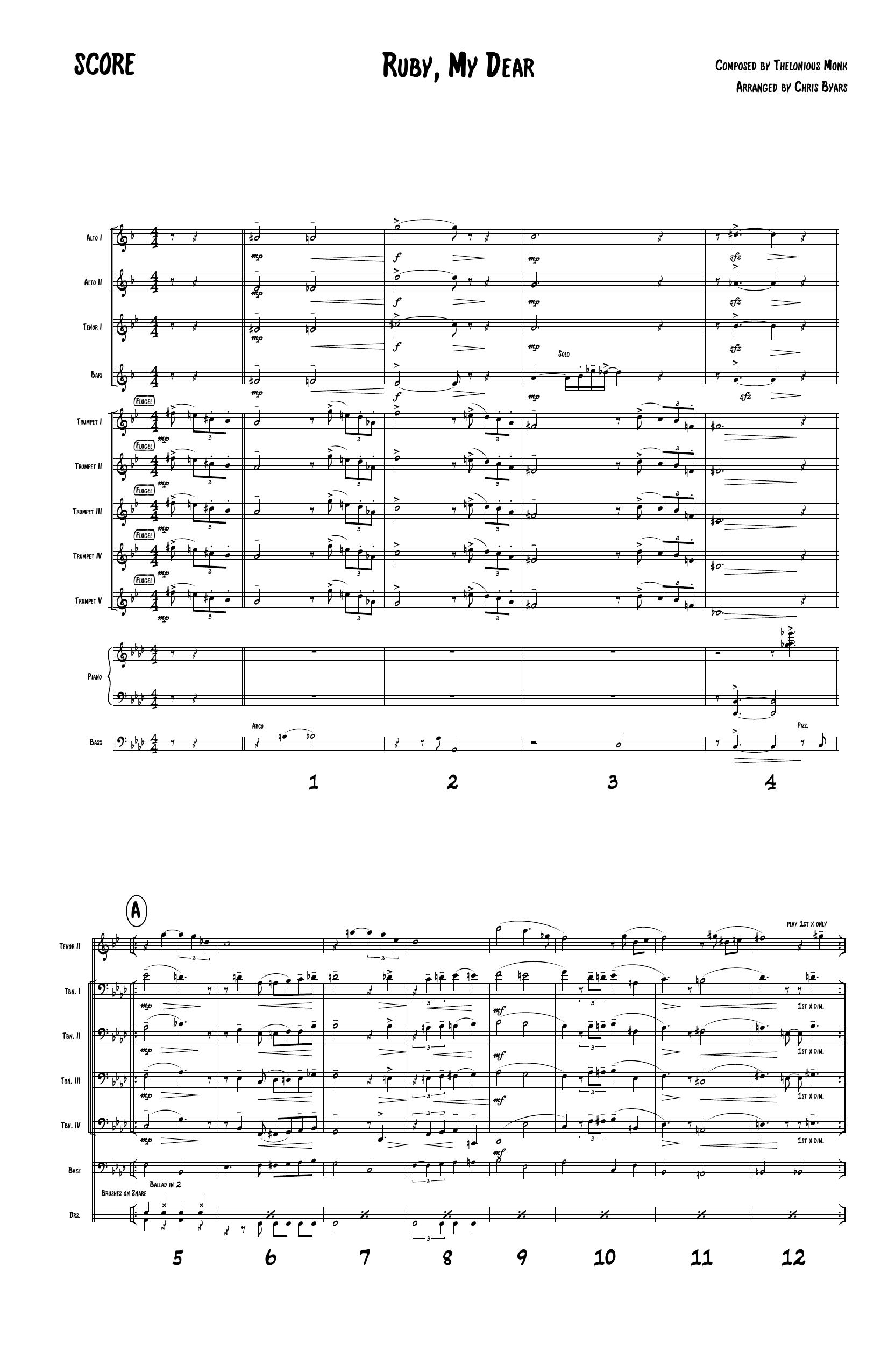
Ruby, My Dear (C.Byars) sheet music preview

Ruby, My Dear (C.Byars)

Composed by Thelonious Monk

Arranged by Thelonious Monk (arr.C.Byars)

  • Ensemble: Big Band
  • Pages: 33
  • Instruments (18): Alto Saxophone I, Alto Saxophone II, Tenor Saxophone I, Tenor Saxophone II, Baritone Saxophone, Trumpet I, Trumpet II, Trumpet III, Trumpet IV, Trumpet V, Trombone I, Trombone II, Trombone III, Trombone IV, Guitar, Piano, Bass, Drums
  • Difficulty: easy
  • Content: Individual Parts
  • Format: PDF Download (Instant)
  • Price: $24.99

Thelonious Monk’s tender, eccentric ballad "Ruby, My Dear" stands as one of the cornerstone compositions of modern jazz, first recorded in 1947 for Blue Note Records and later immortalized on his seminal 1957 Riverside album *Monk's Music*. Named after his childhood sweetheart, the tune showcases Monk's genius for subverting standard Tin Pan Alley harmonic expectations through jagged intervals, unexpected pauses, and a deeply idiosyncratic lyricism. Translating this intensely intimate piano-centric masterpiece into a expansive big band canvas requires a delicate touch, one that preserves Monk's quirky harmonic DNA while fully utilizing the rich textural palette of a modern jazz orchestra. This sophisticated big band setting by C. Byars captures the bittersweet, reflective mood of the original while expanding its emotional resonance across a full 19-piece ensemble. Set in a spacious, unhurried tempo with a nuanced, rubato-leaning ballad feel, the arrangement embraces Monk's signature angular phrasing and dense, dissonant chord clusters. The mood shifts seamlessly between exposed, delicate soli passages and warm, harmonically rich ensemble tuttis that evoke the smoky, nocturnal atmosphere of 1950s New York jazz clubs. Rather than diluting Monk’s eccentricities for the sake of mainstream appeal, the chart leans into his unconventional voice-leading and chromatic displacements. The arrangement brilliantly distributes the thematic material, with the muted brass and rich saxophone solis sharing the weight of Monk’s iconic, circuitous melody. The woodwinds and lower brass are utilized for lush, impressionistic voicings that highlight the composer's penchant for minor seconds and whole-tone inflections. Featured solo space allows a lead horn player to stretch out over Monk’s deceptive chord progression, encouraging the kind of melodic exploration and thematic development that defined the composer's own improvisational ethos. Technical challenges lie primarily in intonation, balance within tight harmonic clusters, and maintaining a relaxed, conversational swing-ballad pulse during rubato transitions. Advanced college ensembles, community jazz orchestras, and professional big bands will find this chart an exceptional vehicle for developing deep listening skills and harmonic awareness. Because the arrangement relies heavily on subtle dynamic control, precise articulation, and a mature understanding of modern jazz phrasing rather than sheer velocity, it offers a refreshing, deeply rewarding artistic challenge. Performing this piece demands a high level of stylistic cohesion, making it a standout centerpiece for any concert program celebrating the architects of modern jazz composition. Conductors should approach "Ruby, My Dear" with an emphasis on elasticity of time and transparent ensemble balance. The tempo must remain fluid yet grounded, requiring the rhythm section—particularly the pianist, who should channel Monk's sparse, percussive comping style—to anchor the groove without overplaying. A major technical hurdle involves navigating the dense, chromatic chord voicings in the saxophones and brass; players must tune minor seconds carefully to let the dissonance bloom naturally rather than sound forced. Use subtle plunger mutes or cup mutes in the brass sections during designated background figures to create a warm, textural contrast behind the soloist. Rehearsal time should be dedicated to sectional tone matching, ensuring that the rubato passages breathe together organically. Encourage the featured soloist to study Monk’s original recordings to absorb the phrasing, space, and emotional weight embedded in every measure. Q: What instrumentation and parts are included in this arrangement? A: The chart is scored for a standard 19-piece big band, which includes two alto saxophones, two tenor saxophones, baritone saxophone, four trumpets, four trombones, guitar, piano, bass, drums, and a comprehensive conductor score covering all parts. Q: What is the difficulty level of this arrangement? A: This piece is rated as advanced, primarily due to the intricate harmonic language, tight dissonant voicings, and the requirement for mature ensemble intonation and stylistic subtlety rather than fast technical execution. Q: What is the historical style and context of this piece? A: The arrangement honors the mid-century modern jazz idiom pioneered by Thelonious Monk, capturing the introspective ballad style and eccentric harmonic vocabulary of his classic 1940s and 1950s compositions. Q: What makes this specific arrangement by C. Byars unique? A: It successfully scales down Monk's idiosyncratic, piano-driven harmonic concepts into a full big band texture without losing the intimate, angular, and avant-garde spirit of the original masterwork. Q: What is the performance duration and tempo feel of the piece? A: The arrangement is designed as a slow, expressive ballad performed at a relaxed, unhurried tempo with a flexible, rubato-influenced feel, lasting approximately 5 to 6 minutes depending on the length of the open solo section.

Questions and answers

What is included in the Ruby, My Dear (C.Byars) PDF?
The verified current file contains a conductor score and individual parts across 33 pages.
How many instruments or parts are listed for Ruby, My Dear (C.Byars)?
The verified instrumentation list contains 18 entries for this Big Band arrangement.
Who is credited for Ruby, My Dear (C.Byars)?
Composer: Thelonious Monk. Arranger: Thelonious Monk (arr.C.Byars).
What difficulty is listed for Ruby, My Dear (C.Byars)?
The verified difficulty level is easy.
Can I preview Ruby, My Dear (C.Byars) before buying?
Yes. The product page provides a preview generated from the current PDF file.
How is Ruby, My Dear (C.Byars) delivered?
After successful payment, the digital PDF is made available for download. The displayed price is $24.99.

Musicians Also Search For

Ruby, My Dear Thelonious Monk (arr.C.Byars) PDFRuby, My Dear Thelonious Monk (arr.C.Byars) sheet musicRuby, My Dear arranged by Thelonious Monk (arr.C.Byars)Thelonious Monk (arr.C.Byars) big band chartsThelonious Monk (arr.C.Byars) jazz arrangements PDFRuby, My Dear Thelonious Monk sheet musicRuby, My Dear Thelonious Monk big band arrangementsThelonious Monk big band chartsRuby, My Dear big band arrangementsRuby, My Dear big band PDF downloadRuby, My Dear jazz sheet musicbig band sheet music downloadRuby, My Dear conductor score PDFRuby, My Dear individual parts downloadRuby, My Dear sheet music PDFbuy Ruby, My Dear sheet musicdownload Ruby, My Dear PDFRuby, My Dear jazz chartsbest Thelonious Monk (arr.C.Byars) big band arrangementsThelonious Monk arranged by Thelonious Monk (arr.C.Byars)Ruby, My Dear printable sheet musicbig band repertoire PDF

All arrangements by Thelonious Monk (arr.C.Byars) All Thelonious Monk sheet music