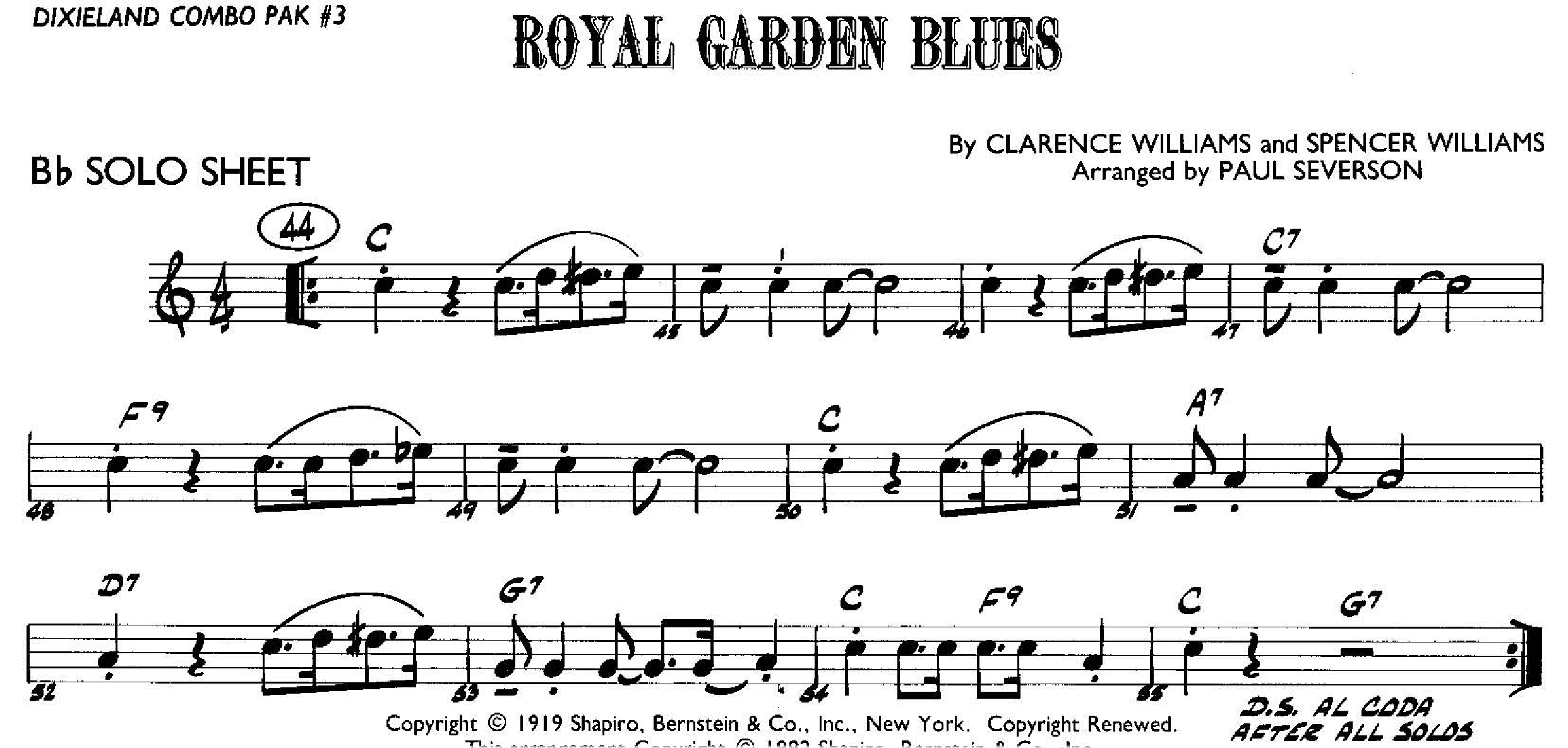
Royal Garden Blues (Severson)
Composed by Clarence Williams
Arranged by Severson
- Ensemble: Dixieland Band
- Style: Blues
- Pages: 12
- Difficulty: easy
- Content: Sheet Music
- Format: PDF Download (Instant)
- Price: $18.99
"Royal Garden Blues" stands as a cornerstone of early jazz, a vibrant testament to the birth of a new American art form. Composed by Clarence Williams and Spencer Williams (no relation) in 1919, this piece emerged from the fertile musical landscape of New Orleans and Chicago, capturing the infectious energy of the Roaring Twenties. It was swiftly popularized by the Original Dixieland Jazz Band, who recorded it in 1921, cementing its status as one of the first popular songs built around a riff. The tune's enduring appeal lies in its foundational blues structure, combined with a joyous, driving rhythm that defines the Dixieland style. Its simple yet compelling melodies and harmonies, often featuring blue notes and a distinctive two-beat feel, made it an instant classic and a staple in the repertoire of countless jazz luminaries, including Louis Armstrong, Bix Beiderbecke, Duke Ellington, and Benny Goodman. Severson's arrangement of "Royal Garden Blues" delivers a faithful yet refreshing interpretation of this Dixieland standard, designed to bring its authentic spirit to contemporary ensembles. The musical character is defined by a medium-up swing feel, maintaining the original's infectious energy while allowing for precise articulation and rhythmic clarity. The arrangement is typically set in a blues-friendly key, often F or G major, facilitating the characteristic blues inflections and improvisational opportunities. Expect a mood of unbridled exuberance and playful call-and-response, evoking the communal joy of early jazz. The energy is consistently high, driven by a buoyant rhythm section and the interwoven lines of the front-line instruments. Severson, known for his nuanced understanding of jazz styles and his focus on pedagogical clarity, approaches this piece with a keen eye for both tradition and performance practicality. His arrangements often feature a balance between "hip and straight," incorporating sophisticated jazz harmonies and counterpoint while remaining accessible. In this "Royal Garden Blues" arrangement, you'll find meticulously crafted voicings that honor the polyphonic improvisation characteristic of Dixieland, where trumpet (or cornet), clarinet, and trombone often improvise simultaneously, each fulfilling a specific role. There are clear sections for collective improvisation, as well as opportunities for featured solos, typically over the standard 12-bar blues form. The arrangement highlights the melody, often carried by the trumpet or clarinet, with the trombone providing a foundational counter-melody or rhythmic embellishment. Technical challenges include maintaining rhythmic precision within the collective improvisation sections and executing idiomatic articulations like falls and smears, which are crucial for an authentic Dixieland sound. The reward lies in the sheer joy of recreating this timeless music, with specific moments like the driving shout choruses and the interplay between the horns creating an exhilarating performance experience. This arrangement is ideally suited for high school, college, and community jazz ensembles seeking to explore the foundational sounds of Dixieland. Its clear structure and thoughtful notation make it an excellent pedagogical tool for introducing students to the collective improvisation and stylistic nuances of early jazz, while still offering enough challenge to engage more experienced players. The arrangement's ability to balance authenticity with playability makes it a valuable addition to any ensemble's library, providing an enjoyable and educational journey into the heart of the blues. Conductors should emphasize a vibrant, medium-up swing feel, ensuring the rhythm section lays down a solid, driving two-beat foundation that propels the ensemble forward. Articulation is paramount for an authentic Dixieland sound; encourage brass players to utilize short, crisp notes for rhythmic figures, and woodwinds to employ a light, flowing legato for melodic lines, punctuated by clear accents. Falls and smears, particularly from the trombone and clarinet, are essential stylistic elements and should be practiced for expressive effect. Technical challenges include maintaining independent lines during collective improvisation sections, requiring active listening and a strong sense of individual rhythmic placement. Rehearsal should focus on developing a cohesive ensemble sound where each instrument's role is clear but contributes to the overall polyphonic texture. Introduce the concept of "stop time" sections, common in Dixieland, where the rhythm section plays on specific beats, creating tension and release. Encourage soloists to embrace the blues scale and simple, melodic improvisation, echoing the early jazz aesthetic. **Q: What instruments and parts are included in this arrangement?** A: This arrangement for Dixieland Band typically includes parts for Trumpet (or Cornet), Clarinet, Trombone, Piano, Bass (or Tuba), Drums, and Banjo or Guitar. The 12 pages suggest a standard set of parts for a Dixieland ensemble. **Q: What is the difficulty level of "Royal Garden Blues (Severson)"?** A: This arrangement is designed for intermediate ensembles, making it suitable for high school, college, and community jazz bands. It offers pedagogical value for developing stylistic authenticity while providing engaging challenges for musicians. **Q: What is the musical style and historical context of "Royal Garden Blues"?** A: "Royal Garden Blues" is a classic blues standard from the early jazz era, composed in 1919 by Clarence Williams. It embodies the Dixieland style with its infectious medium-up swing feel, collective improvisation, and blues-infused melodies, representing a foundational piece in jazz history. **Q: What makes Severson's arrangement of "Royal Garden Blues" unique?** A: Severson's approach balances historical authenticity with modern playability, featuring carefully crafted voicings that honor Dixieland's polyphonic tradition while providing clear sections for both collective improvisation and featured solos. His arrangements are known for their pedagogical clarity and ability to make complex jazz styles accessible. **Q: What is the typical performance duration and tempo for this arrangement?** A: While variable depending on solos, a typical performance of this medium-up swing arrangement would range from approximately 3 to 5 minutes. The tempo should be a driving medium-up swing, allowing for both rhythmic precision and expressive melodic freedom.
Musicians Also Search For
Royal Garden Blues Severson PDF • Royal Garden Blues Severson sheet music • Royal Garden Blues arranged by Severson • Severson dixieland band charts • Severson jazz arrangements PDF • Royal Garden Blues Clarence Williams sheet music • Royal Garden Blues Clarence Williams dixieland band arrangement • Clarence Williams dixieland band charts • Royal Garden Blues dixieland band arrangement • Royal Garden Blues dixieland band PDF download • Royal Garden Blues jazz ensemble sheet music • dixieland band sheet music instant download • Royal Garden Blues sheet music with parts • Royal Garden Blues Blues chart • Blues dixieland band arrangements • buy Royal Garden Blues sheet music online • download Royal Garden Blues PDF • Royal Garden Blues jazz chart • best Severson dixieland band arrangements • Clarence Williams songs arranged by Severson • Royal Garden Blues printable sheet music • dixieland band repertoire PDF