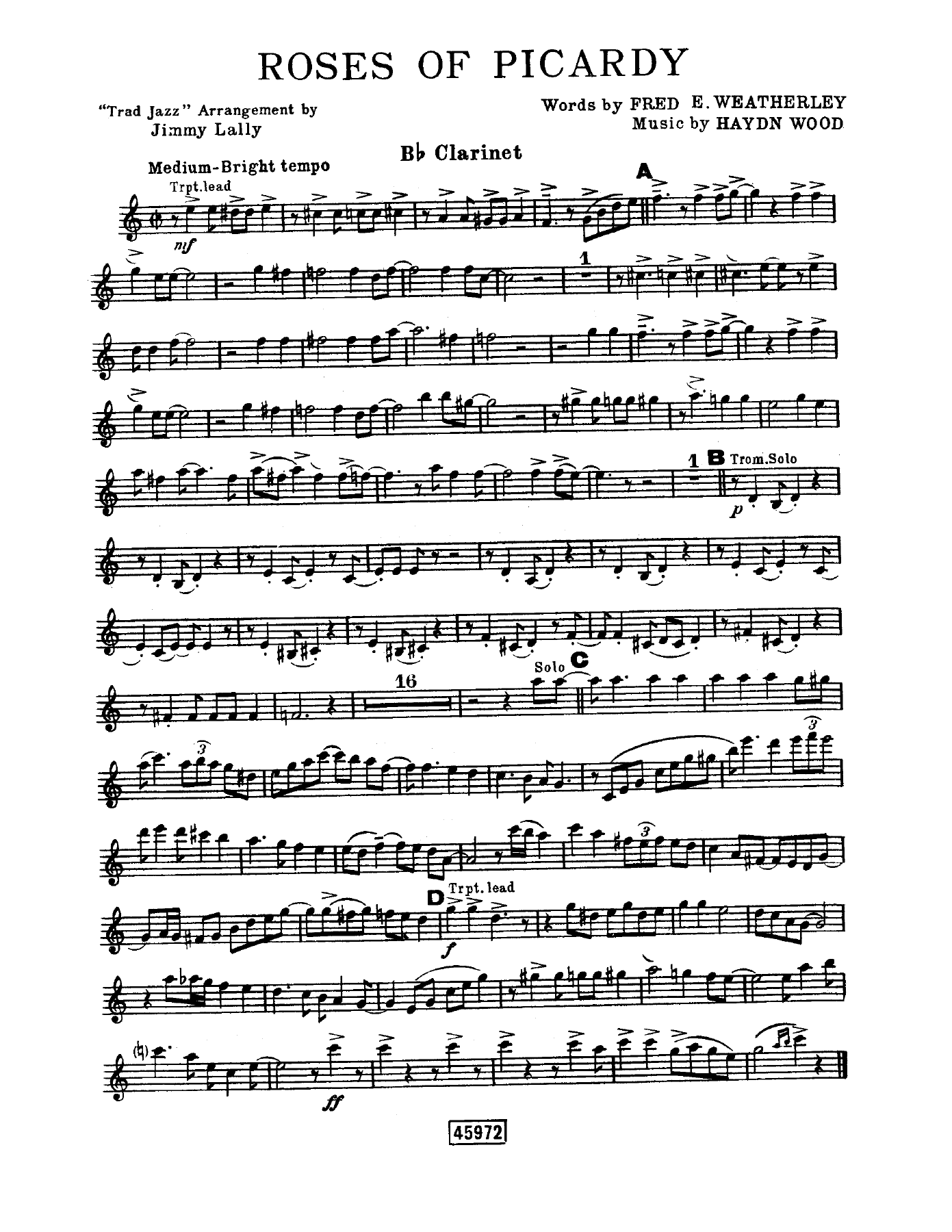
Roses Of Picardy (J.Lally)
Composed by Haydn Wood
Arranged by J.Lally
- Ensemble: Dixieland Band
- Style: Jazz Standard
- Pages: 11
- Instruments (8): Bb Clarinet, Bb Tenor Saxophone, Bb Trumpet, Trombone, Piano, Bass, Drums, Guitar
- Difficulty: easy
- Content: Individual Parts
- Format: PDF Download (Instant)
- Price: $18.99
"Roses of Picardy," composed by Haydn Wood with lyrics by Frederic Weatherly, was first published in London in 1916. It swiftly became one of the most famous songs of the First World War, resonating deeply with soldiers and the public alike as a poignant ballad of longing and love amidst the conflict. The melody, which Wood reportedly conceived on a London bus, and Weatherly's evocative lyrics, inspired by a friend's love story, tapped into universal emotions, cementing its place as a beloved standard. While not originally a jazz tune, its enduring popularity and beautiful melodic structure made it a natural fit for interpretation by jazz artists, notably popularized in a swing version by Sidney Bechet after World War II. Its sentimentality and memorable theme have allowed it to transcend its wartime origins, becoming a timeless piece ripe for diverse musical treatments. J.Lally’s Dixieland arrangement of "Roses of Picardy" reimagines this classic with a joyful, medium-tempo 4/4 swing feel, perfectly capturing the buoyant spirit of early jazz. The arrangement is set in a bright, accessible key, evoking a nostalgic, celebratory mood rather than the original's melancholy. Lally’s signature approach to Dixieland often involves a clear, melodic presentation combined with opportunities for collective improvisation, a hallmark of the style. This particular chart features a robust ensemble sound, with the melody primarily carried by the trumpet or cornet, often in unison or harmony with the clarinet and trombone, creating the characteristic polyphonic texture of Dixieland. The energy is consistently upbeat, making it an ideal selection for injecting a sense of historical charm and lively swing into any performance. Distinctive to J.Lally's treatment are the well-crafted soli sections that allow the various horn voices to shine, often in playful counterpoint. While there isn't a dedicated "shout chorus" in the big band sense, the full ensemble passages build dynamically, culminating in spirited collective improvisation sections that are both exhilarating and true to the Dixieland tradition. The arrangement maintains harmonic clarity, utilizing the simpler, unembellished triads and seventh chords typical of early jazz, rather than extended modern harmonies. This ensures authenticity to the Dixieland style while providing a solid foundation for improvisation. The arrangement is structured to highlight the melodic beauty of the original while infusing it with rhythmic vitality and improvisational freedom. This arrangement is particularly well-suited for high school, college, and community Dixieland bands, as well as professional ensembles seeking an authentic and engaging rendition of a classic. Its clear structure and idiomatic writing make it an excellent teaching tool for understanding Dixieland ensemble playing and collective improvisation. The technical challenges are moderate, focusing more on rhythmic precision, blend, and stylistic articulation rather than extreme ranges or complex harmonic substitutions. Performing this arrangement is rewarding because it allows musicians to engage with a piece of musical history, bringing its enduring melody to life through the vibrant and communal lens of Dixieland jazz. The interplay between the front-line instruments and the driving rhythm section creates a joyous and infectious musical experience for both performers and audience. This arrangement should be approached with a relaxed, medium-swing feel at approximately 120-130 beats per minute, emphasizing a light, buoyant rhythmic pulse. The primary technical challenge lies in achieving a cohesive polyphonic texture during the collective improvisation sections; encourage musicians to listen intently to each other, maintaining individual melodic lines that complement rather than clash. Articulation should be crisp and light, with a focus on short, detached notes for rhythmic clarity. Trumpet and trombone players should utilize plunger mutes where indicated to add authentic Dixieland color and vocal inflections. Rehearsal time should be dedicated to balancing the front-line instruments during the melody statements and soli passages, ensuring that the lead voice is clear while supporting lines are present but not overpowering. Emphasize dynamic contrasts to build excitement, particularly leading into and out of the collective improvisation. Q: What instruments are included in this arrangement? A: This Dixieland arrangement typically includes parts for trumpet/cornet, clarinet, trombone, piano, banjo/guitar, bass (string bass or tuba), and drums, allowing for the characteristic collective improvisation of the style. Q: What is the difficulty level of this arrangement? A: This arrangement is rated as intermediate, suitable for high school, college, and community Dixieland bands. It presents moderate technical challenges focused on stylistic articulation, rhythmic precision, and ensemble listening for collective improvisation. Q: What is the musical style and historical context of "Roses of Picardy"? A: "Roses of Picardy" is a classic British ballad from 1916, originally composed by Haydn Wood, which gained immense popularity during World War I. This arrangement reinterprets it as a lively Dixieland jazz standard, reflecting the early jazz era's energetic and improvisational approach. Q: What makes J.Lally's arrangement of "Roses of Picardy" unique? A: J.Lally's arrangement is unique for its authentic Dixieland treatment, featuring a medium-swing feel, clear melodic presentation, well-crafted soli sections, and opportunities for collective improvisation, all while maintaining the harmonic simplicity characteristic of the style. Q: What is the typical performance duration or tempo for this piece? A: Performed at a medium-swing tempo of approximately 120-130 beats per minute, this arrangement typically has a performance duration of around 3-4 minutes, depending on the length of improvised solos and collective sections.
Questions and answers
- What is included in the Roses Of Picardy (J.Lally) PDF?
- The verified current file contains individual parts across 11 pages.
- How many instruments or parts are listed for Roses Of Picardy (J.Lally)?
- The verified instrumentation list contains 8 entries for this Dixieland Band arrangement.
- Who is credited for Roses Of Picardy (J.Lally)?
- Composer: Haydn Wood. Arranger: J.Lally.
- What difficulty is listed for Roses Of Picardy (J.Lally)?
- The verified difficulty level is easy.
- What style is listed for Roses Of Picardy (J.Lally)?
- The catalog lists the style as Jazz Standard.
- Can I preview Roses Of Picardy (J.Lally) before buying?
- Yes. The product page provides a preview generated from the current PDF file.
- How is Roses Of Picardy (J.Lally) delivered?
- After successful payment, the digital PDF is made available for download. The displayed price is $18.99.
Musicians Also Search For
Roses Of Picardy J.Lally PDF • Roses Of Picardy J.Lally sheet music • Roses Of Picardy arranged by J.Lally • J.Lally dixieland band charts • J.Lally jazz arrangements PDF • Roses Of Picardy Haydn Wood sheet music • Roses Of Picardy Haydn Wood dixieland band arrangements • Haydn Wood dixieland band charts • Roses Of Picardy dixieland band arrangements • Roses Of Picardy dixieland band PDF download • Roses Of Picardy jazz sheet music • dixieland band sheet music download • Roses Of Picardy individual parts download • Roses Of Picardy sheet music PDF • Roses Of Picardy Jazz Standard charts • Jazz Standard dixieland band arrangements • buy Roses Of Picardy sheet music • download Roses Of Picardy PDF • Roses Of Picardy jazz charts • best J.Lally dixieland band arrangements • Haydn Wood arranged by J.Lally • Roses Of Picardy printable sheet music • dixieland band repertoire PDF