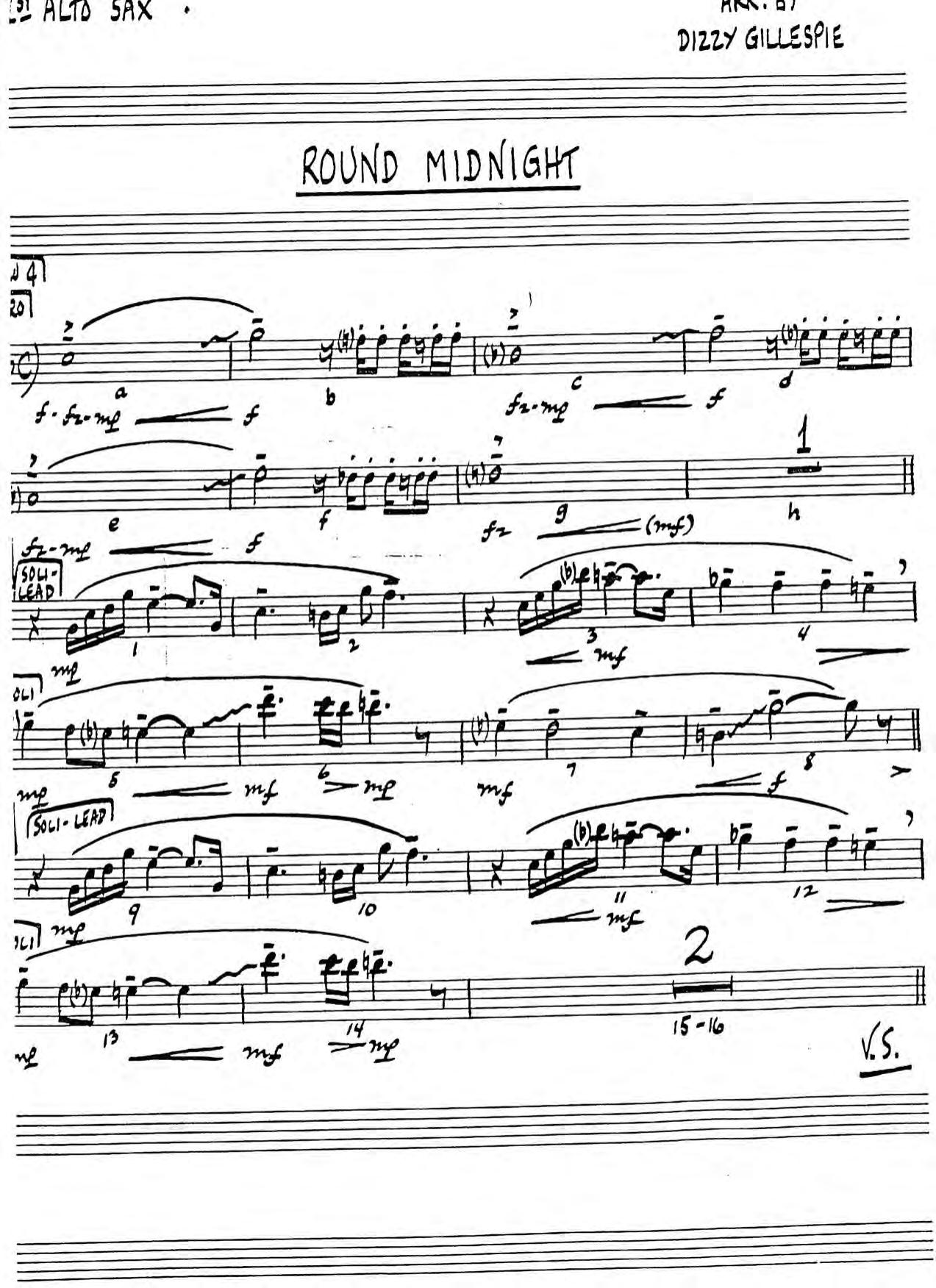
Round Midnight (D.Gillespie) sheet music preview

Round Midnight (D.Gillespie)

Composed by Thelonious Monk

Arranged by Gil Fuller-D.GILLESPIE

  • Ensemble: Big Band
  • Pages: 47
  • Instruments (17): 1st Alto Saxophone, 2nd Alto Saxophone, 3rd Tenor Saxophone, 4th Tenor Saxophone, Baritone Saxophone, Diz (Solo/Lead Trumpet), 1st Trumpet, 2nd Trumpet, 3rd Trumpet, 4th Trumpet, 1st Trombone, 2nd Trombone, 3rd Trombone, Bass Trombone, Piano, Bass, Drums
  • Difficulty: medium
  • Content: Individual Parts
  • Format: PDF Download (Instant)
  • Price: $24.99

Composed by Thelonious Monk in the early 1940s, "'Round Midnight" stands as the most-recorded jazz standard written by a jazz musician, defining the architectural blueprint of modern harmony and the nocturnal mood of the emerging bebop era. While Monk’s original piano-centric statements and subsequent popularized recordings by Miles Davis cemented its legendary status, the collaboration between Dizzy Gillespie and arranger Gil Fuller brought this haunting masterpiece into the grand-scale ecosystem of the bebop big band. Fuller, a master architect of Gillespie’s mid-1940s orchestra charts, recognized that Monk’s angular, chromatic intervals and melancholic, delayed resolutions could be brilliantly re-imagined through lush, expanded brass and reed voicings without losing their avant-garde edge. This masterwork unfolds at a moody, spacious ballad tempo, firmly rooted in E-flat minor, though it frequently ventures into chromatic territory that tests an ensemble's internal ear. The emotional landscape is deeply introspective, shifting between poignant, shadowed vulnerability and towering, dramatic density. Gil Fuller’s arrangement shuns conventional, predictable swing-era clichés in favor of advanced bebop extensions, employing dense chord clusters, striking dynamic contrasts, and sophisticated counterpoint. The legendary Gillespie big band approach is unmistakable here: searing trumpet pyrotechnics are balanced against dark, brooding saxophone solis and heavy, resonant trombone counter-lines that stretch the harmonic boundaries of the standard form. Throughout the chart, the melody shifts fluidly between sections, demanding exceptional blend and intonation, particularly in the trumpet and alto saxophone lines. Featured solo space allows a lead horn player to stretch out over the undulating harmonic backdrop, capturing the improvisational freedom characteristic of 1940s modern jazz experimentation. Technical challenges abound in the form of intricate rhythmic unisons, demanding altissimo registers for the lead trumpet, and precise sub-tone control in the saxophone section to maintain a velvety texture during exposed chordal passages. The reward for mastering this score lies in its profound dramatic arc, offering audiences a rare glimpse into the intersection of early bebop innovation and big band grandeur. Advanced collegiate, professional, and elite community big bands are best suited to tackle this rigorous 47-page arrangement. Because the charts rely heavily on mature stylistic awareness, acute listening across sections, and stamina in high-register brass, it serves as a centerpiece for major concert programs, jazz history retrospectives, and competitive festival sets where historical authenticity and technical precision are paramount. Conductors approaching this monumental chart must first establish a deeply relaxed yet intensely focused psychological space, as the tempo must feel suspended in time while maintaining a resolute internal pulse. The primary technical hurdle lies in the execution of Fuller's complex, extended chord voicings; intonation can easily derail in the lower brass and woodwind registers, requiring meticulous tuning of minor thirds and flatted fifths. Trumpets must balance aggressive bebop articulation with a dark, velvety tone quality, avoiding a strident edge during exposed melodic statements. Section leaders should emphasize dynamic shading, ensuring that background figures never obscure the primary melodic voice. Utilize sectional rehearsals specifically for the rhythm section to lock in the subtle rubato-esque push-and-pull within the strict 4/4 framework, anchoring Monk's iconic harmonic shifts with a steady, unobtrusive walking bass line and tasteful, sparse comping. Q: What instruments and parts are included in this big band arrangement? A: This 47-page score is scored for a standard 16-instrument big band instrumentation, featuring four trumpets, trombones (including bass trombone), a full saxophone section with standard doubling capabilities, and a complete rhythm section of piano, bass, and drums. Q: What is the overall difficulty level of this Gil Fuller-D.Gillespie arrangement? A: This arrangement is rated as advanced/professional, requiring collegiate or professional-level technical proficiency due to its intricate harmonies, high-register brass demands, and sophisticated bebop-era stylistic nuances. Q: How does this arrangement reflect the historical context of jazz? A: It captures the pivotal mid-1940s transition when the genius of Thelonious Monk's bebop compositions was scaled up for Dizzy Gillespie's groundbreaking big band, merging small-group harmonic innovation with large-ensemble power. T: What makes this specific arrangement of "'Round Midnight" unique? A: Unlike standard ballad charts, Gil Fuller’s arrangement utilizes advanced, dense voicings and stark dynamic contrasts that retain Monk's original dissonant, angular character while maximizing the color palette of a 16-piece jazz orchestra. Q: What is the recommended performance duration and tempo for this piece? A: Performed at an authentic, spacious ballad tempo with a moody feel, the arrangement typically runs between 4 to 6 minutes depending on the length of the featured improvised solo sections.

Questions and answers

What is included in the Round Midnight (D.Gillespie) PDF?
The verified current file contains individual parts across 47 pages.
How many instruments or parts are listed for Round Midnight (D.Gillespie)?
The verified instrumentation list contains 17 entries for this Big Band arrangement.
Who is credited for Round Midnight (D.Gillespie)?
Composer: Thelonious Monk. Arranger: Gil Fuller-D.GILLESPIE.
What difficulty is listed for Round Midnight (D.Gillespie)?
The verified difficulty level is medium.
Can I preview Round Midnight (D.Gillespie) before buying?
Yes. The product page provides a preview generated from the current PDF file.
How is Round Midnight (D.Gillespie) delivered?
After successful payment, the digital PDF is made available for download. The displayed price is $24.99.

Musicians Also Search For

Round Midnight Gil Fuller-D.GILLESPIE PDFRound Midnight Gil Fuller-D.GILLESPIE sheet musicRound Midnight arranged by Gil Fuller-D.GILLESPIEGil Fuller-D.GILLESPIE big band chartsGil Fuller-D.GILLESPIE jazz arrangements PDFRound Midnight Thelonious Monk sheet musicRound Midnight Thelonious Monk big band arrangementsThelonious Monk big band chartsRound Midnight big band arrangementsRound Midnight big band PDF downloadRound Midnight jazz sheet musicbig band sheet music downloadRound Midnight individual parts downloadRound Midnight sheet music PDFbuy Round Midnight sheet musicdownload Round Midnight PDFRound Midnight jazz chartsbest Gil Fuller-D.GILLESPIE big band arrangementsThelonious Monk arranged by Gil Fuller-D.GILLESPIERound Midnight printable sheet musicbig band repertoire PDF

All arrangements by Gil Fuller-D.GILLESPIE All Thelonious Monk sheet music