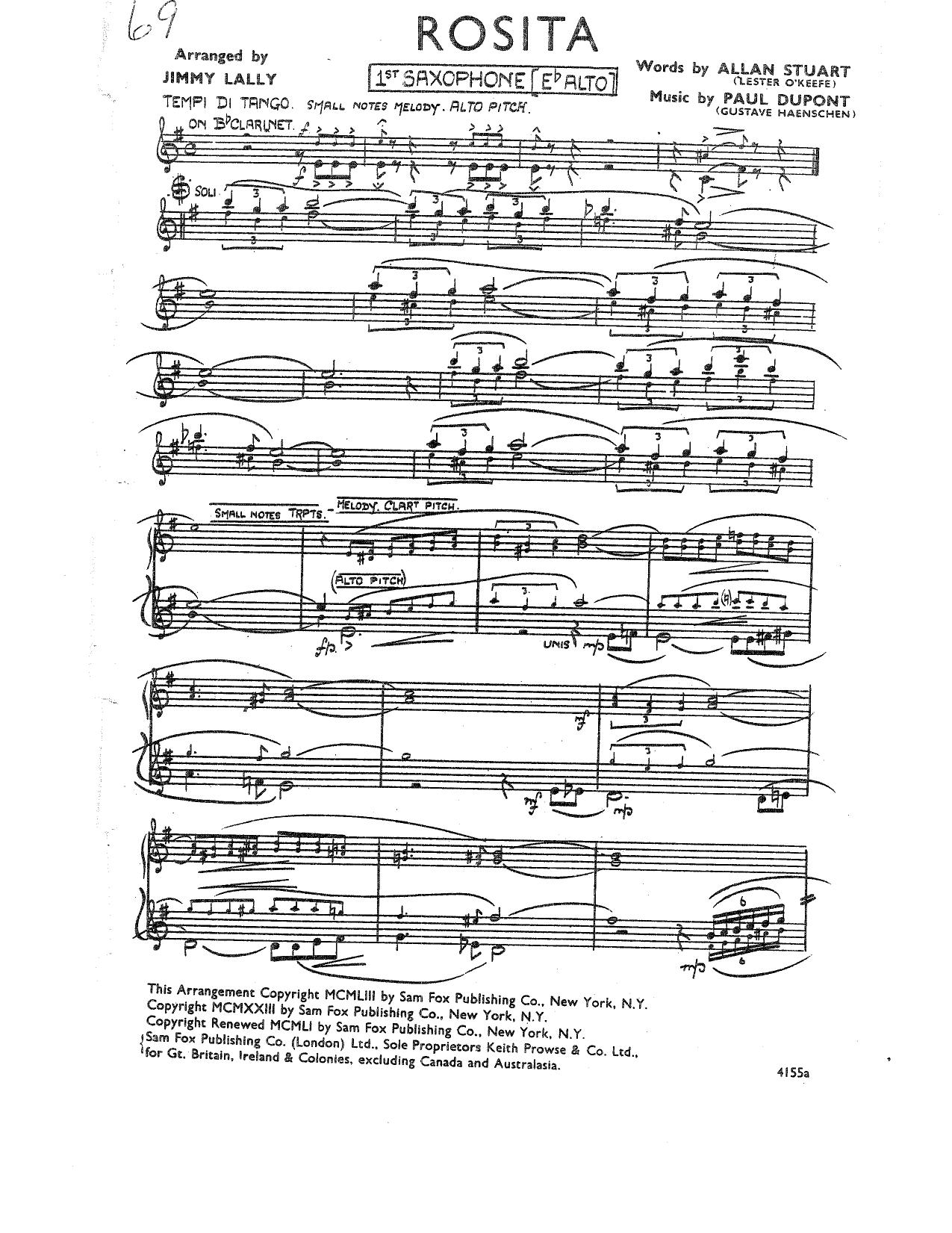
Rosita (J.Lally)
Composed by Paul Dupont
Arranged by Jimmy Lally
- Ensemble: Big Band
- Pages: 26
- Instruments (14): 1st Eb Alto Saxophone, 2nd Bb Tenor Saxophone, 3rd Eb Alto Saxophone, 4th Bb Tenor Saxophone, Eb Baritone Saxophone, 1st Bb Trumpet, 2nd Bb Trumpet, 3rd Bb Trumpet, 1st Trombone, 2nd Trombone, Piano Conductor, Bass, Guitar, Drums
- Difficulty: medium
- Content: Individual Parts
- Format: PDF Download (Instant)
- Price: $24.99
Paul Dupont’s evocative composition “Rosita” occupies a fascinating space in the broader continuum of light jazz and mid-century dance orchestra repertoire, capturing the sophisticated melodic charm that defined European and American syncopated music of the interwar period. While originally conceived as a feature for continental ensembles, the composition’s inherent harmonic flexibility and rhythmic buoyancy naturally attracted jazz arrangers looking to infuse a touch of exoticism and elegant swing into their books. The piece bridges the gap between classic salon orchestration and buoyant, accessible jazz, relying on memorable melodic contours and lush, romantic counterlines that translate seamlessly to the modern big band idiom. Jimmy Lally’s masterwork arrangement breathes vibrant new life into the score, framing Dupont’s timeless themes within a polished, mid-tempo swing framework that emphasizes ensemble blend, dynamic contrast, and crisp articulation. Lally—renowned for his skillful balance of rich, traditional big band voicings and approachable playability—constructs an arrangement where the primary melody is shared gracefully across the saxophone and brass sections. The chart opens with a seductive, atmospheric introduction before settling into a comfortable, driving medium-swing groove in 4/4 time. Rich extended harmonies, subtle chromatic passing tones, and clever reharmonizations elevate the underlying chord progression, giving the brass ample opportunity to shine with warm, muted textures and punchy ensemble figures. Throughout the arrangement, the dynamic interplay between the woodwinds and the rhythm section drives the momentum forward. A standout saxophone soli highlights the agility and tonal cohesion of the reed section, featuring tight, harmonized lines that require a high degree of articulation precision and breath support. The brass section responds with bright, soaring counter-melodies and crisp dynamic swells that culminate in a tasteful, tightly knit shout chorus. Rather than relying on blistering tempos or overwhelming technical hurdles, Lally builds tension through clever orchestration, shifting textures, and strategic modulations that keep both the performers and the audience thoroughly engaged from the first downbeat to the final sustained chord. Advanced high school ensembles, collegiate jazz orchestras, and accomplished community big bands will find this chart to be an ideal vehicle for developing refined swing phrasing, section balance, and stylistic versatility. Because the technical demands are centered around clean articulation, subtle dynamic shading, and stylistic cohesiveness rather than extreme altissimo registers or breakneck speeds, it serves as a stellar educational tool as well as a sophisticated concert piece. Performers will relish the opportunity to showcase their expressive capabilities, making “Rosita” a memorable, crowd-pleasing addition to any standard big band program. Achieving an authentic performance of Jimmy Lally’s arrangement of “Rosita” requires careful attention to a relaxed yet driving medium-swing feel. The rhythm section must anchor the ensemble with a steady, unhurried pulse; the drummer should emphasize a crisp ride cymbal pattern with light hi-hat chokes on beats two and four, avoiding any tendency to rush the tempo. Horn players need to focus on uniform articulation, ensuring that eighth-note lines are swung naturally in the traditional jazz vernacular rather than played rigidly straight or overly dotted. Key technical challenges lie in the dynamic control required during the softer ensemble passages and the precision of the saxophone soli. Conductors should rehearse the saxophones separately to lock in intonation and unified phrasing before integrating them with the full band. Brass players should utilize cup or straight mutes where indicated to achieve the authentic, warm textural contrast essential to the piece's vintage character. Pay close attention to dynamic markings, particularly during the transition into the shout chorus, allowing the band to build organically without forcing the tone. Q: What instruments and parts are included in this big band arrangement? A: The arrangement is scored for a 14-instrument big band instrumentation, featuring Alto Saxophone 1, Tenor Saxophone 2, Alto Saxophone 3, Tenor Saxophone 4, and Baritone Saxophone, alongside standard brass and rhythm section parts, totaling 26 pages with a comprehensive conductor score. Q: What is the difficulty level of this arrangement? A: This chart is graded at an intermediate-to-advanced level, making it exceptionally well-suited for high school jazz ensembles, collegiate bands, and professional community big bands seeking to refine their medium-swing style. Q: What is the historical background and style of "Rosita"? A: Originally composed by Paul Dupont in the mid-20th century tradition of light orchestral jazz, this piece combines European melodic elegance with classic American swing sensibilities, arranged expertly by Jimmy Lally. Q: What makes Jimmy Lally’s arrangement of "Rosita" unique? A: Lally’s treatment stands out for its sophisticated harmonic reharmonization, lush voicing distributions, and an engaging saxophone soli that seamlessly blends traditional dance orchestra charm with modern jazz big band textures. Q: What is the performance duration and tempo feel of this piece? A: The arrangement is set to a comfortable, driving medium-swing tempo (approximately 120–126 BPM) and typically runs around 3 to 4 minutes in duration, depending on soloist allocation and conductor interpretation.
Questions and answers
- What is included in the Rosita (J.Lally) PDF?
- The verified current file contains a conductor score and individual parts across 26 pages.
- How many instruments or parts are listed for Rosita (J.Lally)?
- The verified instrumentation list contains 14 entries for this Big Band arrangement.
- Who is credited for Rosita (J.Lally)?
- Composer: Paul Dupont. Arranger: Jimmy Lally.
- What difficulty is listed for Rosita (J.Lally)?
- The verified difficulty level is medium.
- Can I preview Rosita (J.Lally) before buying?
- Yes. The product page provides a preview generated from the current PDF file.
- How is Rosita (J.Lally) delivered?
- After successful payment, the digital PDF is made available for download. The displayed price is $24.99.
Musicians Also Search For
Rosita Jimmy Lally PDF • Rosita Jimmy Lally sheet music • Rosita arranged by Jimmy Lally • Jimmy Lally big band charts • Jimmy Lally jazz arrangements PDF • Rosita Paul Dupont sheet music • Rosita Paul Dupont big band arrangements • Paul Dupont big band charts • Rosita big band arrangements • Rosita big band PDF download • Rosita jazz sheet music • big band sheet music download • Rosita conductor score PDF • Rosita individual parts download • Rosita sheet music PDF • buy Rosita sheet music • download Rosita PDF • Rosita jazz charts • best Jimmy Lally big band arrangements • Paul Dupont arranged by Jimmy Lally • Rosita printable sheet music • big band repertoire PDF