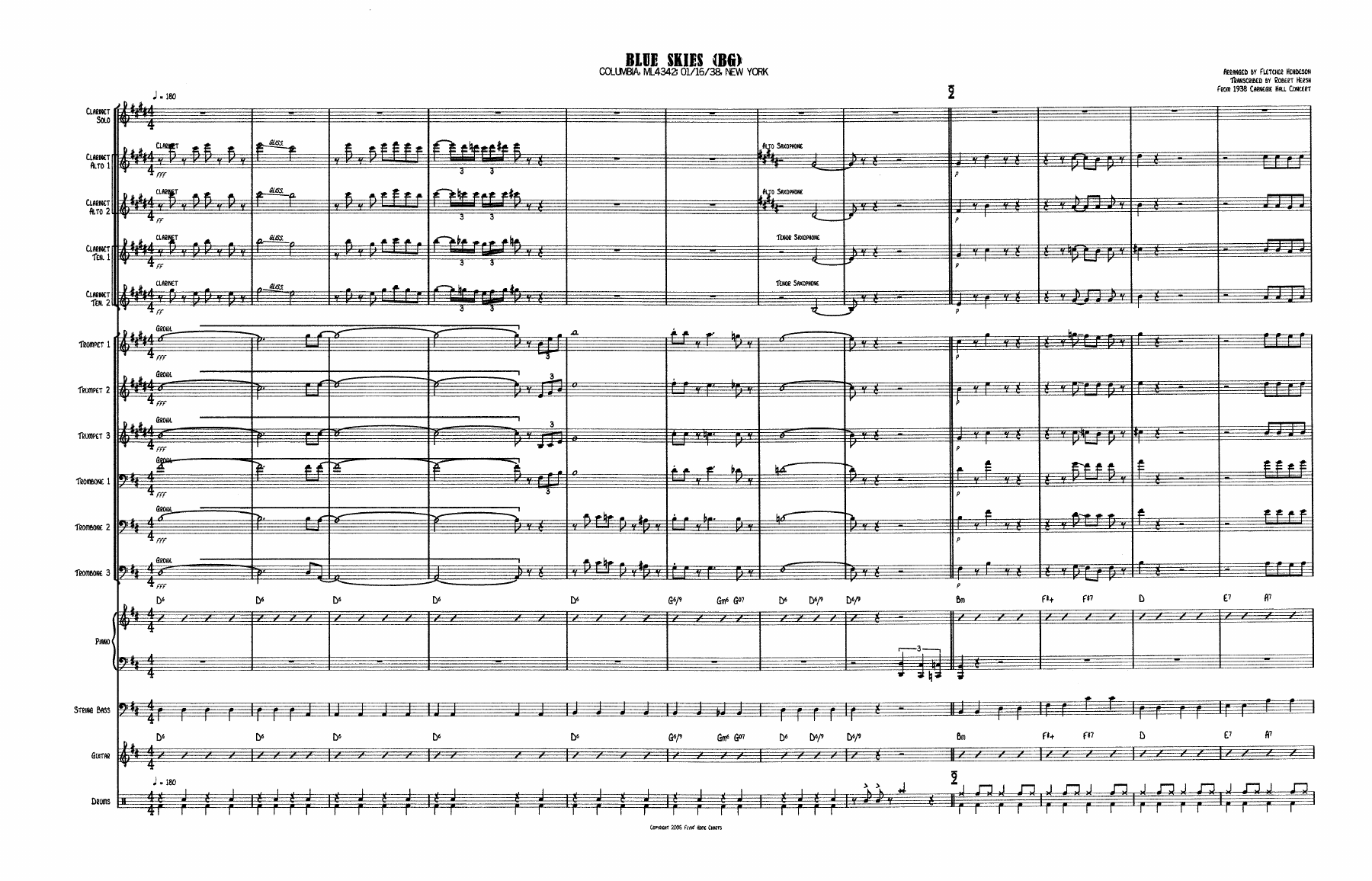
Blue Skies (F.Henderson)
Composed by Irving Berlin
Arranged by Benny Goodman
- Ensemble: Big Band
- Style: Jazz Standard
- Pages: 50
- Instruments (15): Clarinet Solo, Clarinet Alto 1, Clarinet Alto 2, Clarinet Tenor 1, Clarinet Tenor 2, Trumpet 1, Trumpet 2, Trumpet 3, Trombone 1, Trombone 2, Trombone 3, Piano, String Bass, Guitar, Drums
- Difficulty: advanced
- Content: Individual Parts
- Format: PDF Download (Instant)
- Price: $24.99
Irving Berlin's timeless classic, "Blue Skies," first graced the American songbook in 1926, quickly becoming a beacon of the Jazz Age. Introduced in the Rodgers and Hart musical "Betsy," it was Al Jolson's performance in the 1927 film "The Jazz Singer" that cemented its place in popular culture, making it one of the earliest and most enduring jazz standards. Its optimistic melody and hopeful lyrics resonated deeply during a period of burgeoning prosperity and cultural transformation, establishing it as a perennial favorite for vocalists and instrumentalists alike. The tune's harmonic simplicity yet melodic elegance made it a perfect vehicle for improvisation and sophisticated big band treatments, embodying the effervescent spirit of the era. This particular arrangement, attributed to the legendary Benny Goodman and often associated with Fletcher Henderson's groundbreaking contributions to Goodman's book, presents "Blue Skies" as a vibrant, up-tempo swing chart. Set firmly in the key of C major, it exudes an infectious, driving energy characteristic of the Swing Era's most exhilarating dance numbers. The mood is unequivocally jubilant and sophisticated, designed to get audiences tapping their feet and feeling the unbridled optimism of the tune. The arrangement maintains a consistent, bright 4/4 swing feel throughout, showcasing the precision and power of a well-drilled big band. Benny Goodman's approach, heavily influenced by the arranging genius of Fletcher Henderson, is immediately recognizable for its meticulous voicing, dynamic contrasts, and the seamless interplay between sections. Expect crisp, brassy punctuations contrasting with smooth, flowing saxophone soli passages. The melody is initially presented by the saxophone section, often doubled or harmonized in a classic Goodman style, before being passed to the brass for powerful, declarative statements. A hallmark of this arrangement is its expertly crafted shout chorus, building tension and excitement through layered riffs and a driving rhythm section. While specific soloists are not explicitly notated in all charts, there are ample opportunities for improvised solos, typically over the standard AABA form, allowing for individual expression within the ensemble's tight framework. The technical demands include precise articulation, strong sectional balance, and the ability to maintain a relentless, driving swing feel at a brisk tempo. Performing this arrangement is immensely rewarding, offering a tangible connection to the golden age of big band jazz. It's suitable for advanced high school ensembles, college jazz bands, and community big bands aiming to capture the authentic sound and energy of the Goodman orchestra. The challenges lie in achieving the necessary precision and blend, particularly in the fast-moving soli sections and the powerful shout chorus, but mastering these elements yields a truly exhilarating performance that showcases the band's collective musicianship and historical understanding. This arrangement of "Blue Skies (F.Henderson)" demands a bright, unflagging up-tempo swing feel, ideally around quarter note = 200-220 BPM. The primary technical challenge lies in maintaining crisp articulation and impeccable blend, especially within the fast-moving saxophone soli passages and the precise brass figures. Encourage brass players to use a bright, open tone with clear attacks, while the saxophones should strive for a unified, smooth sound in their ensemble work. The rhythm section is crucial: the bassist must provide a strong, walking quarter-note foundation, the drummer a driving ride cymbal pattern, and the pianist rhythmic comping that supports without overpowering. Dynamic contrasts are vital; ensure the band observes the marked crescendos and decrescendos, particularly leading into and out of the shout chorus. No special mutes are explicitly required, but a straight mute for the trumpets in certain sections can add authentic texture if desired. Rehearsal time should focus on sectional precision before combining, paying close attention to intonation at higher dynamics and faster tempos. Q: What instruments are included in this arrangement? A: This big band arrangement is scored for 17 instruments: Alto Saxophone 1, Alto Saxophone 2, Tenor Saxophone 1, Tenor Saxophone 2, Baritone Saxophone, Trumpet 1, Trumpet 2, Trumpet 3, Trumpet 4, Trombone 1, Trombone 2, Trombone 3, Trombone 4, Piano, Bass, Drums, and Guitar. Q: What is the difficulty level of this arrangement? A: This arrangement is considered advanced, suitable for college-level jazz ensembles, skilled community big bands, or advanced high school groups. It requires strong technical proficiency, precise articulation, and a firm grasp of the up-tempo swing idiom. Q: What is the musical style and historical context of this arrangement? A: This is an up-tempo swing arrangement of the jazz standard "Blue Skies," capturing the vibrant energy and sophisticated sound of the Swing Era (late 1930s to early 1940s). It reflects the arranging style associated with Benny Goodman and Fletcher Henderson. Q: What makes this specific arrangement unique or notable? A: This arrangement is notable for its classic Swing Era voicings, driving up-tempo feel, and the interplay between sections, characteristic of the Benny Goodman orchestra's sound. It features well-crafted soli sections and a powerful shout chorus that builds excitement. Q: What is the typical performance duration and tempo for this piece? A: The typical performance duration is approximately 3 to 4 minutes, depending on the number and length of improvised solos. It is designed to be played at a bright, up-tempo swing feel, generally around quarter note = 200-220 BPM.
Questions and answers
- What is included in the Blue Skies (F.Henderson) PDF?
- The verified current file contains a conductor score and individual parts across 50 pages.
- How many instruments or parts are listed for Blue Skies (F.Henderson)?
- The verified instrumentation list contains 15 entries for this Big Band arrangement.
- Who is credited for Blue Skies (F.Henderson)?
- Composer: Irving Berlin. Arranger: Benny Goodman.
- What difficulty is listed for Blue Skies (F.Henderson)?
- The verified difficulty level is advanced.
- What style is listed for Blue Skies (F.Henderson)?
- The catalog lists the style as Jazz Standard.
- Can I preview Blue Skies (F.Henderson) before buying?
- Yes. The product page provides a preview generated from the current PDF file.
- How is Blue Skies (F.Henderson) delivered?
- After successful payment, the digital PDF is made available for download. The displayed price is $24.99.
Musicians Also Search For
Blue Skies Benny Goodman PDF • Blue Skies Benny Goodman sheet music • Blue Skies arranged by Benny Goodman • Benny Goodman big band charts • Benny Goodman jazz arrangements PDF • Blue Skies Irving Berlin sheet music • Blue Skies Irving Berlin big band arrangements • Irving Berlin big band charts • Blue Skies big band arrangements • Blue Skies big band PDF download • Blue Skies jazz sheet music • big band sheet music download • Blue Skies conductor score PDF • Blue Skies individual parts download • Blue Skies sheet music PDF • Blue Skies Jazz Standard charts • Jazz Standard big band arrangements • buy Blue Skies sheet music • download Blue Skies PDF • Blue Skies jazz charts • best Benny Goodman big band arrangements • Irving Berlin arranged by Benny Goodman • Blue Skies printable sheet music • big band repertoire PDF