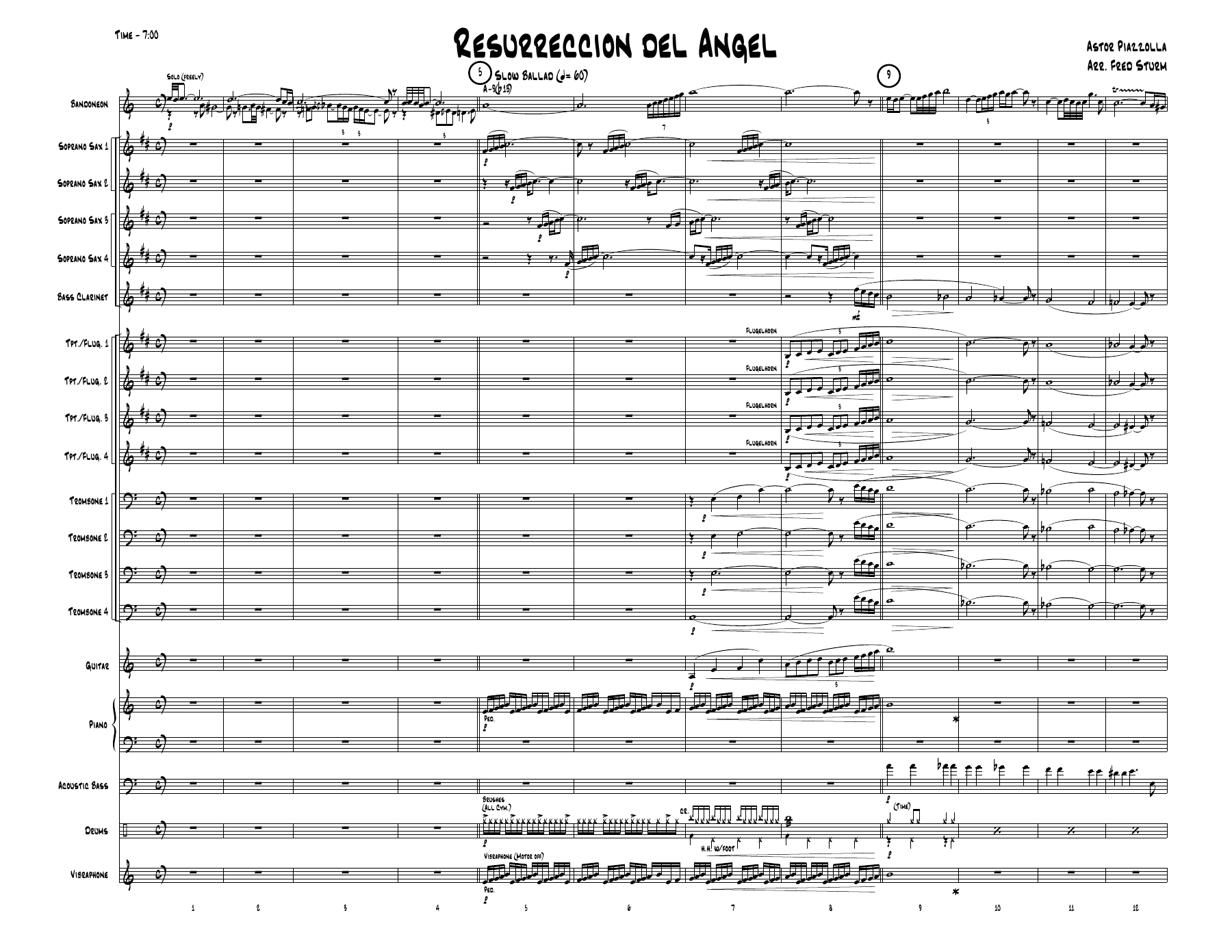
Resurreccion Del Angel (F.Sturm)
Composed by Astor Piazzolla
Arranged by F.Sturm
- Ensemble: Big Band
- Style: Jazz Standard
- Pages: 73
- Instruments (20): Bandoneon, Soprano Sax 1, Soprano Sax 2, Soprano Sax 3, Soprano Sax 4, Alto Sax 2, Bass Clarinet, Trumpet/Flugelhorn 1, Trumpet/Flugelhorn 2, Trumpet/Flugelhorn 3, Trumpet/Flugelhorn 4, Trombone 1, Trombone 2, Trombone 3, Trombone 4, Guitar, Piano, Acoustic Bass, Drums, Vibraphone
- Difficulty: advanced
- Content: Individual Parts
- Format: PDF Download (Instant)
- Price: $24.99
Astor Piazzolla's "Resurrección del Ángel" stands as a poignant testament to the composer's revolutionary "Nuevo Tango" movement, originally conceived in the early 1960s as part of his "Angel Suite." This era marked a profound departure from traditional tango, infusing it with elements of classical counterpoint, jazz harmonies, and a more complex rhythmic and structural approach. While not a jazz standard in the conventional sense, Piazzolla's works, including this one, have been widely embraced and reinterpreted by jazz musicians for their rich harmonic language, dramatic flair, and improvisational potential, making them de facto standards within the contemporary jazz lexicon. The original composition evokes a profound sense of dramatic narrative, often interpreted as the spiritual rebirth of an angel in the gritty urban landscape of Buenos Aires, characterized by its melancholic beauty and underlying tension. F.Sturm's masterful big band arrangement reimagines this iconic work, transforming its intimate chamber tango origins into a powerful, expansive jazz statement. Sturm approaches "Resurrección del Ángel" with a sophisticated understanding of both Piazzolla's original intent and the capabilities of a modern jazz orchestra. The arrangement is set in a driving, medium-up tempo Latin groove, primarily in 4/4, but with subtle rhythmic shifts that maintain the original's dynamic ebb and flow. The key is primarily C minor, allowing for both the inherent melancholy and moments of soaring triumph. Sturm's signature is evident in the rich, often dense voicings that permeate the brass and saxophone sections, creating lush harmonic textures that support and propel the melodic lines. The mood oscillates between introspective yearning and powerful, almost cinematic declarations, evoking a spectrum of emotions from solemnity to passionate exuberance. The arrangement opens with an evocative, sustained introduction, setting a dramatic stage before the main theme emerges, initially carried by the tenor saxophone, offering a lyrical yet authoritative voice. Throughout the piece, the melody is thoughtfully distributed, featuring various sections and soloists, ensuring dynamic contrast and instrumental color. There are prominent feature sections for both Alto Saxophone 1 and Tenor Saxophone 1, providing ample opportunity for expressive improvisation over Sturm's meticulously crafted harmonic progressions. The technical demands are significant, particularly in the intricate rhythmic interplay between sections and the requirement for precise ensemble blend and articulation. Full-band soli sections demand strong individual musicianship and collective cohesion, while a powerful shout chorus builds to an exhilarating climax. Performing this piece is immensely rewarding, offering musicians the chance to explore complex emotional landscapes and engage with a truly unique fusion of tango's passion and jazz's improvisational spirit. This arrangement is ideally suited for advanced high school, collegiate, community, and professional big bands. Its complexity in rhythm, harmony, and ensemble coordination requires a mature understanding of jazz idiom and a commitment to detailed rehearsal. Bands seeking to expand their repertoire beyond traditional swing charts and explore the rich, dramatic world of Latin-infused jazz will find "Resurrección del Ángel" to be a challenging yet deeply satisfying addition, showcasing both individual talent and collective power. "Resurrección del Ángel" requires meticulous attention to rhythmic precision and dynamic shaping. The primary medium-up tempo Latin groove should be maintained with a consistent, driving energy, avoiding any tendency to rush or drag, especially during the intricate syncopated figures. Conductors should emphasize the underlying rhythmic pulse while allowing for the inherent rubato and expressive phrasing within the melodic lines. Technical challenges include complex brass voicings demanding excellent intonation and blend, and saxophone soli sections requiring tight articulation and unified phrasing. The featured soloists (Alto Sax 1, Tenor Sax 1) should be encouraged to embrace both the melodic integrity of Piazzolla's style and the improvisational freedom of jazz. Rehearsal should focus on clarifying rhythmic subdivisions, particularly in tutti passages, and building dynamic contrast from subtle whispers to powerful fortissimos. Special techniques include controlled brass falls and precise cut-offs to enhance the dramatic impact. Q: What instruments and parts are included in this arrangement? A: This big band arrangement includes parts for 17 instruments: Alto Saxophone 1, Alto Saxophone 2, Tenor Saxophone 1, Tenor Saxophone 2, Baritone Saxophone, Trumpet 1, Trumpet 2, Trumpet 3, Trumpet 4, Trombone 1, Trombone 2, Trombone 3, Trombone 4, Piano, Bass, Drums, and Guitar. Q: What is the difficulty level of "Resurrección del Ángel (F.Sturm)"? A: This arrangement is considered advanced, suitable for collegiate, community, and professional big bands. It demands strong technical proficiency, precise ensemble playing, and a sophisticated understanding of jazz and Latin idioms. Q: What musical style and historical context does this arrangement represent? A: This arrangement is a jazz big band interpretation of Astor Piazzolla's "Resurrección del Ángel," a key work from his "Nuevo Tango" period of the early 1960s. It fuses Piazzolla's dramatic, harmonically rich tango with jazz improvisation and big band orchestration. Q: What makes F.Sturm's arrangement of "Resurrección del Ángel" unique? A: F.Sturm's arrangement is distinguished by its transformation of the original's intimate character into a powerful big band statement, utilizing lush, dense voicings, a driving medium-up Latin groove, and prominent feature sections for soloists, all while maintaining Piazzolla's dramatic integrity. Q: What is the typical performance duration and tempo feel for this piece? A: The typical performance duration for this arrangement is approximately 5-6 minutes. It is set at a medium-up tempo with a consistent, driving Latin groove, primarily in 4/4 time.
Questions and answers
- What is included in the Resurreccion Del Angel (F.Sturm) PDF?
- The verified current file contains a conductor score and individual parts across 73 pages.
- How many instruments or parts are listed for Resurreccion Del Angel (F.Sturm)?
- The verified instrumentation list contains 20 entries for this Big Band arrangement.
- Who is credited for Resurreccion Del Angel (F.Sturm)?
- Composer: Astor Piazzolla. Arranger: F.Sturm.
- What difficulty is listed for Resurreccion Del Angel (F.Sturm)?
- The verified difficulty level is advanced.
- What style is listed for Resurreccion Del Angel (F.Sturm)?
- The catalog lists the style as Jazz Standard.
- Can I preview Resurreccion Del Angel (F.Sturm) before buying?
- Yes. The product page provides a preview generated from the current PDF file.
- How is Resurreccion Del Angel (F.Sturm) delivered?
- After successful payment, the digital PDF is made available for download. The displayed price is $24.99.
Musicians Also Search For
Resurreccion Del Angel F.Sturm PDF • Resurreccion Del Angel F.Sturm sheet music • Resurreccion Del Angel arranged by F.Sturm • F.Sturm big band charts • F.Sturm jazz arrangements PDF • Resurreccion Del Angel Astor Piazzolla sheet music • Resurreccion Del Angel Astor Piazzolla big band arrangements • Astor Piazzolla big band charts • Resurreccion Del Angel big band arrangements • Resurreccion Del Angel big band PDF download • Resurreccion Del Angel jazz sheet music • big band sheet music download • Resurreccion Del Angel conductor score PDF • Resurreccion Del Angel individual parts download • Resurreccion Del Angel sheet music PDF • Resurreccion Del Angel Jazz Standard charts • Jazz Standard big band arrangements • buy Resurreccion Del Angel sheet music • download Resurreccion Del Angel PDF • Resurreccion Del Angel jazz charts • best F.Sturm big band arrangements • Astor Piazzolla arranged by F.Sturm • Resurreccion Del Angel printable sheet music • big band repertoire PDF