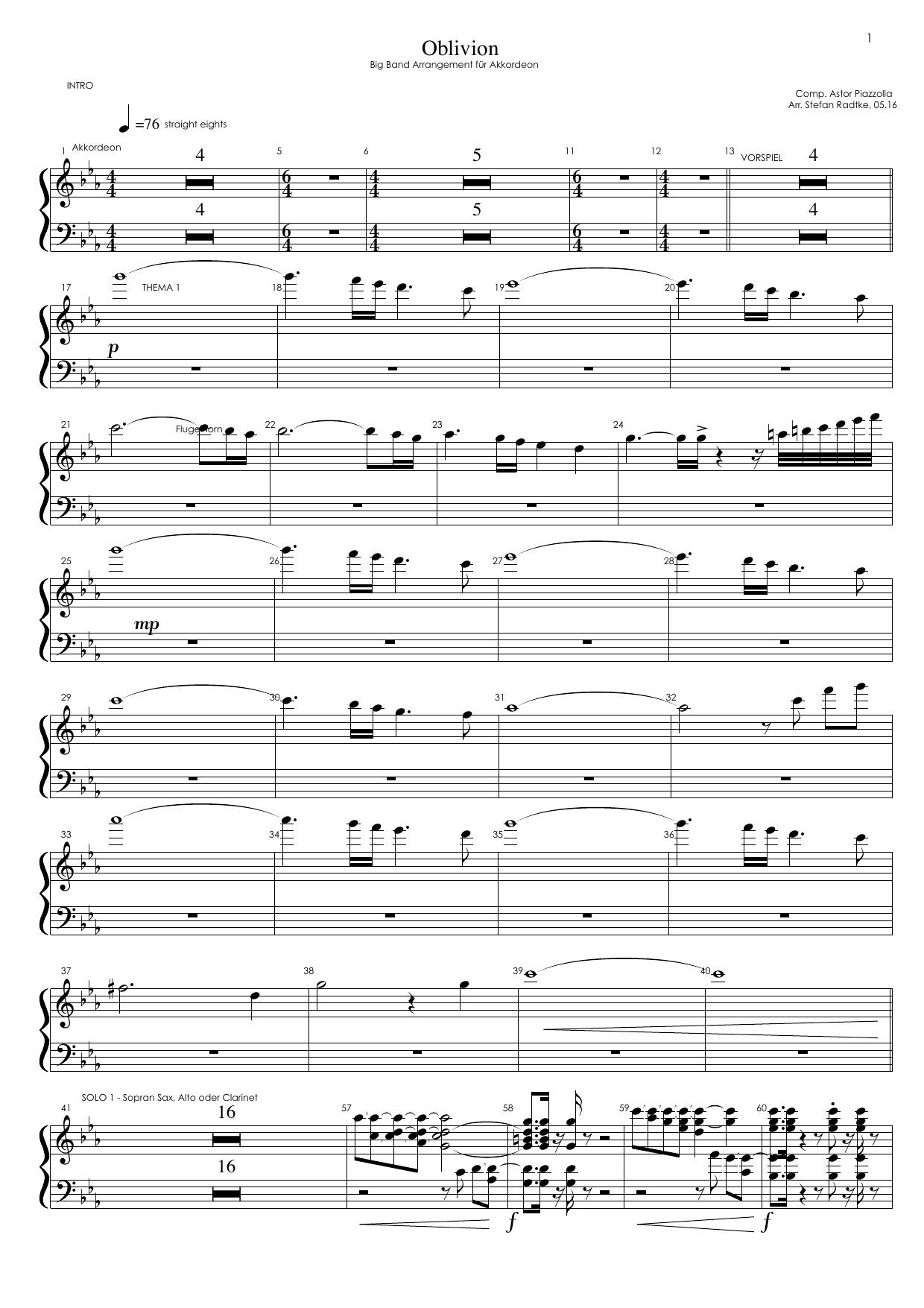
Oblivion (S.Radtke)
Composed by Astor Piazzolla
Arranged by S.Radtke
- Ensemble: Big Band
- Style: Jazz Standard
- Pages: 64
- Instruments (18): Accordion, Clarinet 1, Clarinet 2, Flute 1, Flute 2, Baritone Saxophone, Trumpet 1, Trumpet 2, Trumpet 3, Trumpet 4, Trombone 1, Trombone 2, Trombone 3, Trombone 4, Drums, Piano, Bass, Chords
- Difficulty: advanced
- Content: Individual Parts
- Format: PDF Download (Instant)
- Price: $24.99
Astor Piazzolla’s haunting masterwork “Oblivion,” originally composed in 1982 for Marco Bellocchio’s film *Enrico IV*, stands as one of the definitive pillars of *Nuevo Tango*. While conceived in the rich, melancholic idiom of Argentine tango, the composition’s lush harmonic architecture and soaring, elegiac melody have long invited jazz interpretation, making it a favorite of modern improvisers seeking deep emotional resonance. S.Radtke’s sophisticated big band adaptation brilliantly bridges the worlds of South American chamber jazz and traditional large ensemble writing, recasting Piazzolla’s poignant themes through an expansive, contemporary jazz lens that honors the source material while fully exploiting the dynamic palette of a 17-piece jazz orchestra. At a lingering, expressive ballad tempo with an underlying rubato-inflected Latin groove, this arrangement establishes a mood of introspective melancholy shifting into sweeping dramatic intensity. The key signature and modal colorings preserve the dark, sensual atmosphere of the original while introducing extended jazz harmonies, subtle chromatic mediants, and lush voicing in the saxophones and brass. S.Radtke avoids heavy-handed swing clichés, opting instead for a fluid, breathing time-feel that allows the melody to stretch and pull naturally. The textures are remarkably transparent, utilizing delicate woodwind doubling and a distinctive accordion voice to anchor the authentic tango flavor before opening up into rich, modern big band swells. The narrative of the chart unfolds through a masterful distribution of thematic material across the ensemble. The woodwinds—featuring prominent parts for two flutes and two clarinets—alongside the accordion, carry the initial statements of the fragile, aching melody, establishing an intimate chamber-jazz aesthetic. As the chart builds in emotional density, the brass section enters with warm, muted pads that gradually swell into soaring countermelodies. Featured improvised solo space is thoughtfully integrated, allowing a featured soloist to navigate sophisticated chord changes that maintain the tune's inherent tension. Technical challenges lie primarily in breath control, intonation within tight cluster voicings, and maintaining a unified stylistic pulse during transitional rubato phrases, making the piece deeply rewarding for musicians who excel at expressive, lyric-driven performance. Advanced high school, collegiate, and professional jazz ensembles will find this arrangement an exceptional vehicle for developing lyrical maturity, dynamic control, and stylistic versatility. Because it relies less on sheer velocity and more on tonal color, blend, and emotional interpretation, it serves as a powerful change-of-pace program piece for competitive festivals or formal concert settings. The inclusion of parts for accordion and extensive woodwind doublings elevates it far beyond standard big band repertoire, offering audiences and performers a refreshing, deeply moving exploration of Piazzolla's genius filtered through an innovative modern jazz sensibility. Achieving success with this arrangement requires prioritizing balance, intonation, and a delicate handling of rubato over sheer volume. The conductor must ensure that the rhythm section maintains a subtle, pulsing bossa/tango hybrid groove that never feels rigid or heavy-handed. Key technical challenges involve the intricate woodwind writing for flutes and clarinets; players must match articulation and pitch precisely during exposed unison and harmonized lines. The accordion (or designated synthesizer voice) plays a pivotal role in bridging the jazz harmony with authentic tango texture, and its player should be given adequate amplification to sit naturally within the ensemble mix without overpowering the horns. Pay close attention to dynamic markings: the chart relies heavily on gradual swells and sudden drop-offs to create its cinematic, sweeping emotional arc. Brass players should utilize warm, dark mutes where indicated to avoid piercing the delicate acoustic space established by the rhythm section and woodwinds. Rehearsal time should be dedicated initially to sectional balance, ensuring the inner-voice harmonies in the saxophones are fully voiced before integrating the rhythm section's harmonic accompaniment. Q: What specific instruments and parts are included in this 17-instrument big band arrangement? A: The instrumentation features a comprehensive 17-piece setup including an accordion, two clarinets, two flutes, standard big band brass and saxophones, and a complete rhythm section, accompanied by a full 64-page conductor score. Q: What is the difficulty level of S.Radtke's arrangement of "Oblivion"? A: This arrangement is graded as advanced, primarily suited for collegiate, advanced high school, and professional jazz ensembles due to its demands on intonation, subtle rubato phrasing, and woodwind doubling. Q: What is the musical style and historical background of this piece? A: Rooted in Astor Piazzolla’s 1982 *Nuevo Tango* classic from the film *Enrico IV*, this chart reimagines the composition as a contemporary jazz ballad infused with traditional Argentine tango characteristics. Q: What makes this specific arrangement by S.Radtke unique? A: It uniquely integrates non-traditional big band instruments—such as an accordion and dual flute/clarinet parts—with advanced jazz harmonies and a cinematic approach that diverges from standard swing-era arranging formulas. Q: What is the performance duration and tempo feel of the piece? A: The arrangement is performed at a slow, expressive ballad tempo with an elastic, breathing Latin groove, typically running between 4 to 6 minutes depending on the length of the improvised solo sections.
Questions and answers
- What is included in the Oblivion (S.Radtke) PDF?
- The verified current file contains a conductor score and individual parts across 64 pages.
- How many instruments or parts are listed for Oblivion (S.Radtke)?
- The verified instrumentation list contains 18 entries for this Big Band arrangement.
- Who is credited for Oblivion (S.Radtke)?
- Composer: Astor Piazzolla. Arranger: S.Radtke.
- What difficulty is listed for Oblivion (S.Radtke)?
- The verified difficulty level is advanced.
- What style is listed for Oblivion (S.Radtke)?
- The catalog lists the style as Jazz Standard.
- Can I preview Oblivion (S.Radtke) before buying?
- Yes. The product page provides a preview generated from the current PDF file.
- How is Oblivion (S.Radtke) delivered?
- After successful payment, the digital PDF is made available for download. The displayed price is $24.99.
Musicians Also Search For
Oblivion S.Radtke PDF • Oblivion S.Radtke sheet music • Oblivion arranged by S.Radtke • S.Radtke big band charts • S.Radtke jazz arrangements PDF • Oblivion Astor Piazzolla sheet music • Oblivion Astor Piazzolla big band arrangements • Astor Piazzolla big band charts • Oblivion big band arrangements • Oblivion big band PDF download • Oblivion jazz sheet music • big band sheet music download • Oblivion conductor score PDF • Oblivion individual parts download • Oblivion sheet music PDF • Oblivion Jazz Standard charts • Jazz Standard big band arrangements • buy Oblivion sheet music • download Oblivion PDF • Oblivion jazz charts • best S.Radtke big band arrangements • Astor Piazzolla arranged by S.Radtke • Oblivion printable sheet music • big band repertoire PDF