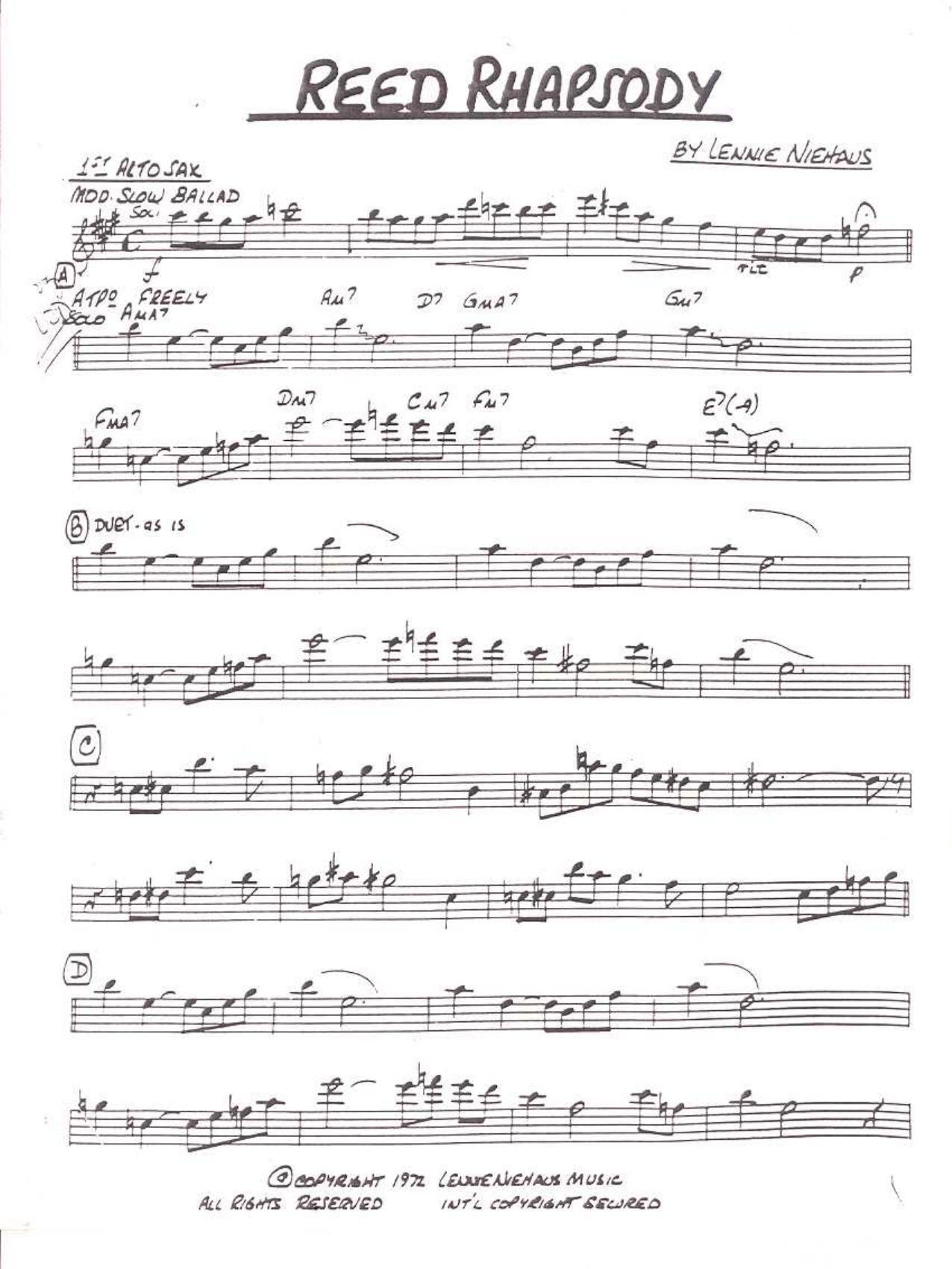
Reed Rhapsody (L.Niehaus) sheet music preview

Reed Rhapsody (L.Niehaus)

Composed by Lennie Niehaus

Arranged by Lennie Niehaus

  • Ensemble: Big Band
  • Pages: 33
  • Instruments (17): 1st Alto Sax, 2nd Alto Sax, 1st Tenor Sax, 2nd Tenor Sax, Baritone Sax, 1st Trumpet, 2nd Trumpet, 3rd Trumpet, 4th Trumpet, 1st Trombone, 2nd Trombone, 3rd Trombone, 4th Trombone, Piano, Guitar, Bass, Drums
  • Difficulty: medium
  • Content: Individual Parts
  • Format: PDF Download (Instant)
  • Price: $24.99

Lennie Niehaus’s "Reed Rhapsody" stands as a quintessential testament to West Coast jazz sophistication, capturing the cool, harmonically rich, and intricately counterpointed ethos that defined the California jazz scene of the 1950s and beyond. As an alto saxophonist and legendary staff arranger for Stan Kenton—as well as a prolific film and television composer—Niehaus mastered the art of writing idiomatically for horns with a lightness of touch and a rigorous counterpoint derived from his classical background. This composition reflects an era when modern jazz big bands began exploring cooler, linear textures without sacrificing the driving, underlying pulse of straight-ahead swing. Driven by an infectious, buoyant medium-up swing feel, "Reed Rhapsody" opens with an inviting rhythmic pulse that immediately showcases Niehaus’s signature gift for bright, optimistic melodies. The harmonic language is steeped in sophisticated bebop extensions—utilizing major sevenths, ninths, and clever chromatic passing tones—yet the overall mood remains remarkably transparent and breezy. Rather than relying solely on heavy brass blasts, the energy is propelled by crisp articulation, agile horn lines, and a conversational interplay between the rhythm section and the horn tiers. The arrangement evokes the sunny, polished atmosphere of a West Coast jazz club, balancing intellectual compositional rigor with an effortless, swinging charm. True to its title, Niehaus grants the reed section a starring role, crafting gorgeous multi-part solis that demand pristine intonation, seamless blend, and light, articulated phrasing. The arrangement features intricate writing where the alto and tenor saxophones weave tightly knit countermelodies around the lead lines, while the baritone sax anchors the lower register with warm, nimble bass-line support. Trumpets and trombones are deployed judiciously, providing brass punctuation and rich harmonic padding rather than constant overwhelming volume. The shout chorus builds organically, utilizing linear development and subtle dynamic shading rather than sheer brute force, leading into a satisfying, high-energy climax that highlights Niehaus's structural elegance. Executing this chart successfully requires a mature, rhythmically precise ensemble capable of handling West Coast style’s demand for understated drive and transparent textures. Advanced high school jazz ensembles with strong reed sections, college bands looking to refine their swing articulation and section blend, and professional or community big bands seeking a sophisticated change of pace will find this piece deeply rewarding. The technical challenges lie primarily in the nimble, scalar passages of the reed soli and the necessity for uniform articulation across all players, making it an exceptional vehicle for developing stylistic polish, section unity, and linear phrasing in a classic mid-century jazz idiom. Rehearsing "Reed Rhapsody" successfully hinges on achieving a lightweight, West Coast swing feel where eighth notes are played with a relaxed, forward-moving interpretation rather than a heavy, accented downbeat. The tempo should be kept moderate and steady; pushing it too fast will muddy the intricate counterpoint and compromise the breezy character of the lines. Conductor focus should initially center on the reed section, ensuring that the multi-part solis are balanced internally before layering in the brass punctuations. Trumpets and trombones must approach their background figures with extreme restraint, using a warm, fat tone that supports rather than overpowers the saxophones. Pay close attention to articulation markings: short notes must be clipped and clean, while legato lines require smooth, connected air support. Section leaders should run isolated spots of the rhythm section alongside the horns to lock in the agile bass lines and syncopated comping patterns characteristic of Niehaus’s sophisticated writing style. Q: What instruments and parts are included in this arrangement? A: This arrangement is scored for an 8-instrument big band instrumentation, featuring Alto Saxophone, Tenor Saxophone, Baritone Saxophone, Trumpet, and Trombone parts, alongside a complete rhythm section. Q: What is the difficulty level of "Reed Rhapsody"? A: This chart is best suited for advanced high school, collegiate, and professional jazz ensembles due to its dense, linear counterpoint, agile reed soli demands, and requirement for precise stylistic articulation. Q: What musical style and historical context does this piece represent? A: Composed by Lennie Niehaus, this arrangement exemplifies the sophisticated West Coast "cool" jazz style of the 1950s, blending bebop-inspired harmonies with transparent textures and linear elegance. Q: What makes this specific Lennie Niehaus arrangement unique? A: Its uniqueness lies in the brilliant spotlight given to the reed section through intricate, multi-part solis and conversational counterpoint, utilizing brass primarily for harmonic color and subtle punctuation rather than continuous heavy volume. Q: What is the approximate performance duration and tempo feel? A: The arrangement is written in a buoyant 4/4 meter with a medium-up swing tempo feel, typically clocking in around 3 to 4 minutes depending on the chosen tempo and soloist rotations.

Questions and answers

What is included in the Reed Rhapsody (L.Niehaus) PDF?
The verified current file contains individual parts across 33 pages.
How many instruments or parts are listed for Reed Rhapsody (L.Niehaus)?
The verified instrumentation list contains 17 entries for this Big Band arrangement.
Who is credited for Reed Rhapsody (L.Niehaus)?
Composer: Lennie Niehaus. Arranger: Lennie Niehaus.
What difficulty is listed for Reed Rhapsody (L.Niehaus)?
The verified difficulty level is medium.
Can I preview Reed Rhapsody (L.Niehaus) before buying?
Yes. The product page provides a preview generated from the current PDF file.
How is Reed Rhapsody (L.Niehaus) delivered?
After successful payment, the digital PDF is made available for download. The displayed price is $24.99.

Musicians Also Search For

Reed Rhapsody Lennie Niehaus PDFReed Rhapsody Lennie Niehaus sheet musicReed Rhapsody arranged by Lennie NiehausLennie Niehaus big band chartsLennie Niehaus jazz arrangements PDFReed Rhapsody Lennie Niehaus big band arrangementsReed Rhapsody big band arrangementsReed Rhapsody big band PDF downloadReed Rhapsody jazz sheet musicbig band sheet music downloadReed Rhapsody individual parts downloadReed Rhapsody sheet music PDFbuy Reed Rhapsody sheet musicdownload Reed Rhapsody PDFReed Rhapsody jazz chartsbest Lennie Niehaus big band arrangementsReed Rhapsody printable sheet musicbig band repertoire PDF

All arrangements by Lennie Niehaus All Lennie Niehaus sheet music