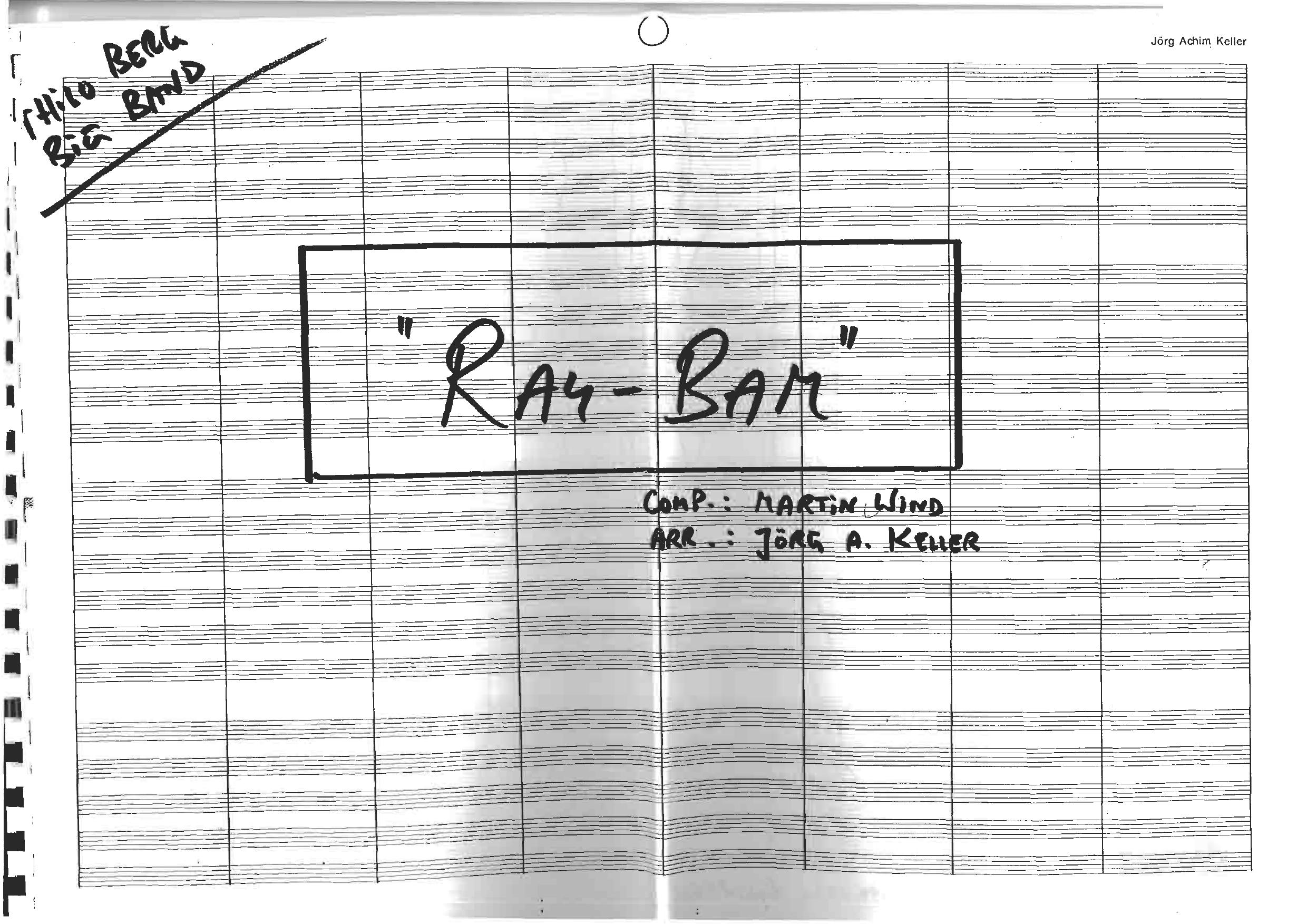
Ray Bam (J.Keller)
Composed by Jim Keller
Arranged by J.Keller
- Ensemble: Big Band
- Style: Jazz Standard
- Pages: 63
- Instruments (17): Alto Saxophone 1, Alto Saxophone 2, Tenor Saxophone 1, Tenor Saxophone 2, Baritone Saxophone, Trumpet 1, Trumpet 2, Trumpet 3, Trumpet 4, Trombone 1, Trombone 2, Trombone 3, Trombone 4, Guitar, Piano, Bass, Drums
- Difficulty: advanced
- Content: Individual Parts
- Format: PDF Download (Instant)
- Price: $24.99
Jim Keller’s distinctive compositional voice finds its ultimate big band expression in "Ray Bam," a sophisticated modern jazz standard that bridges the gap between classic post-bop harmonic exploration and contemporary large-ensemble propulsion. Rooted in the rich tradition of late-twentieth-century writers who pushed the boundaries of standard big band voicings, the piece reflects an era where modal flexibility and driving rhythmic counterpoint began to dominate progressive jazz composition. While drawing inspiration from the swinging vitality of the Vanguard Jazz Orchestra and the intricate sectional writing of Bob Brookmeyer, "Ray Bam" maintains an entirely singular identity defined by its unpredictable melodic turns and rich harmonic landscape. Propelled by an infectious, driving medium-up swing groove in 4/4 time, the arrangement opens with an urgent, angular head statement that immediately establishes an atmosphere of tense, sophisticated energy. The mood shifts fluidly between aggressive, brass-heavy punctuations and lush, harmonically dense woodwind interludes that evoke a cinematic sense of urban motion. J.Keller utilizes a contemporary palette characterized by extended tertian structures, chromatic mediant relationships, and tight, cluster-based saxophone solis that demand absolute precision. The writing shuns predictable cadence points, instead favoring deceptive resolutions that keep both the performers and the audience intensely engaged from the downbeat of the chart to the final suspended chord. J.Keller’s arrangement treats the standard big band 17-piece instrumentation as an interconnected chamber ensemble rather than a monolithic block of brass and reeds. The melodic weight is distributed democratically, passing fluidly from a sultry, harmonized saxophone section feature into roaring, interconnected brass counterlines. A standout feature of the chart is its meticulously crafted shout chorus, which builds systematically through interlocking rhythmic layers before exploding into a full-ensemble tutti that tests the dynamic range and endurance of the upper voices. Open solo sections are provided over accessible yet stimulating chord changes, allowing featured performers on tenor saxophone and trumpet to stretch out within a secure, high-energy harmonic framework. Advanced high school ensembles with strong section leaders, as well as collegiate and professional community jazz orchestras, will find this chart an exhilarating addition to their repertoire. While the technical demands—particularly regarding fast articulation in the brass and complex time-feel coordination within the rhythm section—are substantial, the reward lies in the natural logical flow of Keller’s voice leading. The included conductor score provides clear navigational signposts for managing the shifting metric accents and dynamic contours, ensuring that groups willing to invest rehearsal time will unlock a deeply satisfying, professional-grade performance experience. Conductors should approach "Ray Bam" with a strict focus on front-end articulation and rhythmic crispness within the rhythm section. The tempo must remain rock-solid; avoid rushing the peaks of the shout chorus, as the underlying tension relies heavily on a relaxed, driving pulse behind aggressive syncopations. Saxophones must blend tightly during the unison and close-harmony soli sections, ensuring that internal voices do not overpower the lead alto. Brass players should execute falls and doits with stylistic restraint—keeping them musical rather than theatrical—while plunger mutes in the trumpets require careful balance to match the open trombones. Rehearsals should initially isolate the complex cross-rhythms between the low reeds and the rhythm section before integrating the full ensemble, paying close attention to dynamic contrast to make the sudden modulations and harmonic shifts speak with maximum clarity. Q: What specific instruments and parts are included in the 17-instrument big band instrumentation for "Ray Bam"? A: The arrangement is scored for a standard 17-piece big band consisting of 5 saxophones (2 altos, 2 tenors, 1 baritone), 4 trumpets, 4 trombones, piano, guitar, acoustic/electric bass, and drum set, accompanied by a comprehensive conductor score across its 63 pages. Q: What is the overall difficulty level of J.Keller's arrangement of "Ray Bam"? A: This chart is graded as advanced (suitable for top-tier high school, collegiate, and professional jazz orchestras) due to its demanding technical passages, extended harmonic language, and intricate rhythmic synchronization requirements. Q: What musical style and historical context define "Ray Bam"? A: Written in the modern jazz standard idiom, the piece reflects the sophisticated post-bop and contemporary big band traditions popularized by writers bridging classic swing aesthetics with progressive harmonic exploration. Q: What makes this specific arrangement by J.Keller unique compared to other big band charts? A: Its uniqueness lies in Keller's chamber-like treatment of the 17-voice ensemble, featuring cluster-based saxophone solis, deceptive harmonic resolutions, and a structurally dynamic shout chorus that avoids predictable cadence points. Q: What is the approximate performance duration and tempo feel of the piece? A: "Ray Bam" is structured around an energetic, driving medium-up swing groove in 4/4 time, yielding a standard performance duration of approximately 5 to 6 minutes depending on the length of the open solo sections.
Questions and answers
- What is included in the Ray Bam (J.Keller) PDF?
- The verified current file contains a conductor score and individual parts across 63 pages.
- How many instruments or parts are listed for Ray Bam (J.Keller)?
- The verified instrumentation list contains 17 entries for this Big Band arrangement.
- Who is credited for Ray Bam (J.Keller)?
- Composer: Jim Keller. Arranger: J.Keller.
- What difficulty is listed for Ray Bam (J.Keller)?
- The verified difficulty level is advanced.
- What style is listed for Ray Bam (J.Keller)?
- The catalog lists the style as Jazz Standard.
- Can I preview Ray Bam (J.Keller) before buying?
- Yes. The product page provides a preview generated from the current PDF file.
- How is Ray Bam (J.Keller) delivered?
- After successful payment, the digital PDF is made available for download. The displayed price is $24.99.
Musicians Also Search For
Ray Bam J.Keller PDF • Ray Bam J.Keller sheet music • Ray Bam arranged by J.Keller • J.Keller big band charts • J.Keller jazz arrangements PDF • Ray Bam Jim Keller sheet music • Ray Bam Jim Keller big band arrangements • Jim Keller big band charts • Ray Bam big band arrangements • Ray Bam big band PDF download • Ray Bam jazz sheet music • big band sheet music download • Ray Bam conductor score PDF • Ray Bam individual parts download • Ray Bam sheet music PDF • Ray Bam Jazz Standard charts • Jazz Standard big band arrangements • buy Ray Bam sheet music • download Ray Bam PDF • Ray Bam jazz charts • best J.Keller big band arrangements • Jim Keller arranged by J.Keller • Ray Bam printable sheet music • big band repertoire PDF