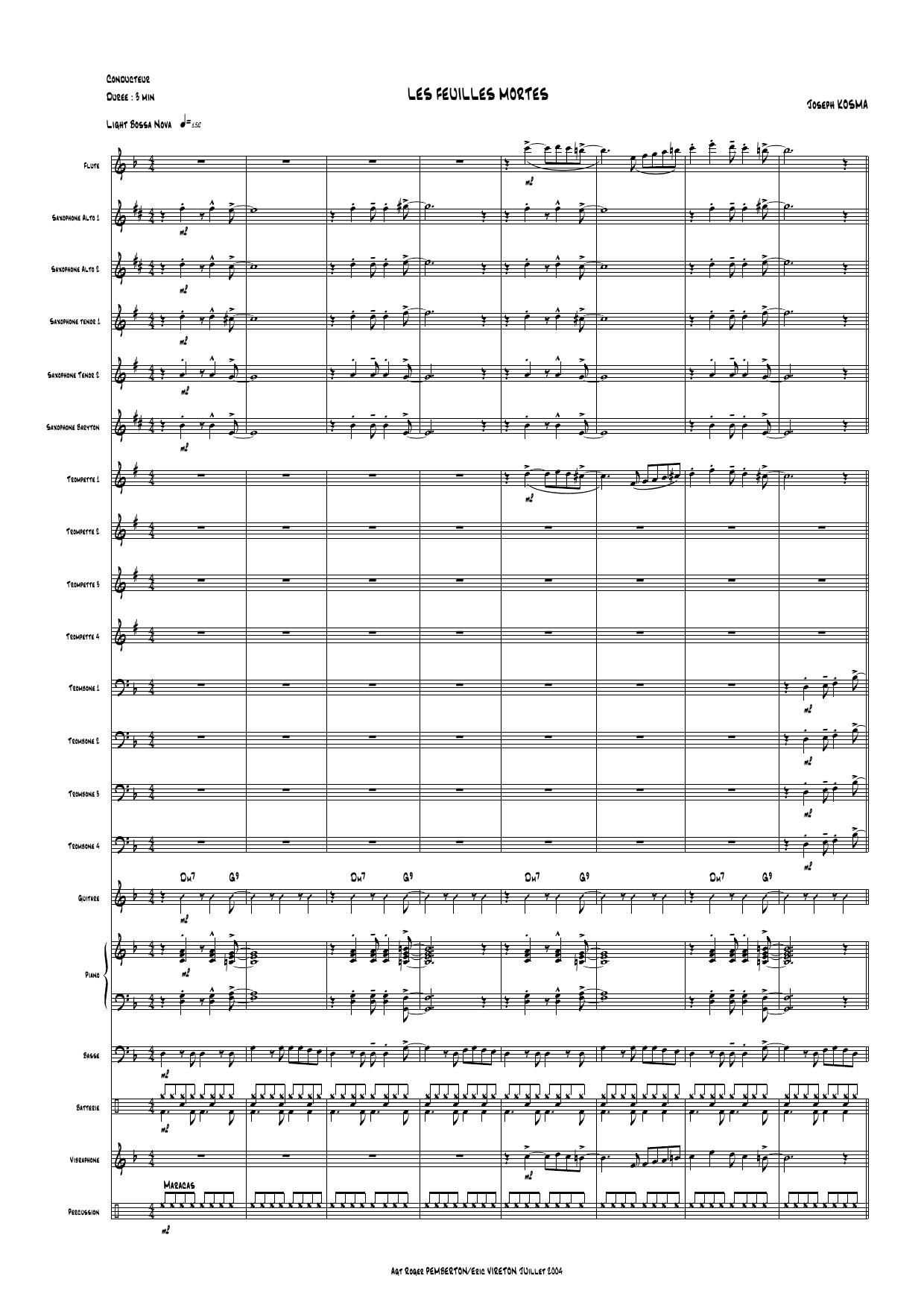
Les Feuilles Mortes (J.Kosma)
Composed by Joseph Kosma
Arranged by J.Kosma
- Ensemble: Big Band
- Style: Jazz Standard
- Pages: 56
- Instruments (20): Flute, Saxophone Alto 1, Saxophone Alto 2, Saxophone Tenor 1, Saxophone Tenor 2, Saxophone Baryton, Trompette 1, Trompette 2, Trompette 3, Trompette 4, Trombone 1, Trombone 2, Trombone 3, Trombone 4, Guitare, Basse, Batterie, Vibraphone, Percussion (Maracas - Congas), Piano
- Difficulty: advanced
- Content: Individual Parts
- Format: PDF Download (Instant)
- Price: $24.99
Originally penned in 1945 by composer Joseph Kosma with lyricist Jacques Prévert as "Les Feuilles Mortes" for Roland Petit’s ballet *Le Rendez-vous*, the haunting melody achieved immortal status after being popularized by Yves Montand and subsequently transformed into an American jazz cornerstone by the likes of Miles Davis, Cannonball Adderley, and Chet Baker. As "Autumn Leaves," this quintessential minor-key vehicle represents a masterclass in functional harmony, built upon a descending circle-of-fifths progression that invites both lyrical introspection and sophisticated modal exploration. It stands as one of the most performed and recorded standards in the entire jazz canon, serving as an essential rite of passage for improvisers navigating European-inflected melancholy fused with American swing sensibilities. Evoking a contemplative, autumnal atmosphere, this big band interpretation unfolds at a relaxed, smoldering medium-swing tempo that prioritizes lush harmonic textures and subtle dynamic shading over sheer velocity. Set primarily in a rich, resonant minor key tailored for optimal horn voicing, the arrangement balances bittersweet nostalgia with a lingering, sophisticated warmth. The harmonic landscape expands upon Kosma's original changes with extended upper-structure dominants and chromatic counterlines, creating a soundscape that feels simultaneously rooted in the mid-century cool tradition and refreshingly modern. The emotional trajectory shifts seamlessly from fragile, exposed vulnerability in the opening statements to a robust, harmonically dense ensemble density as the chart progresses. The orchestration brilliantly utilizes the full 21-piece big band palette, dividing thematic responsibilities with meticulous care. The woodwind doublings—featuring flute alongside traditional saxophones—introduce the head with an ethereal, impressionistic sheen before handing the primary melody to a velvety alto saxophone soli. Rather than relying on a generic shouting climax, the arranger builds tension through intricate horn-section interplays and a tightly wound counterpoint that showcases the lower reeds and muted brass. Improvised solo space is thoughtfully integrated, providing ample room for a featured tenor saxophone or trumpet to stretch out over standard changes, while carefully sculpted background figures maintain momentum without overcrowding the soloist. Advanced high school, collegiate, and professional jazz ensembles will find this 56-page publication to be a profoundly rewarding addition to their repertoire. While the individual technical demands for the brass and rhythm sections avoid extreme virtuosic hurdles, the true test lies in ensemble blend, intonation through tight voicing, and the sustain of a deep, languid groove. Conductors will appreciate the comprehensive nature of the included conductor score, which clarifies complex sectional balances and dynamic gradations. Ultimately, this chart offers audiences a deeply moving journey through a timeless melody, elevated by sophisticated arranging techniques that honor the European cinematic roots of the composition while celebrating the dynamic power of the modern big band. Achieving the authentic, bittersweet mood of this arrangement requires absolute precision in time-feel and dynamic restraint from the rhythm section. The underlying medium-swing groove must stay relaxed behind the beat, avoiding any tendency to rush during the minor-key modal turnarounds. Horn players should focus on a warm, vocal quality of sound, utilizing minimal vibrato on the exposed unison and soli passages to capture a cool-school aesthetic. Special attention must be paid to the dynamic markings; the contrast between the delicate flute-and-reed openings and the fuller, harmonically saturated ensemble swells creates the emotional arc of the chart. Brass players should keep mutes ready where indicated—cup or harmon mutes work best to achieve the desired intimate timbre during the middle choruses—and ensure that any background figures remain transparent, strictly supporting the featured soloist without muddying the harmonic texture. Q: What instruments and parts are included in this big band package? A: The complete 21-instrument ensemble instrumentation features parts for Flute, Alto Saxophone 1, Alto Saxophone 2, Tenor Saxophone 1, Tenor Saxophone 2, and additional standard big band sections, accompanied by a comprehensive 56-page conductor score. Q: What is the overall difficulty level of this arrangement? A: This chart is best suited for advanced high school, collegiate, and professional big bands that possess strong sectional control, precise intonation, and maturity in handling nuanced swing feels. Q: What style and historical era does this chart represent? A: It is rooted in the jazz standard tradition, bridging the gap between European cinematic melancholy of the 1940s and the sophisticated, cool-jazz harmonic approaches popularized by mid-century American jazz icons. Q: What makes this particular arrangement unique? A: It stands out through its sophisticated extended harmonies, subtle woodwind doublings featuring flute, and an impressionistic approach that avoids a standard loud shout chorus in favor of rich, textural counterpoint. Q: What is the recommended performance tempo and duration? A: The arrangement is designed for a relaxed, smoldering medium-swing tempo, resulting in a performance duration of approximately four to six minutes depending on the length of the improvised solos.
Questions and answers
- What is included in the Les Feuilles Mortes (J.Kosma) PDF?
- The verified current file contains a conductor score and individual parts across 56 pages.
- How many instruments or parts are listed for Les Feuilles Mortes (J.Kosma)?
- The verified instrumentation list contains 20 entries for this Big Band arrangement.
- Who is credited for Les Feuilles Mortes (J.Kosma)?
- Composer: Joseph Kosma. Arranger: J.Kosma.
- What difficulty is listed for Les Feuilles Mortes (J.Kosma)?
- The verified difficulty level is advanced.
- What style is listed for Les Feuilles Mortes (J.Kosma)?
- The catalog lists the style as Jazz Standard.
- Can I preview Les Feuilles Mortes (J.Kosma) before buying?
- Yes. The product page provides a preview generated from the current PDF file.
- How is Les Feuilles Mortes (J.Kosma) delivered?
- After successful payment, the digital PDF is made available for download. The displayed price is $24.99.
Musicians Also Search For
Les Feuilles Mortes J.Kosma PDF • Les Feuilles Mortes J.Kosma sheet music • Les Feuilles Mortes arranged by J.Kosma • J.Kosma big band charts • J.Kosma jazz arrangements PDF • Les Feuilles Mortes Joseph Kosma sheet music • Les Feuilles Mortes Joseph Kosma big band arrangements • Joseph Kosma big band charts • Les Feuilles Mortes big band arrangements • Les Feuilles Mortes big band PDF download • Les Feuilles Mortes jazz sheet music • big band sheet music download • Les Feuilles Mortes conductor score PDF • Les Feuilles Mortes individual parts download • Les Feuilles Mortes sheet music PDF • Les Feuilles Mortes Jazz Standard charts • Jazz Standard big band arrangements • buy Les Feuilles Mortes sheet music • download Les Feuilles Mortes PDF • Les Feuilles Mortes jazz charts • best J.Kosma big band arrangements • Joseph Kosma arranged by J.Kosma • Les Feuilles Mortes printable sheet music • big band repertoire PDF