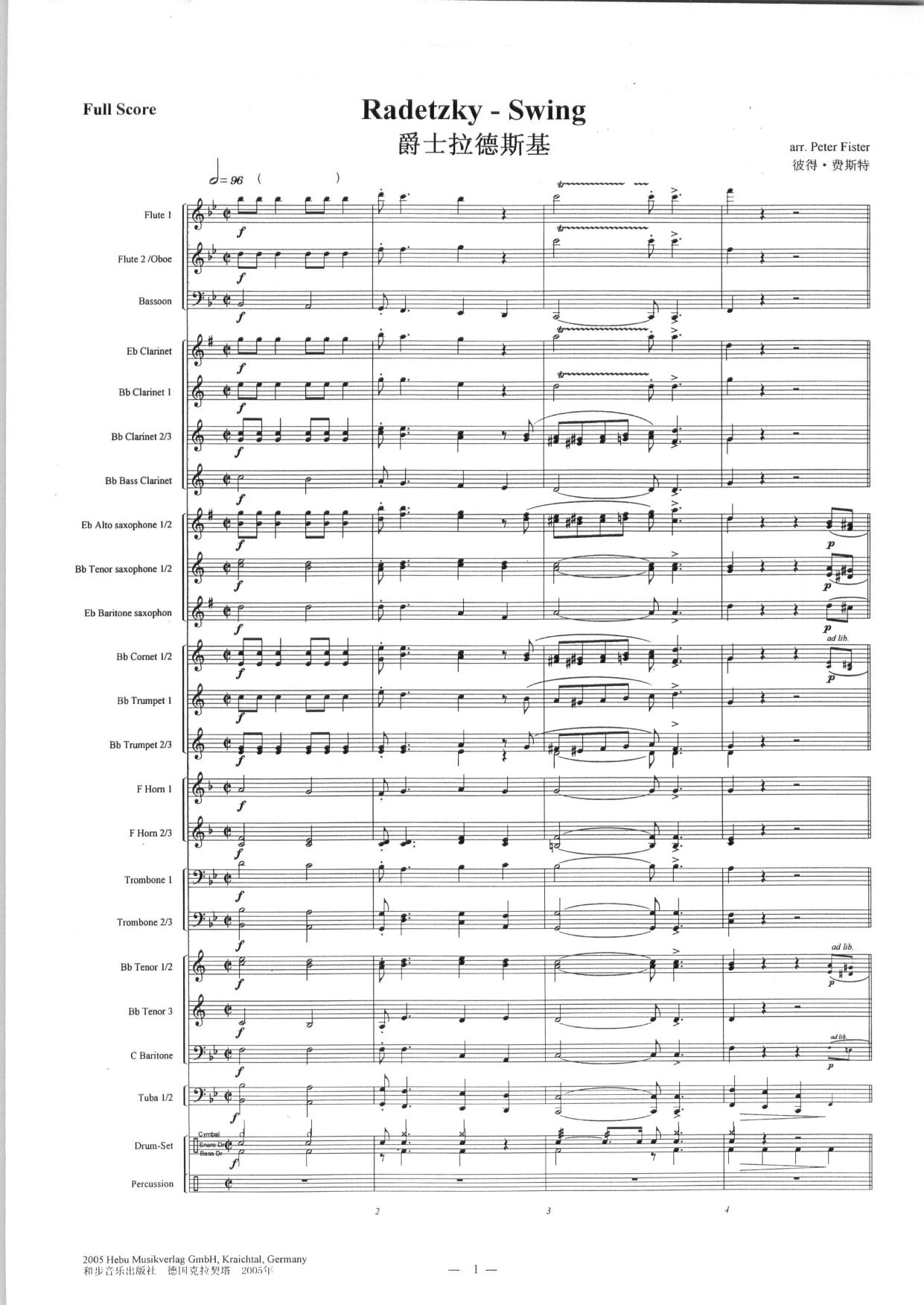
Radetzky Swing (P.Fister)
Composed by Johann Strauss Sr.
- Ensemble: Concert Band
- Pages: 42
- Instruments (27): Flute, Oboe, Eb Clarinet, Bassoon, 1st Clarinet, 2nd Clarinet, 3rd Clarinet, Bass Clarinet, 1st Alto Saxophone, 2nd Alto Saxophone, Tenor Saxophone, Baritone Saxophone, 1st Horn, 2nd & 3rd Horn, 1st Trumpet, Cornet, 2nd Trumpet, 3rd Trumpet, 1st Trombone, 2nd Trombone, 3rd Trombone, 1st & 2nd Tenor, 3rd Tenor, Baritone, Tuba, Percussion, Drum Set
- Difficulty: medium
- Content: Individual Parts
- Format: PDF Download (Instant)
- Price: $22.99
Johann Strauss Sr.'s iconic "Radetzky March," originally composed in 1848 to commemorate Field Marshal Joseph Radetzky von Radetz's victory at the Battle of Custoza, is a cornerstone of the classical repertoire, particularly famous for its rousing, celebratory nature and its traditional inclusion in the Vienna New Year's Concert. This arrangement, "Radetzky Swing (P.Fister)," masterfully recontextualizes the familiar martial strains into a vibrant jazz idiom, transforming its 19th-century European grandeur into a sophisticated, mid-20th-century American big band sound. While the original evoked military parades and imperial balls, this jazz interpretation captures the spirit of the swing era, blending historical reverence with undeniable modern flair. It's not a jazz standard in the traditional sense, but rather a brilliant reimagining that showcases the versatility and enduring appeal of Strauss's melody when placed in the hands of an inventive arranger. The musical character of "Radetzky Swing" is defined by a bright, medium-up swing feel, typically hovering around 160-180 BPM, maintaining the original's energetic pulse but reinterpreting it through a driving 4/4 jazz rhythm. The primary key, likely C Major or G Major, provides a familiar, accessible harmonic landscape, yet the arranger, P. Fister, introduces sophisticated jazz harmonies, including extended chords (9ths, 11ths, 13ths) and altered dominant voicings, adding depth and color. The mood is unequivocally joyful and celebratory, but with an underlying coolness characteristic of classic big band charts. The piece builds dynamically, moving from crisp, articulated ensemble passages to soaring soli sections, evoking a sense of playful grandeur and rhythmic vitality. P. Fister's distinctive approach to "Radetzky Swing" is evident in several key areas. The arrangement opens with the instantly recognizable main theme, but instead of a straight military march, it's presented with a swinging eighth-note feel, often voiced in the brass or saxophones with tight, harmonized lines. Soli sections for the saxophones are prominent, showcasing intricate melodic and rhythmic interplay that demands precision and blend. The arranger frequently employs call-and-response patterns between brass and woodwinds, injecting a conversational quality into the piece. A notable feature is the creative use of rhythmic displacement and syncopation, which keeps the familiar melody fresh and engaging. While there are no explicit solo sections indicated, the arrangement provides ample opportunities for individual players to shine within the ensemble context through exposed lines and technically demanding passages. The piece culminates in a powerful shout chorus that brings all sections together in a glorious, full-ensemble statement, followed by a driving coda that reaffirms its swinging energy. This arrangement is ideally suited for college and advanced high school concert bands, as well as community ensembles seeking a challenging yet highly rewarding piece that bridges classical tradition with jazz innovation. Its technical demands, particularly in articulation, rhythmic accuracy, and dynamic control, make it an excellent vehicle for developing ensemble cohesion and stylistic versatility. Conductors should establish a crisp, medium-up swing tempo (approx. 160-180 BPM) from the outset, emphasizing a light, buoyant feel rather than a heavy, driving one. Articulation is paramount; ensure all eighth notes swing consistently, and staccato markings are executed with precision and clarity, especially in the brass. The woodwind sections, particularly the clarinets and flutes, will need to maintain excellent intonation and blend during their exposed soli passages. Encourage a strong, unified dynamic contrast between the softer, lyrical moments and the powerful tutti sections. While no specific mutes are indicated, brass players should be prepared for quick, clean entrances and releases. Rehearsal time should focus on rhythmic accuracy in the syncopated figures and achieving a cohesive ensemble sound, particularly in the call-and-response sections and the final shout chorus. Q: What instruments are included in the "Radetzky Swing (P.Fister)" arrangement? A: This arrangement is scored for a 16-instrument concert band, including Flute, Oboe, Clarinet, Bass Clarinet, Alto Saxophone, and other standard concert band instrumentation, spread across 42 pages of music. Q: What is the difficulty level of "Radetzky Swing (P.Fister)"? A: This arrangement is considered advanced high school to college/community level, requiring strong technical proficiency, rhythmic accuracy, and stylistic understanding from all sections. Q: What is the musical style and historical context of this arrangement? A: "Radetzky Swing" is a jazz arrangement of Johann Strauss Sr.'s 1848 "Radetzky March," transforming the original classical military march into a vibrant, medium-up swing piece reminiscent of mid-20th century big band jazz. Q: What makes this particular arrangement unique compared to other versions of the "Radetzky March"? A: P. Fister's arrangement uniquely reharmonizes the classical melody with sophisticated jazz voicings, incorporates intricate saxophone soli sections, and utilizes rhythmic displacement and syncopation to create a fresh, swinging interpretation of the familiar theme. Q: What is the typical performance duration and tempo for "Radetzky Swing (P.Fister)"? A: While specific duration can vary, this piece typically performs for 3-4 minutes at a medium-up swing tempo, generally between 160-180 beats per minute.
Questions and answers
- What is included in the Radetzky Swing (P.Fister) PDF?
- The verified current file contains a conductor score and individual parts across 42 pages.
- How many instruments or parts are listed for Radetzky Swing (P.Fister)?
- The verified instrumentation list contains 27 entries for this Concert Band arrangement.
- Who is credited for Radetzky Swing (P.Fister)?
- Composer: Johann Strauss Sr..
- What difficulty is listed for Radetzky Swing (P.Fister)?
- The verified difficulty level is medium.
- Can I preview Radetzky Swing (P.Fister) before buying?
- Yes. The product page provides a preview generated from the current PDF file.
- How is Radetzky Swing (P.Fister) delivered?
- After successful payment, the digital PDF is made available for download. The displayed price is $22.99.
Musicians Also Search For
Radetzky Swing Johann Strauss Sr. sheet music • Radetzky Swing Johann Strauss Sr. concert band arrangements • Johann Strauss Sr. concert band charts • Radetzky Swing concert band arrangements • Radetzky Swing concert band PDF download • Radetzky Swing jazz sheet music • concert band sheet music download • Radetzky Swing conductor score PDF • Radetzky Swing individual parts download • Radetzky Swing sheet music PDF • buy Radetzky Swing sheet music • download Radetzky Swing PDF • Radetzky Swing jazz charts • Radetzky Swing printable sheet music • concert band repertoire PDF