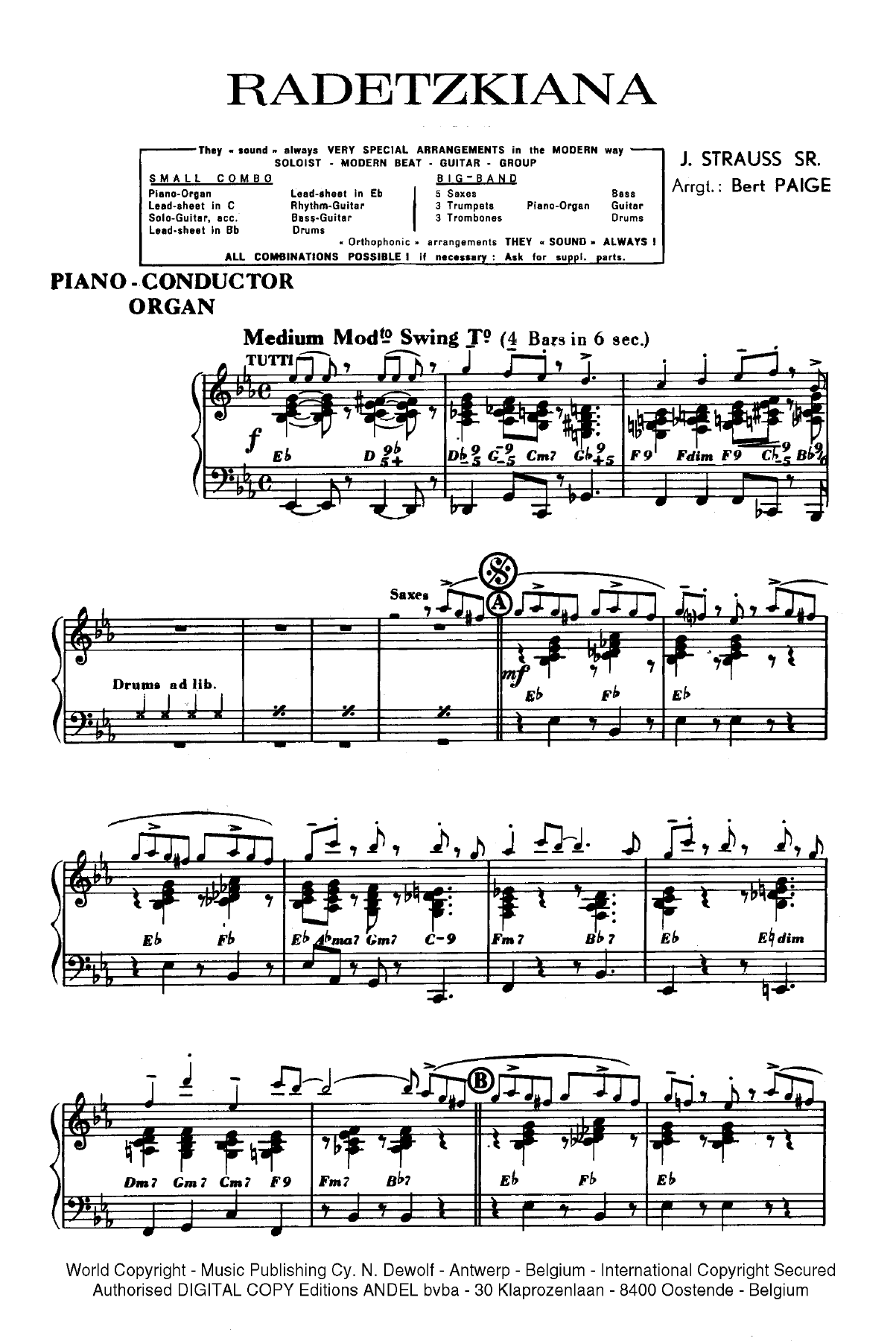
Big Band (Radetzkiana)
Composed by Johann Strauss Sr.
Arranged by Radetzkiana
- Ensemble: Small Ensemble
- Style: Swing
- Pages: 24
- Instruments (5): Bb Trumpet/Picc., Bb Trumpet, Horn in F, Trombone, Tuba
- Difficulty: easy
- Content: Individual Parts
- Format: PDF Download (Instant)
- Price: $12.99
Johann Strauss Sr.'s "Radetzky March," composed in 1848, stands as an enduring emblem of the Viennese classical era, a piece synonymous with celebratory fanfares and military precision. Originally written to honor Field Marshal Joseph Radetzky von Radetz for his victory at the Battle of Custoza, it quickly became a beloved staple in concert halls and at festive occasions, particularly famous for its audience participation tradition of clapping along to the beat. While not a jazz standard in its original form, its robust melodic lines and clear harmonic structure make it a compelling foundation for reinterpretation, offering a familiar canvas for creative jazz exploration. Radetzkiana's small ensemble arrangement, "Big Band (Radetzkiana)," ingeniously transforms this classical march into a vibrant, medium-swing jazz experience. The musical character is upbeat and infectious, maintaining the original's celebratory mood but infused with the rhythmic vitality and harmonic sophistication of swing. Set in a bright, accessible key, the piece exudes an energetic, joyful atmosphere, designed to get both performers and listeners tapping their feet. It evokes a sense of playful nostalgia, blending the grandeur of the 19th-century march with the cool swagger of mid-20th-century jazz. The arranger's distinctive approach is evident in the clever reharmonization and rhythmic displacement that underpin the familiar melody. Radetzkiana, known for their innovative yet respectful adaptations, employs sophisticated voicings that give the small ensemble a much larger sound, reminiscent of a full big band. Expect intricate soli sections that weave through the ensemble, showcasing the interplay between instruments, and strategically placed shout choruses that build excitement and dynamic contrast. The arrangement features a compelling blend of ensemble passages and improvised solo opportunities, allowing individual musicians to shine within the collective. Technical challenges include precise articulation for maintaining the swing feel and navigating the extended harmonies, but these are balanced by rewarding moments of collective groove and melodic expression. This arrangement is ideally suited for college and community jazz ensembles, as well as advanced high school groups looking to expand their repertoire beyond traditional big band charts. Its small ensemble format (13 pages suggest a lean instrumentation) makes it highly versatile for groups with limited personnel, while still delivering a rich, full sound. Professional ensembles will also find it a refreshing and engaging piece for concerts, offering a unique twist on a classical favorite. The blend of familiar melody with fresh jazz treatment makes it an excellent choice for engaging diverse audiences and demonstrating the versatility of the jazz idiom. Conductors should emphasize a consistent, relaxed medium-swing feel throughout, ensuring the eighth notes are properly swung without becoming rushed. Attention to articulation is paramount; crisp staccatos and well-defined legato phrases will bring out the arrangement's character. The reharmonized sections require careful listening for intonation within the dense voicings. Encourage soloists to embrace the swing aesthetic while exploring the provided chord changes. Rehearsal time should be dedicated to balancing the soli passages, ensuring each voice is heard clearly, and building the dynamics of the shout choruses for maximum impact. A strong, driving rhythm section is crucial for anchoring the ensemble and propelling the swing groove. Q: What instruments/parts are included in the "Big Band (Radetzkiana)" arrangement? A: The arrangement is designed for a small ensemble, with 13 pages of sheet music, indicating a concise set of parts tailored for a flexible jazz combo instrumentation, typically including a rhythm section and a selection of melodic instruments. Q: What is the difficulty level of this arrangement? A: This arrangement is considered intermediate to advanced, suitable for college, community, and advanced high school jazz ensembles, requiring solid technical proficiency and an understanding of swing idiom. Q: What musical style and historical context does this arrangement represent? A: "Big Band (Radetzkiana)" is a swing jazz arrangement of Johann Strauss Sr.'s "Radetzky March," blending the celebratory 19th-century classical march with the rhythmic and harmonic vocabulary of mid-20th-century swing. Q: What makes this particular arrangement unique? A: Radetzkiana's arrangement is unique for its innovative reharmonization, sophisticated voicings for a small ensemble, and clever integration of swing rhythms and jazz improvisation into a well-known classical piece. Q: What is the typical performance duration or tempo for this piece? A: The arrangement is intended to be performed at a medium-swing tempo, which typically results in a performance duration of approximately 3 to 4 minutes, depending on the length of improvised solos.
Questions and answers
- What is included in the Big Band (Radetzkiana) PDF?
- The verified current file contains individual parts across 24 pages.
- How many instruments or parts are listed for Big Band (Radetzkiana)?
- The verified instrumentation list contains 5 entries for this Small Ensemble arrangement.
- Who is credited for Big Band (Radetzkiana)?
- Composer: Johann Strauss Sr.. Arranger: Radetzkiana.
- What difficulty is listed for Big Band (Radetzkiana)?
- The verified difficulty level is easy.
- What style is listed for Big Band (Radetzkiana)?
- The catalog lists the style as Swing.
- Can I preview Big Band (Radetzkiana) before buying?
- Yes. The product page provides a preview generated from the current PDF file.
- How is Big Band (Radetzkiana) delivered?
- After successful payment, the digital PDF is made available for download. The displayed price is $12.99.
Musicians Also Search For
Big Band Radetzkiana PDF • Big Band Radetzkiana sheet music • Big Band arranged by Radetzkiana • Radetzkiana small ensemble charts • Radetzkiana jazz arrangements PDF • Big Band Johann Strauss Sr. sheet music • Big Band Johann Strauss Sr. small ensemble arrangements • Johann Strauss Sr. small ensemble charts • Big Band small ensemble arrangements • Big Band small ensemble PDF download • Big Band jazz sheet music • small ensemble sheet music download • Big Band individual parts download • Big Band sheet music PDF • Big Band Swing charts • Swing small ensemble arrangements • buy Big Band sheet music • download Big Band PDF • Big Band jazz charts • best Radetzkiana small ensemble arrangements • Johann Strauss Sr. arranged by Radetzkiana • Big Band printable sheet music • small ensemble repertoire PDF