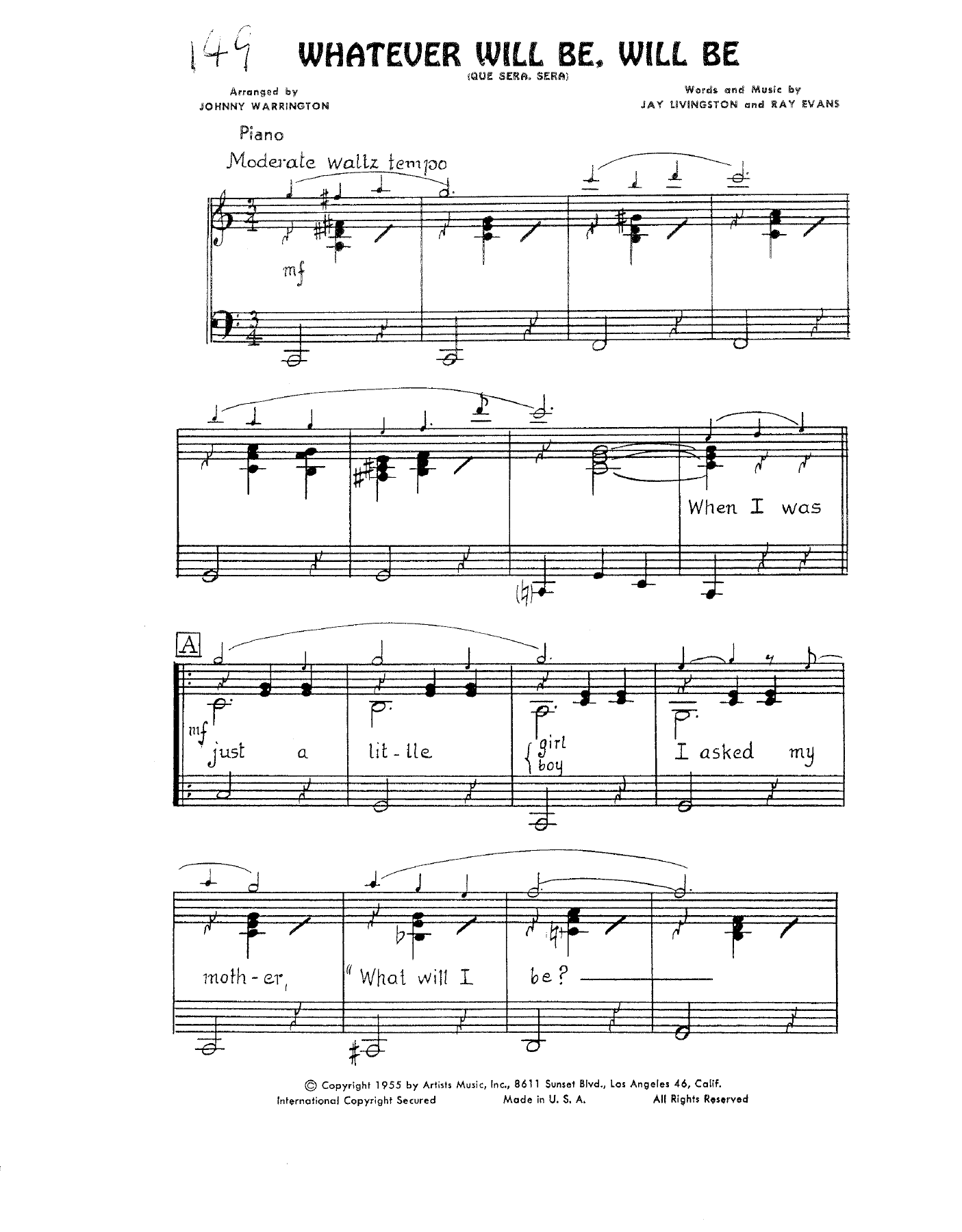
Que Sera Sera (J.Warrington)
Composed by Jay Livingston, Ray Evans
Arranged by Johnny Warrington
- Ensemble: Big Band
- Style: Waltz
- Pages: 33
- Instruments (16): Piano, Bass, Guitar, Drums, 1st Violins, 1st Saxophone Eb Alto, 3rd Saxophone Eb Alto, 2nd Saxophone Bb Tenor, 4th Saxophone Bb Tenor, Baritone Saxophone, 1st Trombone, 2nd Trombone, 3rd Trombone, 1st Trumpet in Bb, 2nd Trumpet in Bb, 3rd Trumpet in Bb
- Difficulty: medium
- Content: Individual Parts
- Format: PDF Download (Instant)
- Price: $24.99
"Que Sera Sera (Whatever Will Be, Will Be)" emerged as an iconic song from the 1956 Alfred Hitchcock film *The Man Who Knew Too Much*, famously performed by Doris Day. Its immediate popularity earned it an Academy Award for Best Original Song and cemented its place in mid-20th century popular culture. While not a traditional jazz standard, its melodic simplicity and enduring appeal made it ripe for interpretation across various genres, including big band. The song's optimistic, reflective lyrics and waltz-time structure evoke a sense of nostalgic charm, characteristic of the post-war era's family-friendly entertainment and musical sensibilities. This arrangement by Johnny Warrington transforms the beloved tune into a sophisticated big band waltz, offering a fresh perspective on a familiar classic. Johnny Warrington’s arrangement of "Que Sera Sera" is a masterclass in big band scoring, reimagining the original's gentle 3/4 feel into a vibrant, medium-tempo jazz waltz. The piece is set primarily in the key of F Major, maintaining the song's inherent brightness while introducing a rich harmonic palette. Warrington, known for his meticulous voicings and ability to craft arrangements that are both accessible and musically engaging, imbues this chart with a sophisticated yet swinging character. The melody is initially presented by the alto saxophone, often doubled by a trumpet, creating a warm, inviting timbre. As the arrangement progresses, Warrington employs his signature tight voicings across the saxophone section, delivering lush soli passages that are both harmonically interesting and rhythmically precise. A distinctive feature of Warrington's approach here is the strategic use of dynamic contrasts and textural shifts. He builds the arrangement through carefully orchestrated swells and releases, leading to a powerful, yet never overpowering, shout chorus. This section features the full ensemble, with brass figures punctuating the saxophone lines, creating a glorious wall of sound that is both exhilarating and true to the song's melodic core. While there are no explicit written solos, the arrangement provides ample opportunity for individual sections to shine through their ensemble playing. The technical demands are moderate, focusing more on blend, balance, and rhythmic precision within the waltz feel rather than virtuosic improvisation. The chart culminates in a full-ensemble restatement of the theme, leaving the audience with the song's memorable refrain ringing in their ears. This arrangement is ideally suited for high school, college, and community jazz ensembles looking to expand their repertoire with a well-crafted, recognizable tune that offers significant educational and performance value. It provides an excellent vehicle for developing ensemble cohesion, dynamic control, and a nuanced understanding of the jazz waltz feel. The rewarding performance lies in achieving the seamless flow of the 3/4 meter, the precision of the section work, and the expressive delivery of the melody. It’s a chart that audiences will instantly connect with, while musicians will appreciate Warrington's thoughtful and elegant scoring. This arrangement demands a precise yet flowing medium jazz waltz feel, with a consistent emphasis on the "one" of each measure without becoming rigid. Conductors should encourage a light, buoyant articulation, particularly in the saxophone soli sections, ensuring clarity and blend. The primary technical challenge lies in maintaining the 3/4 swing pulse consistently across all sections, avoiding any tendency to rush or drag. Brass players should focus on clean attacks and releases, particularly in the shout chorus, where dynamic control is paramount to prevent overblowing. Rehearsal should prioritize rhythmic accuracy, intonation within the tight voicings, and careful attention to Warrington's dynamic markings to build the arrangement's emotional arc effectively. No special techniques like plunger mutes or extended ranges are required, making it accessible for a wide range of ensembles. Q: What instruments and parts are included in this arrangement? A: This arrangement is scored for a standard 17-instrument big band, including Alto Saxophone 1 & 2, Tenor Saxophone 1 & 2, Baritone Saxophone, Trumpet 1-4, Trombone 1-4, Piano, Bass, Drums, and Guitar. Q: What is the difficulty level of "Que Sera Sera (J.Warrington)"? A: This arrangement is rated as a medium-easy to medium difficulty, making it appropriate for high school, college, and community jazz ensembles. It focuses on ensemble blend and rhythmic precision rather than advanced technical solos. Q: What is the musical style and historical context of this arrangement? A: This is a big band jazz waltz arrangement of "Que Sera Sera," a popular song from 1956, famous for its performance by Doris Day. It reimagines the classic tune with a sophisticated mid-20th century big band sound. Q: What makes Johnny Warrington's arrangement of "Que Sera Sera" unique? A: Warrington's distinctive approach includes lush saxophone soli sections, tight brass voicings, and a carefully crafted dynamic build-up to a powerful shout chorus, all while maintaining the song's charming waltz feel. Q: What is the typical performance duration and tempo for this piece? A: The typical performance duration is approximately 3:00-3:30 minutes. It should be performed at a medium jazz waltz tempo, around 130-140 beats per minute, emphasizing a flowing and buoyant 3/4 swing feel.
Questions and answers
- What is included in the Que Sera Sera (J.Warrington) PDF?
- The verified current file contains individual parts across 33 pages.
- How many instruments or parts are listed for Que Sera Sera (J.Warrington)?
- The verified instrumentation list contains 16 entries for this Big Band arrangement.
- Who is credited for Que Sera Sera (J.Warrington)?
- Composer: Jay Livingston, Ray Evans. Arranger: Johnny Warrington.
- What difficulty is listed for Que Sera Sera (J.Warrington)?
- The verified difficulty level is medium.
- What style is listed for Que Sera Sera (J.Warrington)?
- The catalog lists the style as Waltz.
- Can I preview Que Sera Sera (J.Warrington) before buying?
- Yes. The product page provides a preview generated from the current PDF file.
- How is Que Sera Sera (J.Warrington) delivered?
- After successful payment, the digital PDF is made available for download. The displayed price is $24.99.
Musicians Also Search For
Que Sera Sera Johnny Warrington PDF • Que Sera Sera Johnny Warrington sheet music • Que Sera Sera arranged by Johnny Warrington • Johnny Warrington big band charts • Johnny Warrington jazz arrangements PDF • Que Sera Sera Jay Livingston, Ray Evans sheet music • Que Sera Sera Jay Livingston, Ray Evans big band arrangements • Jay Livingston, Ray Evans big band charts • Que Sera Sera big band arrangements • Que Sera Sera big band PDF download • Que Sera Sera jazz sheet music • big band sheet music download • Que Sera Sera individual parts download • Que Sera Sera sheet music PDF • Que Sera Sera Waltz charts • Waltz big band arrangements • buy Que Sera Sera sheet music • download Que Sera Sera PDF • Que Sera Sera jazz charts • best Johnny Warrington big band arrangements • Jay Livingston, Ray Evans arranged by Johnny Warrington • Que Sera Sera printable sheet music • big band repertoire PDF