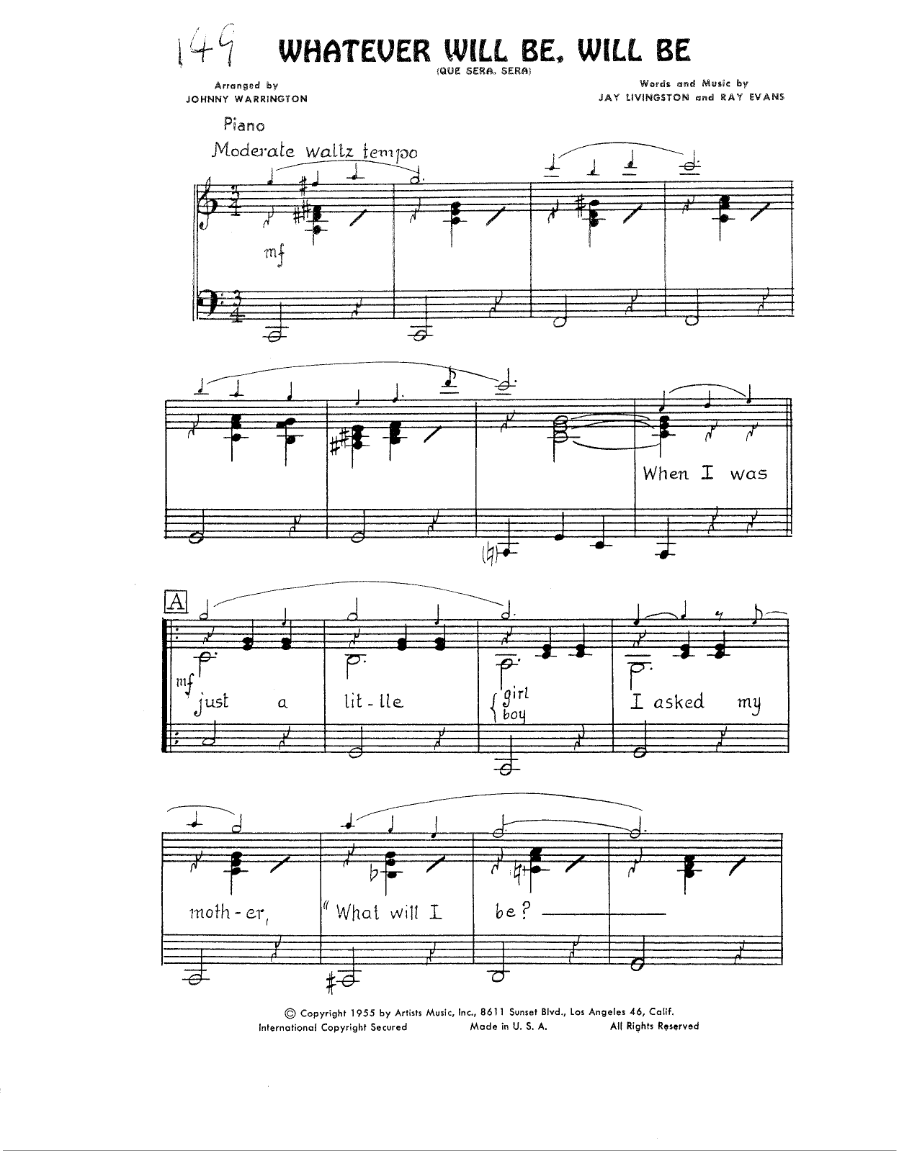
Whatever Will Be, Will Be (J.Warrington)
Composed by Jay Livingston, Ray Evans
Arranged by Johnny Warrington
- Ensemble: Big Band
- Style: Waltz
- Pages: 33
- Instruments (17): Alto Saxophone 1, Alto Saxophone 2, Tenor Saxophone 1, Tenor Saxophone 2, Baritone Saxophone, Trumpet 1, Trumpet 2, Trumpet 3, Trumpet 4, Trombone 1, Trombone 2, Trombone 3, Bass Trombone, Piano, Bass, Drums, Guitar
- Difficulty: medium
- Content: Individual Parts
- Format: PDF Download (Instant)
- Price: $24.99
Originally penned by the prolific songwriting duo Jay Livingston and Ray Evans, "Que Sera, Sera (Whatever Will Be, Will Be)" achieved global fame in 1956 through Doris Day's iconic performance in Alfred Hitchcock's film, *The Man Who Knew Too Much*. This charming waltz, a quintessential example of mid-20th-century pop sensibilities, quickly transcended its film origins to become a beloved standard, emblematic of an era characterized by optimism and a touch of nostalgic sentimentality. Its simple, memorable melody and philosophical lyrics about embracing the unknown resonated deeply, cementing its place in the popular music canon. While not traditionally a jazz standard, its enduring popularity and accessible structure have made it an attractive canvas for jazz arrangers seeking to infuse familiar melodies with sophisticated big band textures. Johnny Warrington’s arrangement masterfully transforms this classic into a captivating big band waltz, maintaining its inherent charm while elevating it with his characteristic harmonic richness and orchestral flair. The piece unfolds at a graceful, medium waltz tempo (3/4 time), establishing a relaxed yet flowing groove from the outset. Warrington’s signature style is immediately evident in the lush, often close-voiced harmonies that permeate the brass and saxophone sections, creating a warm, inviting soundscape. The mood is one of elegant sophistication and gentle nostalgia, evoking images of a classic ballroom or a refined concert hall. The arrangement artfully balances the melody's inherent simplicity with intricate counter-melodies and rhythmic interplay, ensuring sustained interest throughout. Warrington’s treatment features the melody prominently, initially presented by the lead alto saxophone, often doubled or harmonized by other saxophones, lending a smooth, vocal quality. Subsequent sections see the melody passed to the trumpet section, offering a brighter, more assertive statement, before returning to the full ensemble. While there are no extended improvised solo sections in this particular arrangement, Warrington skillfully integrates short, melodic fills and obligatos from various instruments, particularly the trombones and tenor saxophones, which add a jazz-inflected sparkle without disrupting the waltz feel. The arrangement builds dynamically towards a full-ensemble shout chorus, where the familiar melody is presented with maximum power and harmonic density, showcasing the full capabilities of the big band. This arrangement is ideally suited for college, community, and advanced high school jazz ensembles. Its technical demands are moderate, focusing more on blend, balance, and rhythmic precision within the 3/4 meter than on extreme ranges or rapid-fire articulation. The rewarding aspect lies in achieving the rich, cohesive sound Warrington intended, allowing the ensemble to explore expressive dynamics and articulate the nuanced harmonic voicings. It provides an excellent opportunity for bands to develop their ensemble playing in a lyrical, non-swing context, expanding their repertoire beyond traditional jazz forms and offering a delightful and recognizable piece for audiences. This arrangement calls for a refined, flowing waltz feel at a medium tempo, typically around quarter note = 130-140 BPM. Conductors should emphasize a strong, yet not heavy, pulse in 3/4, encouraging musicians to lean into the second beat slightly to enhance the dance-like quality. Key technical challenges include maintaining precise rhythmic accuracy in the ensemble figures, especially during the harmonized saxophone and brass soli sections, and achieving a balanced blend across the full 17-instrument instrumentation. Pay close attention to Warrington's dynamic markings, which are crucial for shaping the piece's emotional arc. Rehearsal should focus on intonation within the often close-voiced harmonies, particularly in the saxophone section, and ensuring clear articulation without sacrificing the lyrical flow. No special techniques like plunger mutes or falls are explicitly notated, allowing the focus to remain on the ensemble's collective musicality and expressive phrasing. Q: What instruments are included in this arrangement? A: This arrangement is scored for a standard 17-piece big band: Alto Saxophone 1, Alto Saxophone 2, Tenor Saxophone 1, Tenor Saxophone 2, Baritone Saxophone, Trumpet 1, Trumpet 2, Trumpet 3, Trumpet 4, Trombone 1, Trombone 2, Trombone 3, Trombone 4, Piano, Bass, Drums, and Guitar. Q: What is the difficulty level of "Whatever Will Be, Will Be (J.Warrington)"? A: This arrangement is rated as moderate difficulty, suitable for advanced high school, college, and community jazz ensembles. It emphasizes ensemble blend, intonation, and rhythmic precision within a waltz feel, rather than extreme technical demands. Q: What is the musical style and historical context of this piece? A: This is a big band waltz arrangement of "Que Sera, Sera (Whatever Will Be, Will Be)," a popular song from 1956, famously sung by Doris Day. Johnny Warrington's arrangement infuses this classic pop tune with sophisticated mid-20th-century big band jazz harmonies and orchestration. Q: What makes Johnny Warrington's arrangement of "Whatever Will Be, Will Be" unique? A: Warrington's signature approach is evident in the lush, close-voiced harmonies for the brass and saxophones, creating a rich, orchestral sound. He transforms the simple melody into an elegant big band waltz, showcasing his mastery of ensemble voicing and dynamic shaping without relying on improvisation. Q: What is the typical performance duration and tempo for this arrangement? A: The performance duration is approximately 3-4 minutes, depending on the chosen tempo. It is intended to be performed at a graceful, medium waltz tempo, typically around quarter note = 130-140 BPM.
Musicians Also Search For
Whatever Will Be, Will Be Johnny Warrington PDF • Whatever Will Be, Will Be Johnny Warrington sheet music • Whatever Will Be, Will Be arranged by Johnny Warrington • Johnny Warrington big band charts • Johnny Warrington jazz arrangements PDF • Whatever Will Be, Will Be Jay Livingston, Ray Evans sheet music • Whatever Will Be, Will Be Jay Livingston, Ray Evans big band arrangement • Jay Livingston, Ray Evans big band charts • Whatever Will Be, Will Be big band arrangement • Whatever Will Be, Will Be big band PDF download • Whatever Will Be, Will Be jazz ensemble sheet music • big band sheet music instant download • Whatever Will Be, Will Be individual parts download • Whatever Will Be, Will Be sheet music with parts • Whatever Will Be, Will Be Waltz chart • Waltz big band arrangements • buy Whatever Will Be, Will Be sheet music online • download Whatever Will Be, Will Be PDF • Whatever Will Be, Will Be jazz chart • best Johnny Warrington big band arrangements • Jay Livingston, Ray Evans songs arranged by Johnny Warrington • Whatever Will Be, Will Be printable sheet music • big band repertoire PDF