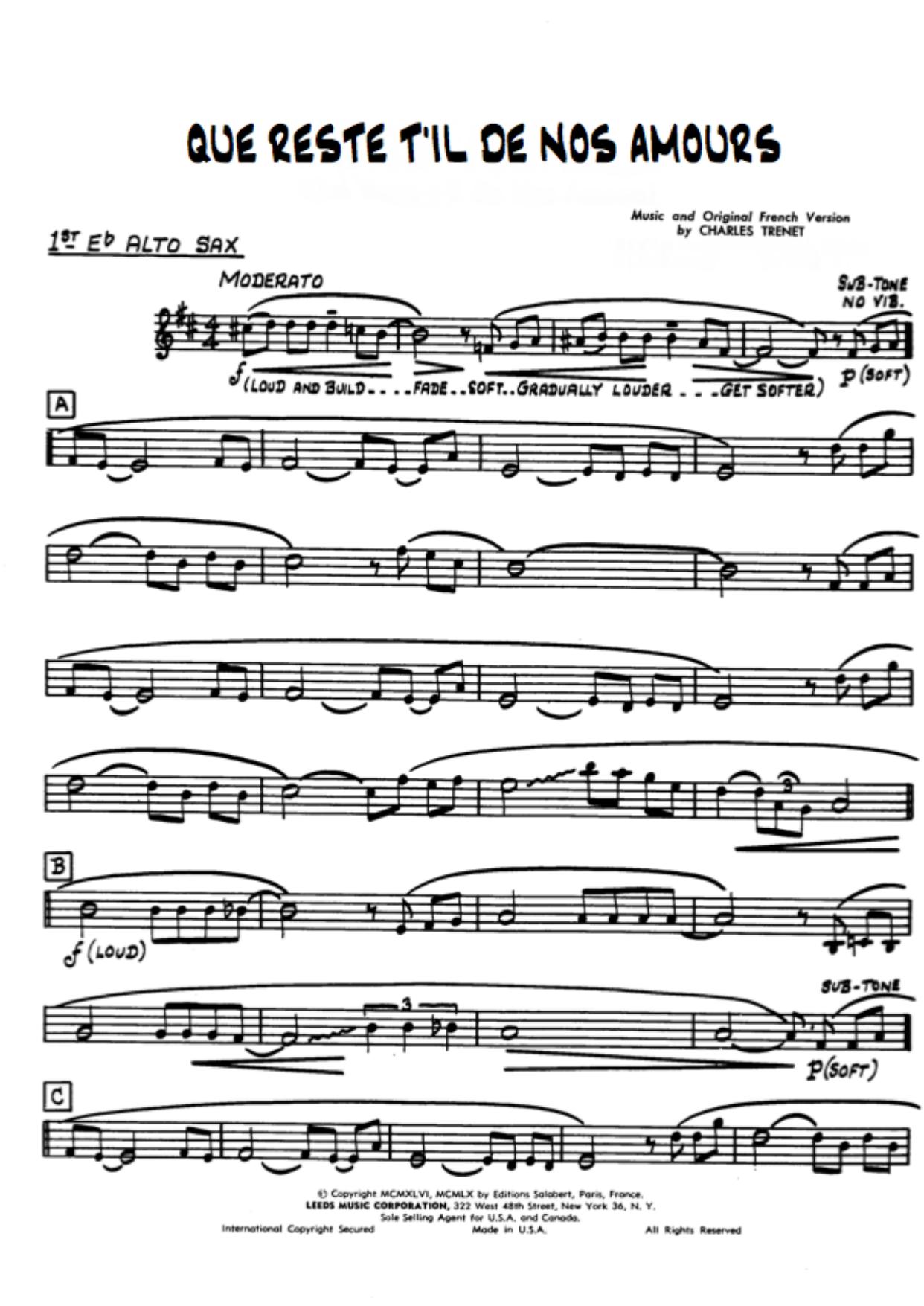
Que Reste T'il De Nos Amours (C.Trenet) sheet music preview

Que Reste T'il De Nos Amours (C.Trenet)

Composed by Charles Trenet

Arranged by C.Trenet

  • Ensemble: Big Band
  • Style: Jazz Standard
  • Pages: 36
  • Instruments (16): 1st Eb Alto Sax, 3rd Eb Alto Sax, 2nd Bb Tenor Sax, 4th Bb Tenor Sax, 5th Eb Baritone Sax, 1st Bb Trumpet, 2nd Bb Trumpet, 3rd Bb Trumpet, 1st Trombone, 2nd Trombone, 3rd Trombone, 4th Trombone, Bass (String), Drums, Guitar, Piano (Accordion)
  • Difficulty: medium
  • Content: Individual Parts
  • Format: PDF Download (Instant)
  • Price: $24.99

"Que Reste-t-il de nos amours?", composed by the iconic French singer-songwriter Charles Trenet and co-written with Léo Chauliac, stands as one of the crown jewels of the twentieth-century French chanson catalog, subsequently crossing over into the international jazz consciousness (famously adapted in English as "I Wish You Love"). Written in 1942 during the German occupation of France, the composition carries a profound bittersweet duality—blending an outwardly charming, rolling melody with a deep, nostalgic melancholia about the remnants of past romance. This timeless quality has earned it a revered place in the standard repertoire, frequently interpreted by jazz instrumentalists and vocalists alike who find rich harmonic terrain beneath its deceptively simple exterior. Brought to life in a sophisticated big band setting scored for a standard 16-instrument powerhouse lineup—including dual altos, dual tenors, a full four-trombone section, and a robust rhythm foundation—this arrangement translates the intimate French classic into a sweeping jazz canvas. The chart gracefully balances a lush, cinematic European harmonic palette with a fluid, mid-tempo swing groove. The mood shifts effortlessly from introspective, rubato-esque atmospheric textures to buoyant, walking-bass-driven sections that evoke the smoky elegance of mid-century Parisian jazz clubs meeting the grand tradition of American big band arranging. Charles Trenet’s own conceptualization of his work prioritized lyrical phrasing and emotional narrative, elements that heavily influence the flow of this 36-page score. The arrangement avoids heavy-handed, bombastic shout choruses in favor of sophisticated horn voicings, rich chord extensions, and delicate counter-melodies that weave through the ensemble. The saxophones frequently enjoy lush, close-position block-chord solis, while the brass provide warm, cushioned pads that support rather than overwhelm the line. Featured solo opportunities allow individual players to stretch out over changes that naturally invite a lyrical, melodically driven improvisational approach reminiscent of Stan Getz or Zoot Sims. Advanced high school, collegiate, and professional jazz ensembles will find this 16-instrument arrangement a deeply rewarding addition to their repertoire. While the individual technical demands on range and velocity are manageable, the true challenge lies in stylistic nuance: achieving a unified French chanson rubato feel within a disciplined big band framework, maintaining pristine intonation during exposed chordal passages, and sustaining a sophisticated, relaxed swing feel. It offers audiences a refreshing departure from standard blues and aggressive up-tempo burners, providing a masterclass in subtlety, emotional depth, and ensemble blend. The primary hurdle in mastering this arrangement lies in capturing the delicate stylistic balance between French cabaret melancholy and American medium-swing propulsion. Conductor and ensemble must approach the opening statements with rhythmic flexibility, avoiding a rigid, mechanical swing subdivision until the rhythm section establishes a steady, buoyant walking bass line. Horn players should pay meticulous attention to dynamic shading; the chart relies heavily on subtle crescendos and decrescendos to shape the romantic narrative, particularly during the saxophone soli sections where internal balance is critical. Brass players should keep mutes ready if opting for coloristic changes, though open horns with a warm, dark tone are preferred to maintain the rich European texture. Rehearsal time should be heavily dedicated to listening across sections—saxophones must lock their intonation on tight upper-structure chords, while the rhythm section must keep the accompaniment light, transparent, and unforced. Avoid rushing the tempo; the magic of this chart lives in its unhurried, sophisticated swagger. Q: What specific instruments and parts are included in this 16-instrument big band score? A: The arrangement is scored for a standard 16-piece big band lineup, including Alto Saxophone 1, Alto Saxophone 3, Tenor Saxophone 2, Tenor Saxophone 4, a full four-trombone section (Trombone 4 included), trumpets, and a complete rhythm section. Q: What is the overall difficulty level of this arrangement? A: This chart is best suited for advanced high school, collegiate, and professional big bands due to its heavy reliance on subtle intonation, stylistic versatility, and ensemble blend rather than extreme technical speed. Q: What is the historical background and musical style of "Que Reste-t-il de nos amours"? A: Originally composed by Charles Trenet in 1942, this piece is a masterpiece of French chanson that transitioned seamlessly into a sophisticated jazz standard, blending European romanticism with a medium swing jazz feel. Q: What makes this specific arrangement unique compared to standard big band charts? A: Instead of relying on aggressive, high-energy shout choruses, this arrangement utilizes lush, cinematic harmonic voicings, delicate counter-melodies, and a cinematic approach that highlights lyricism and emotional depth. Q: What are the expected performance duration and tempo guidelines for this piece? A: The arrangement is performed at a comfortable, unhurried medium-swing tempo designed to emphasize the melodic contours of Trenet's composition, typically resulting in a performance duration of approximately 4 to 5 minutes.

Questions and answers

What is included in the Que Reste T'il De Nos Amours (C.Trenet) PDF?
The verified current file contains individual parts across 36 pages.
How many instruments or parts are listed for Que Reste T'il De Nos Amours (C.Trenet)?
The verified instrumentation list contains 16 entries for this Big Band arrangement.
Who is credited for Que Reste T'il De Nos Amours (C.Trenet)?
Composer: Charles Trenet. Arranger: C.Trenet.
What difficulty is listed for Que Reste T'il De Nos Amours (C.Trenet)?
The verified difficulty level is medium.
What style is listed for Que Reste T'il De Nos Amours (C.Trenet)?
The catalog lists the style as Jazz Standard.
Can I preview Que Reste T'il De Nos Amours (C.Trenet) before buying?
Yes. The product page provides a preview generated from the current PDF file.
How is Que Reste T'il De Nos Amours (C.Trenet) delivered?
After successful payment, the digital PDF is made available for download. The displayed price is $24.99.

Musicians Also Search For

Que Reste T'il De Nos Amours C.Trenet PDFQue Reste T'il De Nos Amours C.Trenet sheet musicQue Reste T'il De Nos Amours arranged by C.TrenetC.Trenet big band chartsC.Trenet jazz arrangements PDFQue Reste T'il De Nos Amours Charles Trenet sheet musicQue Reste T'il De Nos Amours Charles Trenet big band arrangementsCharles Trenet big band chartsQue Reste T'il De Nos Amours big band arrangementsQue Reste T'il De Nos Amours big band PDF downloadQue Reste T'il De Nos Amours jazz sheet musicbig band sheet music downloadQue Reste T'il De Nos Amours individual parts downloadQue Reste T'il De Nos Amours sheet music PDFQue Reste T'il De Nos Amours Jazz Standard chartsJazz Standard big band arrangementsbuy Que Reste T'il De Nos Amours sheet musicdownload Que Reste T'il De Nos Amours PDFQue Reste T'il De Nos Amours jazz chartsbest C.Trenet big band arrangementsCharles Trenet arranged by C.TrenetQue Reste T'il De Nos Amours printable sheet musicbig band repertoire PDF

All arrangements by C.Trenet All Charles Trenet sheet music