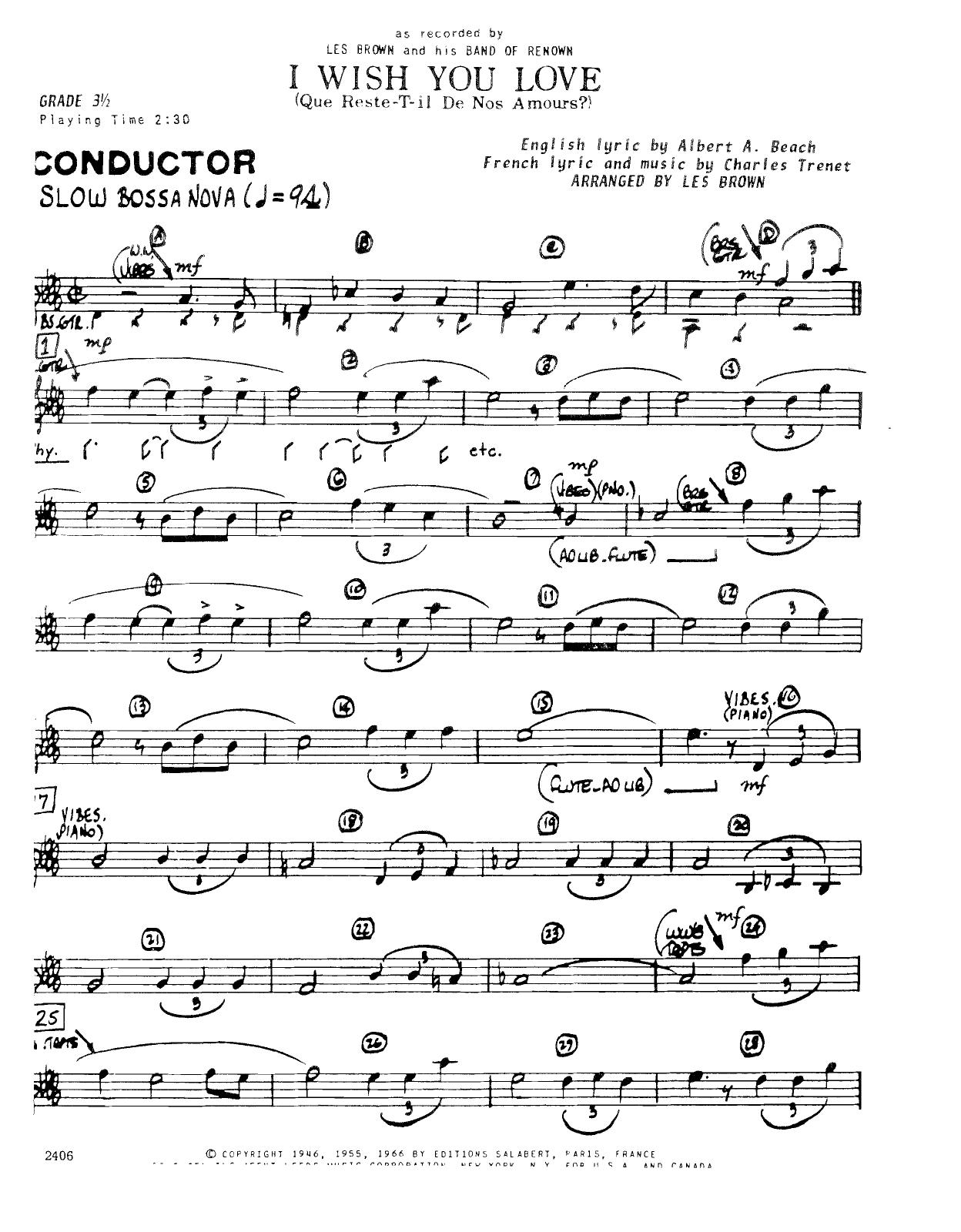
I Wish You Love (L.Brown)
Composed by Charles Trenet
Arranged by Les Brown
- Ensemble: Big Band
- Pages: 33
- Instruments (20): Conductor, 1st Sax (Flute), 1st Sax (Substitute Part - Eb Alto), 2nd Eb Alto Sax, 3rd Sax (Alto Flute or C Flute), 3rd Sax (Substitute Part - Bb Tenor), 4th Bb Tenor Sax, Baritone (Optional), 1st Trumpet, 2nd Trumpet, 3rd Trumpet, 4th Trumpet, 1st Trombone, 2nd Trombone, 3rd Trombone, 4th Trombone, Piano, Rhythm Guitar, Bass, Drums
- Difficulty: medium
- Content: Individual Parts
- Format: PDF Download (Instant)
- Price: $24.99
Charles Trenet’s timeless classic "Que reste-t-il de nos amours?"—adapted brilliantly into English as "I Wish You Love"—stands as one of the most enduring melodic statements in the modern jazz canon. Originally penned in 1942 during the tumultuous occupation of France, the song found its definitive American jazz life through landmark recordings by artists like Frank Sinatra, Chet Baker, and Keely Smith. However, when master bandleader Les Brown applied his signature touch to the material, the tune transformed from a fragile Parisian chanson into a sophisticated, swinging vehicle tailored for the precision and power of a premier American big band. This arrangement bridges the gap between European lyrical melancholy and the polished, high-energy sophistication of West Coast swing. Lyrically bittersweet and harmonically rich, this arrangement unfolds at a sophisticated, relaxed medium-swing tempo that prioritizes lush harmonic textures and subtle dynamic shading over sheer velocity. The mood is deeply romantic yet swinging, capturing the quintessential Les Brown "Band of Renown" aesthetic: immaculate section balance, crystalline brass voicings, and an effortless forward-driving pulse. The arrangement opens with an inviting, atmospheric introduction that immediately establishes the sophisticated harmonic landscape before settling into a warm, undulating groove. Throughout the chart, Les Brown utilizes close-voiced saxophone solis and lush, muted brass counterlines that evoke the late-night sophistication of a premier ballroom performance. Melodic duties are distributed masterfully across the ensemble, giving every section a chance to shine while maintaining a cohesive narrative arc. The woodwinds—featuring flute and vibrant saxophone doubling—add an airy, continental coloration to the primary themes, while the rhythm section, anchored by a sophisticated bass guitar and shimmering vibraphone, lays down a buoyant, understated swing foundation. Featured solo space allows a soloist to stretch out over changes that favor lyrical phrasing and melodic development. The arrangement builds organically toward a tasteful, dynamically controlled climax rather than a bombastic shout chorus, preserving the intimate emotional core of Trenet’s original melody while showcasing the refined ensemble interplay characteristic of Brown’s best charts. Advanced high school, collegiate, and professional jazz ensembles will find this 20-instrument arrangement an exceptional vehicle for developing stylistic maturity, blend, and subtle swing feel. Because the chart relies heavily on dynamic control, intonation in extended harmonies, and light-footed timekeeping rather than sheer technical endurance, it serves as an ideal masterclass in big band sophistication. Conductor and players alike will appreciate the comprehensive 33-page conductor score, which provides clear roadmap guidance for navigating the subtle tempo nuances and textural shifts that make this Les Brown adaptation a timeless masterwork. Navigating this arrangement successfully requires a mature understanding of medium-swing phrasing and immaculate sectional balance. The tempo should remain steady and relaxed; avoid rushing the back-end of the beats, as the chart relies heavily on a lazy, confident pocket to achieve its signature West Coast feel. Brass players must exercise strict dynamic discipline, ensuring that muted passages blend seamlessly without pinching the tone. Watch for subtle dynamic swells in the saxophone solis, treating them like vocal phrases rather than mechanical exercises. The rhythm section should approach the groove with an airy, feather-light ride cymbal pattern and a supportive, melodic bassline that avoids overplaying. Rehearsal time should be heavily invested in achieving a unified articulation style—specifically, long, connected lines with gentle tenuto markings on the sustained notes, contrasted by crisp, unaccented short notes in the backgrounds. Pay close attention to the blend between the vibraphone and the frontline horns to capture the authentic, shimmering texture of the classic Les Brown orchestration. Q: What instruments and parts are included in this arrangement? A: The package comprises a comprehensive 33-page conductor score and individual parts for a standard 20-instrument big band lineup, including bass guitar, vibraphone, flute, 1st alto saxophone, and full brass and rhythm sections. Q: What is the difficulty level of this Les Brown arrangement? A: This chart is best suited for advanced high school, collegiate, and professional jazz ensembles due to its heavy reliance on subtle swing phrasing, intonation within extended harmonies, and precise dynamic control. Q: What is the musical style and historical background of this piece? A: Styled as a sophisticated medium-swing jazz arrangement, it adapts Charles Trenet’s 1942 French classic "Que reste-t-il de nos amours?" through the polished, West Coast big band aesthetic pioneered by Les Brown. Q: What makes this specific arrangement unique? A: Unlike high-velocity shout-chorus charts, this arrangement distinguishes itself by transforming a fragile European chanson into a swinging, harmonically lush vehicle that emphasizes intimate ensemble interplay, woodwind colors, and vibraphone textures over sheer volume. Q: What is the recommended performance tempo and duration? A: The arrangement is set at a relaxed, medium-swing tempo that typically yields a performance duration of approximately 3 to 4 minutes, depending on the length of the featured solo space.
Questions and answers
- What is included in the I Wish You Love (L.Brown) PDF?
- The verified current file contains a conductor score and individual parts across 33 pages.
- How many instruments or parts are listed for I Wish You Love (L.Brown)?
- The verified instrumentation list contains 20 entries for this Big Band arrangement.
- Who is credited for I Wish You Love (L.Brown)?
- Composer: Charles Trenet. Arranger: Les Brown.
- What difficulty is listed for I Wish You Love (L.Brown)?
- The verified difficulty level is medium.
- Can I preview I Wish You Love (L.Brown) before buying?
- Yes. The product page provides a preview generated from the current PDF file.
- How is I Wish You Love (L.Brown) delivered?
- After successful payment, the digital PDF is made available for download. The displayed price is $24.99.
Musicians Also Search For
I Wish You Love Les Brown PDF • I Wish You Love Les Brown sheet music • I Wish You Love arranged by Les Brown • Les Brown big band charts • Les Brown jazz arrangements PDF • I Wish You Love Charles Trenet sheet music • I Wish You Love Charles Trenet big band arrangements • Charles Trenet big band charts • I Wish You Love big band arrangements • I Wish You Love big band PDF download • I Wish You Love jazz sheet music • big band sheet music download • I Wish You Love conductor score PDF • I Wish You Love individual parts download • I Wish You Love sheet music PDF • buy I Wish You Love sheet music • download I Wish You Love PDF • I Wish You Love jazz charts • best Les Brown big band arrangements • Charles Trenet arranged by Les Brown • I Wish You Love printable sheet music • big band repertoire PDF