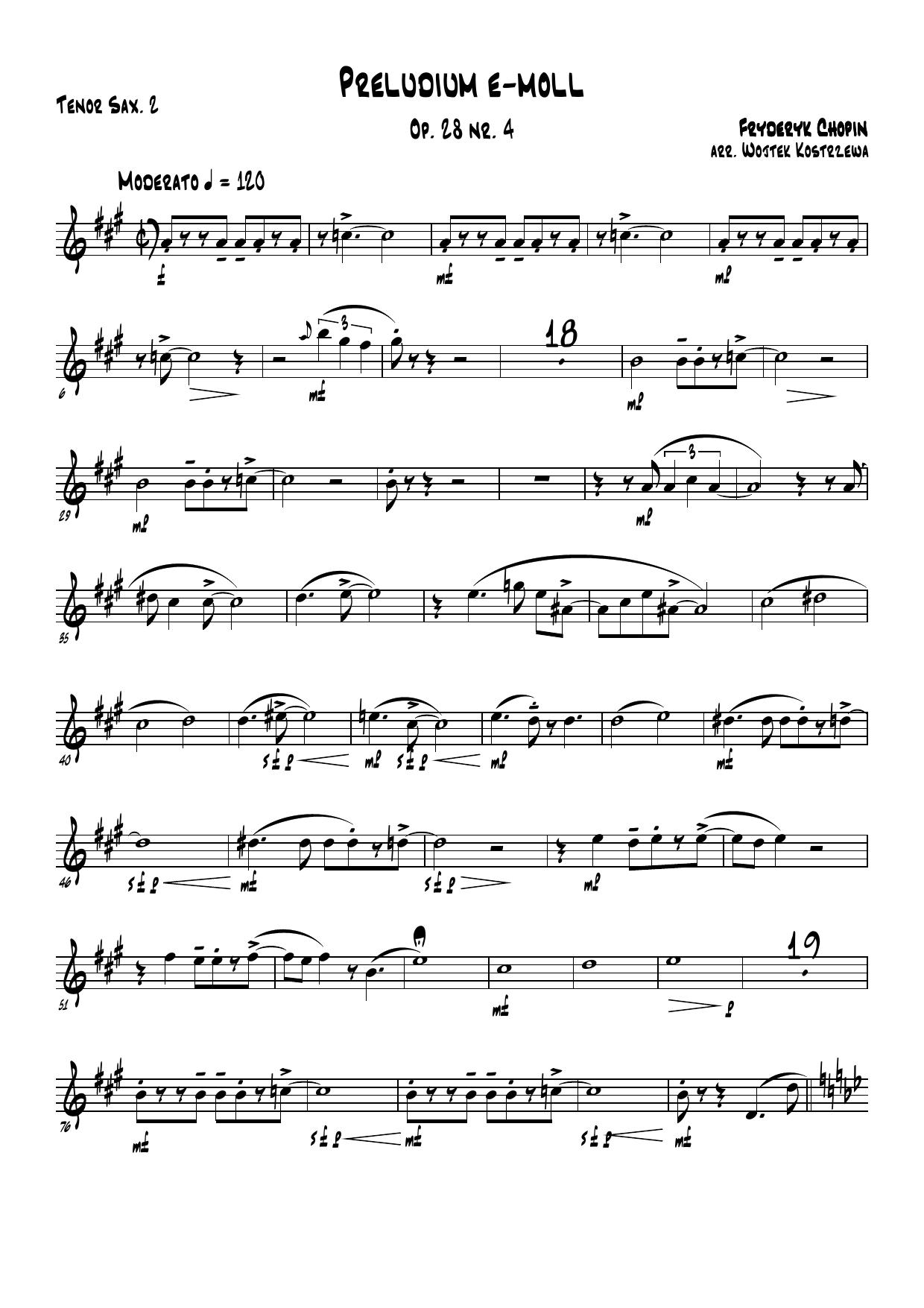
Preludium E-Moll (W.Kostrzewa)
Composed by Wojciech Kostrzewa
Arranged by W.Kostrzewa
- Ensemble: Big Band
- Style: Jazz Standard
- Pages: 27
- Instruments (15): Alto Saxophone 1, Alto Saxophone 2, Tenor Saxophone 1, Tenor Saxophone 2, Baritone Saxophone, Trumpet in Bb 1, Trumpet in Bb 2, Trumpet in Bb 3, Trumpet in Bb 4, Trombone 1, Trombone 2, Trombone 3, Bass, Drum Set, Piano
- Difficulty: medium
- Content: Individual Parts
- Format: PDF Download (Instant)
- Price: $24.99
Wojciech Kostrzewa’s striking big band adaptation of the classic *Preludium E-Moll* bridges the worlds of European romantic solemnity and contemporary modal jazz. Originally rooted in classical counterpoint and minor-mode introspection, this reimagining transforms a melancholic thematic core into a sophisticated modern jazz vehicle. The piece represents a fascinating intersection of traditional compositional rigor and contemporary big band arranging practices, offering ensembles a chance to explore rich harmonic textures that move far beyond standard blues and rhythm changes forms. From the opening measures, the arrangement establishes a brooding, atmospheric mood anchored in E minor, oscillating between lush, impressionistic chord clusters and driving, contemporary swing grooves. The tempo feel shifts deftly between rubato, highly expressive ballad sections and a pulsing, aggressive medium-up swing that propels the ensemble forward. Kostrzewa employs expansive extended harmonies—utilizing sharp alterations, stacked fourths, and chromatic mediant movements—to evoke a deep sense of dramatic tension and release. The emotional landscape shifts dynamically from quiet, nocturnal reflection to thunderous, brass-heavy climaxes that demand absolute precision and control from every section. Kostrzewa’s arranging fingerprint is defined by meticulous voice-leading and transparent, highly textured scoring. Rather than relying on standard block-chord writing, the chart features intricate contrapuntal lines winding through the inner voices, giving the saxophone and trombone sections independent, linear responsibilities. The melody is initially introduced with haunting delicacy by the tenor saxophone before being expanded across the full ensemble in sweeping, harmonized soli passages. A dynamic shout chorus near the climax serves as the structural anchor, utilizing aggressive brass stabs and cascading woodwind counterlines to build an overwhelming wall of sound before resolving into a haunting, quiet coda. Advanced high school, collegiate, and professional big bands will find this 27-page, 14-instrument chart an immensely rewarding challenge. The technical demands center primarily on intonation within complex modal harmonies, blend and balance in exposed rubato passages, and rhythmic agility during the faster interpolated swing interludes. Solo space is provided for tenor saxophone, allowing featured improvisers to stretch out over sophisticated minor-key changes. Conscientious directors will appreciate how the chart forces sections to listen across the ensemble, making it an exceptional festival piece or a standout programmatic contrast in any advanced concert set. Navigating Kostrzewa’s *Preludium E-Moll* successfully requires meticulous attention to dynamic contrast and stylistic shifts. The primary technical challenge lies in maintaining pristine intonation through dense, extended chord voicings, particularly during the exposed, slower introductory and transitional rubato phrases. The conductor should insist on a unified concept of time before the rhythm section locks into the primary swing groove. Articulation is critical: ensure that swing eighth notes are played with a lightweight, forward-moving bop interpretation in the medium-tempo sections, while maintaining crisp, classical precision on the staccato figures in the heavier ensemble blasts. No specialized plunger or special mutes are strictly required, allowing the natural acoustic brilliance of the brass section to shape the dynamic contour. Rehearsal should begin by isolating the inner-voice counterlines in the trombones and tenor saxophone 2 to ensure transparency beneath the primary melodic statements. Balance is paramount; because the chart utilizes deep minor-mode voicings, the lower-register instruments (bass trombone, baritone sax if present, and bass) must anchor the foundation without masking the intricate upper-structure triads floating above them. Q: What specific instrumentation and parts are included in this 27-page set? A: The arrangement is scored for a 14-instrument big band ensemble, which specifically includes parts for Tenor Saxophone 2, Trombone 1, Trombone 2, Trombone 3, and Trumpet in Bb 1, alongside the remaining standard big band complement across 27 total pages of manuscript. Q: What is the difficulty level of this arrangement? A: This chart is best suited for advanced high school, collegiate, and professional big bands due to its sophisticated modal harmonies, intricate inner-voice counterpoint, and demands for mature ensemble intonation and blend. Q: What is the musical style and historical background of the piece? A: It is a modern jazz standard arrangement conceived by contemporary composer Wojciech Kostrzewa, transforming classical minor-mode thematic material into a sophisticated vehicle blending European romanticism with contemporary big band jazz. Q: What makes this specific arrangement by W.Kostrzewa unique? A: It stands out through its use of contrapuntal inner voices, impressionistic extended chord clusters, and seamless transitions between rubato ballad textures and driving, modal swing grooves rather than relying on standard blues or AABA forms. Q: What is the performance duration and tempo approach of the piece? A: The piece features a flexible performance duration of approximately 5 to 6 minutes, driven by an initial rubato feel that transitions dynamically into a pulsing, medium-up swing tempo.
Questions and answers
- What is included in the Preludium E-Moll (W.Kostrzewa) PDF?
- The verified current file contains individual parts across 27 pages.
- How many instruments or parts are listed for Preludium E-Moll (W.Kostrzewa)?
- The verified instrumentation list contains 15 entries for this Big Band arrangement.
- Who is credited for Preludium E-Moll (W.Kostrzewa)?
- Composer: Wojciech Kostrzewa. Arranger: W.Kostrzewa.
- What difficulty is listed for Preludium E-Moll (W.Kostrzewa)?
- The verified difficulty level is medium.
- What style is listed for Preludium E-Moll (W.Kostrzewa)?
- The catalog lists the style as Jazz Standard.
- Can I preview Preludium E-Moll (W.Kostrzewa) before buying?
- Yes. The product page provides a preview generated from the current PDF file.
- How is Preludium E-Moll (W.Kostrzewa) delivered?
- After successful payment, the digital PDF is made available for download. The displayed price is $24.99.
Musicians Also Search For
Preludium E-Moll W.Kostrzewa PDF • Preludium E-Moll W.Kostrzewa sheet music • Preludium E-Moll arranged by W.Kostrzewa • W.Kostrzewa big band charts • W.Kostrzewa jazz arrangements PDF • Preludium E-Moll Wojciech Kostrzewa sheet music • Preludium E-Moll Wojciech Kostrzewa big band arrangements • Wojciech Kostrzewa big band charts • Preludium E-Moll big band arrangements • Preludium E-Moll big band PDF download • Preludium E-Moll jazz sheet music • big band sheet music download • Preludium E-Moll individual parts download • Preludium E-Moll sheet music PDF • Preludium E-Moll Jazz Standard charts • Jazz Standard big band arrangements • buy Preludium E-Moll sheet music • download Preludium E-Moll PDF • Preludium E-Moll jazz charts • best W.Kostrzewa big band arrangements • Wojciech Kostrzewa arranged by W.Kostrzewa • Preludium E-Moll printable sheet music • big band repertoire PDF