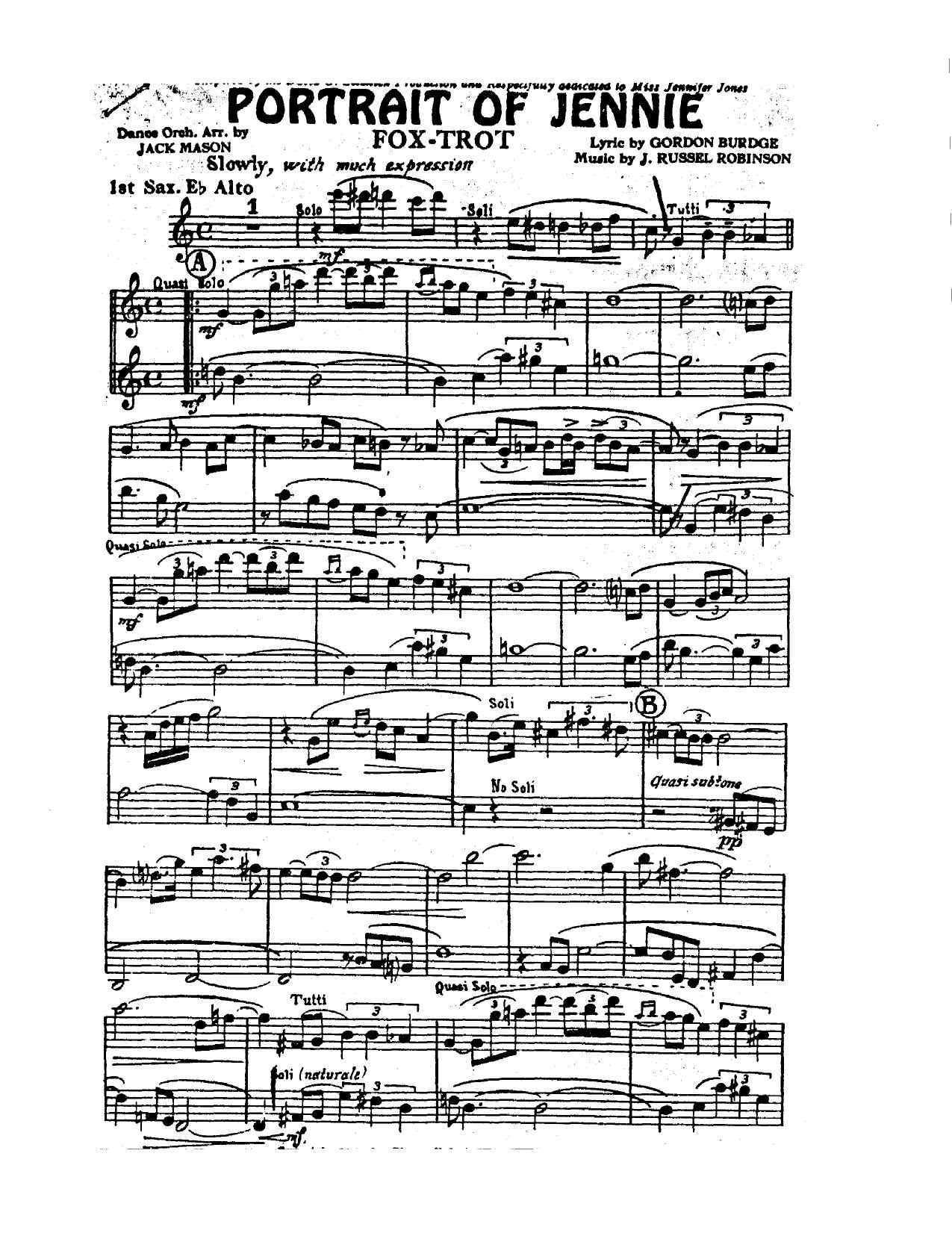
Portrait Of Jennie (J.Mason) No Drums sheet music preview

Portrait Of Jennie (J.Mason) No Drums

Composed by Gordon Jenkins

Arranged by Jack Mason

  • Ensemble: Big Band
  • Pages: 25
  • Instruments (12): 1st Sax. Eb Alto, 3rd Sax. Eb Alto, 2nd Sax. Bb Tenor, 4th Sax. Bb Tenor, 5th Sax. Eb Baritone, 1st Bb Trumpet, 2nd Trumpet in Bb, 3rd Bb Trumpet, 1st Trombone, 2nd Trombone, Piano, Bass
  • Difficulty: medium
  • Content: Individual Parts
  • Format: PDF Download (Instant)
  • Price: $24.99

"Portrait of Jennie," composed by Gordon Jenkins with lyrics by J. Russel Robinson, emerged as a hauntingly evocative ballad from the 1940s, immortalized by the 1948 romantic fantasy film of the same name. Over the decades, this cinematic gem transitioned seamlessly into the jazz canon, championed by legendary interpreters such as Nat King Cole, Clifford Brown, and Keith Jarrett. The composition is celebrated for its lush, cinematic harmonic progression and bittersweet melodic contour, making it a supreme vehicle for expressive, mood-driven jazz performance. It represents the pinnacle of mid-century popular songwriting that naturally invited sophisticated jazz reharmonization. Jack Mason’s masterful big band adaptation translates this sweeping, romantic masterwork into an intimate yet rich setting tailored for a flexible, reduced instrumentation of six horns and rhythm section (Alto Saxophone, Tenor Saxophone, Trumpet, Trombone, Piano, and Bass, notably configured here with *No Drums*). Set as a lush, introspective ballad in a rubato-leaning 4/4 feel, the arrangement evokes an atmosphere of nocturnal contemplation and cinematic nostalgia. The emotional palette shifts dynamically from delicate, whispered unison lines between the saxophones and brass to soaring, emotionally resonant climaxes that test the band's collective control of tone and intonation. Mason’s signature arranging style shines through his transparent, sophisticated voicings, which maximize the harmonic color of a smaller horn section without sacrificing fullness. Rather than relying on a traditional heavy-handed shout chorus, Mason builds intensity through subtle counterpoint, interwoven chordal extensions, and rubato transitional passages that allow the rhythm section—anchored by a sophisticated piano accompaniment part—to weave intricate harmonic webs beneath the horns. The arrangement avoids clutter, granting each of the six instrumental voices a distinct, chamber-like independence where intonation and blend are paramount. The melodic weight is shared gracefully between the alto and tenor saxophones, creating a warm, vocalized timbre that honors the original lyrical intent of the composition. Featured improvised solo space is thoughtfully provided, inviting a sensitive soloist on either trumpet or tenor saxophone to stretch out over a supportive, changing background texture. Technical challenges center less on digital velocity and far more on breath control, flawless blend, dynamic sensitivity, and maintaining a consistent sense of linear momentum through slow, sustained ballad tempos. Advanced high school ensembles, collegiate jazz combos, and professional regional big bands looking to scale down their horn sections will find this 25-page score an invaluable addition to their library. It serves as an exceptional contrast piece for a concert program, demanding high-level musicianship, deep listening skills, and a mature aesthetic appreciation for space, nuance, and lyricism in jazz arrangement. Conductors approaching Jack Mason’s setting of "Portrait of Jennie" should prioritize a flexible, elastic approach to time over strict metronomic rigidity. While the underlying pulse is firmly rooted in a slow 4/4 ballad feel, rubato sections require the ensemble to breathe as one unit, watching the conductor closely for tempo fluctuations and phrase expansions. The primary technical challenge lies in sustained tone production at ultra-soft dynamics (pianissimo to mezzo-piano). Horn players must employ excellent breath support to ensure that long tones do not sag in pitch, particularly in the inner-voice harmonies assigned to the tenor saxophone and trombone. No special plunger mutes or extended special effects are required; the beauty of the chart relies on a pure, warm, straight-toned acoustic blend that mimics a vocal ensemble. In rehearsal, isolate the horn sections first without rhythm to lock in intonation on the dense secondary chords. Next, have the piano and bass rehearse the underlying harmonic movement independently to ensure the chordal voicings support, rather than crowd, the horn melodies. Encourage the featured soloist to treat their space as an extension of the melody, maintaining the nocturnal, reflective mood established in the opening measures. Q: What instruments and parts are included in this arrangement? A: This arrangement is scored for a 6-instrument ensemble consisting of Alto Saxophone, Tenor Saxophone, Trumpet, Trombone, Piano, and Bass, completely omitting the drum set (*No Drums*), spread across a comprehensive 25-page score and parts format. Q: What is the difficulty level of this chart? A: It is best suited for advanced high school, collegiate, and professional musicians who possess strong ballad-playing skills, mature blend, and precise intonation control rather than rapid technical facility. Q: What is the historical style and musical context of the piece? A: Based on Gordon Jenkins' classic 1940s ballad popularized by jazz icons like Clifford Brown and Nat King Cole, this chart operates as a slow, cinematic jazz ballad dripping with mid-century romanticism and sophisticated modal color. Q: What makes Jack Mason's arrangement unique? A: Mason successfully scales down a rich orchestral jazz concept into a nimble six-instrument texture, utilizing chamber-jazz transparency, interwoven counterpoint, and evocative harmonic voicings instead of a standard heavy big band shout chorus. Q: What is the recommended performance tempo and duration? A: The piece is performed at a slow, expressive ballad tempo (around 60 to 68 BPM) with rubato elements, resulting in a standard performance duration of approximately 3.5 to 4.5 minutes depending on the length of improvised solos.

Questions and answers

What is included in the Portrait Of Jennie (J.Mason) No Drums PDF?
The verified current file contains individual parts across 25 pages.
How many instruments or parts are listed for Portrait Of Jennie (J.Mason) No Drums?
The verified instrumentation list contains 12 entries for this Big Band arrangement.
Who is credited for Portrait Of Jennie (J.Mason) No Drums?
Composer: Gordon Jenkins. Arranger: Jack Mason.
What difficulty is listed for Portrait Of Jennie (J.Mason) No Drums?
The verified difficulty level is medium.
Can I preview Portrait Of Jennie (J.Mason) No Drums before buying?
Yes. The product page provides a preview generated from the current PDF file.
How is Portrait Of Jennie (J.Mason) No Drums delivered?
After successful payment, the digital PDF is made available for download. The displayed price is $24.99.

Musicians Also Search For

Portrait Of Jennie Jack Mason PDFPortrait Of Jennie Jack Mason sheet musicPortrait Of Jennie arranged by Jack MasonJack Mason big band chartsJack Mason jazz arrangements PDFPortrait Of Jennie Gordon Jenkins sheet musicPortrait Of Jennie Gordon Jenkins big band arrangementsGordon Jenkins big band chartsPortrait Of Jennie big band arrangementsPortrait Of Jennie big band PDF downloadPortrait Of Jennie jazz sheet musicbig band sheet music downloadPortrait Of Jennie individual parts downloadPortrait Of Jennie sheet music PDFbuy Portrait Of Jennie sheet musicdownload Portrait Of Jennie PDFPortrait Of Jennie jazz chartsbest Jack Mason big band arrangementsGordon Jenkins arranged by Jack MasonPortrait Of Jennie printable sheet musicbig band repertoire PDF

All arrangements by Jack Mason All Gordon Jenkins sheet music