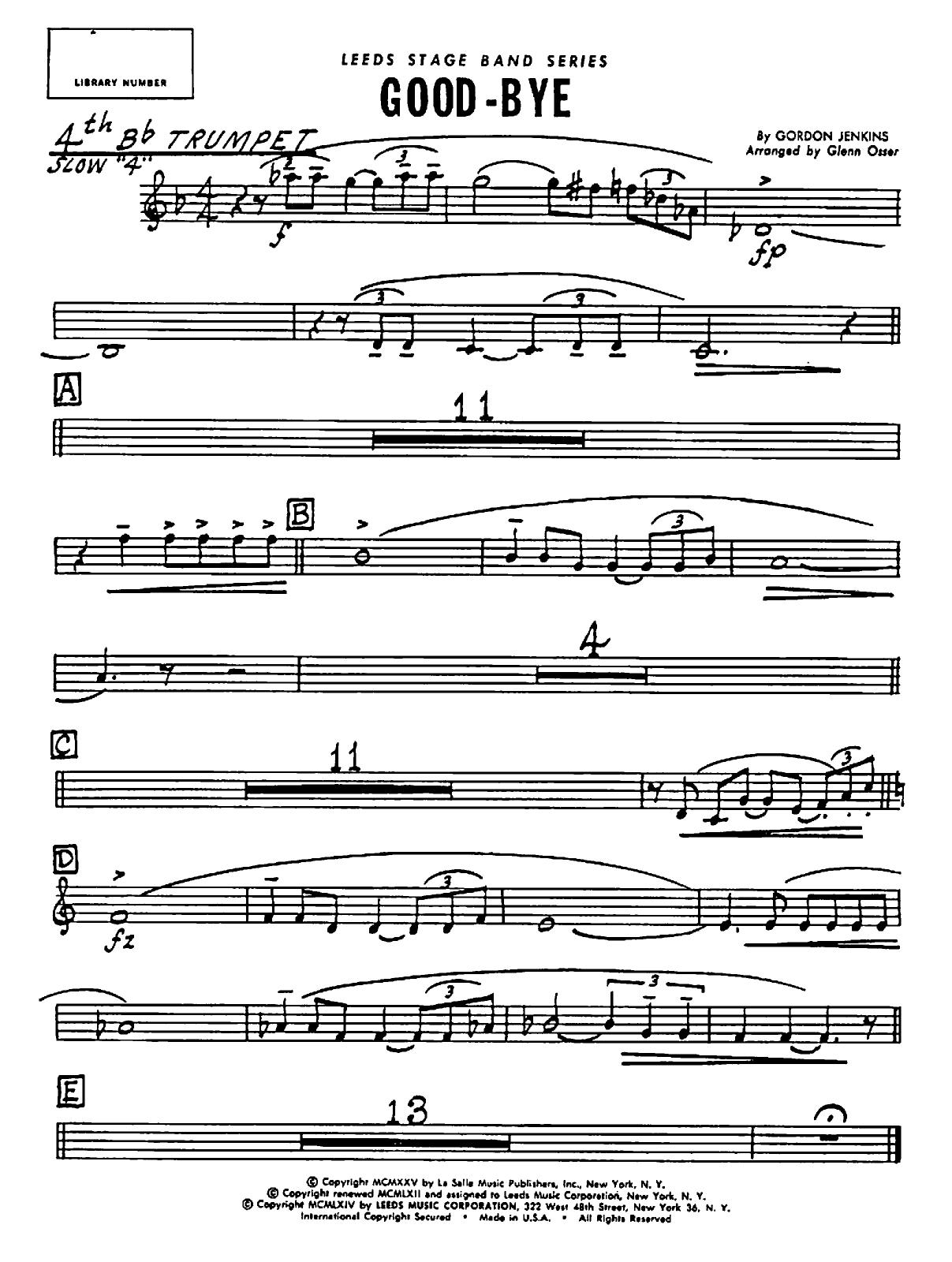
Good-Bye (G.Osser)
Composed by Gordon Jenkins
Arranged by Glenn Osser
- Ensemble: Big Band
- Pages: 35
- Instruments (19): 1st Bb Trumpet, 2nd Bb Trumpet, 3rd Bb Trumpet, 4th Bb Trumpet, 1st Trombone, 2nd Trombone, 3rd Trombone, 4th Trombone, Vocal (Optional), Tuba, Piano (Accordion), Drums, String Bass, Guitar, 1st Eb Alto Sax, 3rd Eb Alto Sax, 2nd Bb Tenor Sax, 4th Bb Tenor Sax, 5th Eb Baritone Sax
- Difficulty: medium
- Content: Individual Parts
- Format: PDF Download (Instant)
- Price: $24.99
Gordon Jenkins originally penned "Good-Bye" in 1935, anchoring it firmly in the golden era of the American popular songbook before Benny Goodman famously adopted it as his closing theme song. This poignant, elegant composition represents the sophisticated ballad writing of the late swing era, capturing the bittersweet emotions of parting through lush, cinematic harmonies and a lingering, memorable melody. While Jenkins conceived it as a vocal and orchestral feature, it quickly transitioned into the instrumental jazz lexicon, celebrated for its ability to showcase a band's capacity for controlled dynamics, rich textures, and expressive phrasing. Glenn Osser’s masterful big band arrangement translates the sweeping orchestral romanticism of the original work into a quintessential jazz ensemble setting. Built around a lush, flowing ballad tempo in 4/4 time, the arrangement evokes a warm, nostalgic mood characterized by sweeping harmonic motion and gentle tension-and-release cycles. Osser avoids heavy-handed swing in favor of a rubato-inflected, expressive ballad feel that requires immense collective breathing and linear momentum from the entire ensemble. The emotional arc moves from a quiet, intimate opening to rich, full-ensemble climaxes before dissolving back into a serene, reflective conclusion. Osser is renowned for his brilliant commercial arranging style, and this chart exemplifies his signature approach to woodblock and brass voicings. The arrangement opens with a delicate, atmospheric intro that transitions into a gorgeous saxophone soli, where the alto and tenor saxophones weave tightly knit, modernistic harmonies that demonstrate classic mid-century voicing techniques. The brass section is deployed judiciously, functioning as a warm cushion rather than a dominant force until well-placed transitional swells lift the harmonic ceiling. Instead of a high-energy shout chorus, Osser crafts a sweeping developmental section that peaks with rich, stacked ninth and eleventh chords, testing the band’s ability to maintain pristine intonation across wide dynamic ranges. Melodic duties are shared primarily between the lead alto saxophone and the principal trumpet, requiring players with refined tone production, impeccable breath support, and a mature sense of rubato phrasing. While there are no extended improvised solo sections, the arrangement functions as a collective showcase where every chair must execute demanding inner-voice lines with absolute precision. Technical challenges center on blend, balance, and sustained pitch control during slow passages rather than finger dexterity. Performers will find immense satisfaction in shaping the sophisticated chord progressions and achieving the seamless, buttery ensemble blend that defines top-tier traditional big band ballad playing. Advanced high school, collegiate, and professional community big bands will find this 35-page, 8-instrument arrangement an exceptional vehicle for developing stylistic maturity and ensemble listening skills. Because it relies heavily on nuance, dynamic control, and subtle tempo manipulation rather than raw velocity, it serves as an invaluable pedagogical tool for teaching classical big-band ballad interpretation. It offers advanced ensembles a sophisticated change of pace that highlights beauty of sound and emotional depth over volume and speed. Success with Glenn Osser’s arrangement of "Good-Bye" hinges on exceptional breath support, flawless intonation, and a unified concept of rubato time. Conductors should treat the tempo as fluid, allowing the melody to breathe while maintaining a steady underlying pulse in the rhythm section. The primary technical challenge lies in sustaining clean, warm tones during soft passages (pianissimo to mezzo-forte), particularly in the saxophone soli where inner voicings must balance perfectly against the lead alto. Rhythm section players, especially the pianist and guitarist, should approach the comping with sparse, tasteful chord voicings that complement the rich horn harmonies without cluttering the texture. Avoid heavy ride cymbal ping; instead, use shimmering brushes or a warm half-note feel on the hi-hat to support the flowing lines. Rehearsal should focus heavily on section blend and intonation matching on extended chords (specifically major 7ths and minor 9ths). Ensure that the brass players use warm, muted vibrato only where appropriate, favoring a pure, vocal-like tone quality that honors the nostalgic character of Jenkins' timeless melody. Q: What instruments and parts are included in this arrangement? A: This arrangement is scored for an 8-instrument ensemble featuring Alto Saxophone, Tenor Saxophone, Baritone Saxophone, Trumpet, and Trombone, totaling 35 pages of comprehensive score and instrumental parts. Q: What is the difficulty level of this arrangement? A: This chart is best suited for advanced high school, collegiate, and professional jazz ensembles due to its high demand for breath control, blend, intonation, and mature ballad interpretation. Q: What is the style and historical context of "Good-Bye"? A: Originally composed by Gordon Jenkins in 1935 and famously used by Benny Goodman as his radio broadcast sign-off theme, this piece is a classic swing-era ballad that emphasizes lush romanticism and sophisticated harmonic motion. Q: What makes this Glenn Osser arrangement unique? A: Osser utilizes his signature commercial arranging style, featuring rich saxophone solis, beautifully stacked extended chord voicings, and an atmospheric developmental structure rather than a traditional high-energy shout chorus. Q: What is the performance duration and tempo feel? A: The arrangement is designed as a flowing, expressive ballad in 4/4 time, typically lasting between 3 to 4 minutes depending on the conductor's interpretation of the rubato phrases and transitional stretches.
Questions and answers
- What is included in the Good-Bye (G.Osser) PDF?
- The verified current file contains a conductor score and individual parts across 35 pages.
- How many instruments or parts are listed for Good-Bye (G.Osser)?
- The verified instrumentation list contains 19 entries for this Big Band arrangement.
- Who is credited for Good-Bye (G.Osser)?
- Composer: Gordon Jenkins. Arranger: Glenn Osser.
- What difficulty is listed for Good-Bye (G.Osser)?
- The verified difficulty level is medium.
- Can I preview Good-Bye (G.Osser) before buying?
- Yes. The product page provides a preview generated from the current PDF file.
- How is Good-Bye (G.Osser) delivered?
- After successful payment, the digital PDF is made available for download. The displayed price is $24.99.
Musicians Also Search For
Good-Bye Glenn Osser PDF • Good-Bye Glenn Osser sheet music • Good-Bye arranged by Glenn Osser • Glenn Osser big band charts • Glenn Osser jazz arrangements PDF • Good-Bye Gordon Jenkins sheet music • Good-Bye Gordon Jenkins big band arrangements • Gordon Jenkins big band charts • Good-Bye big band arrangements • Good-Bye big band PDF download • Good-Bye jazz sheet music • big band sheet music download • Good-Bye conductor score PDF • Good-Bye individual parts download • Good-Bye sheet music PDF • buy Good-Bye sheet music • download Good-Bye PDF • Good-Bye jazz charts • best Glenn Osser big band arrangements • Gordon Jenkins arranged by Glenn Osser • Good-Bye printable sheet music • big band repertoire PDF