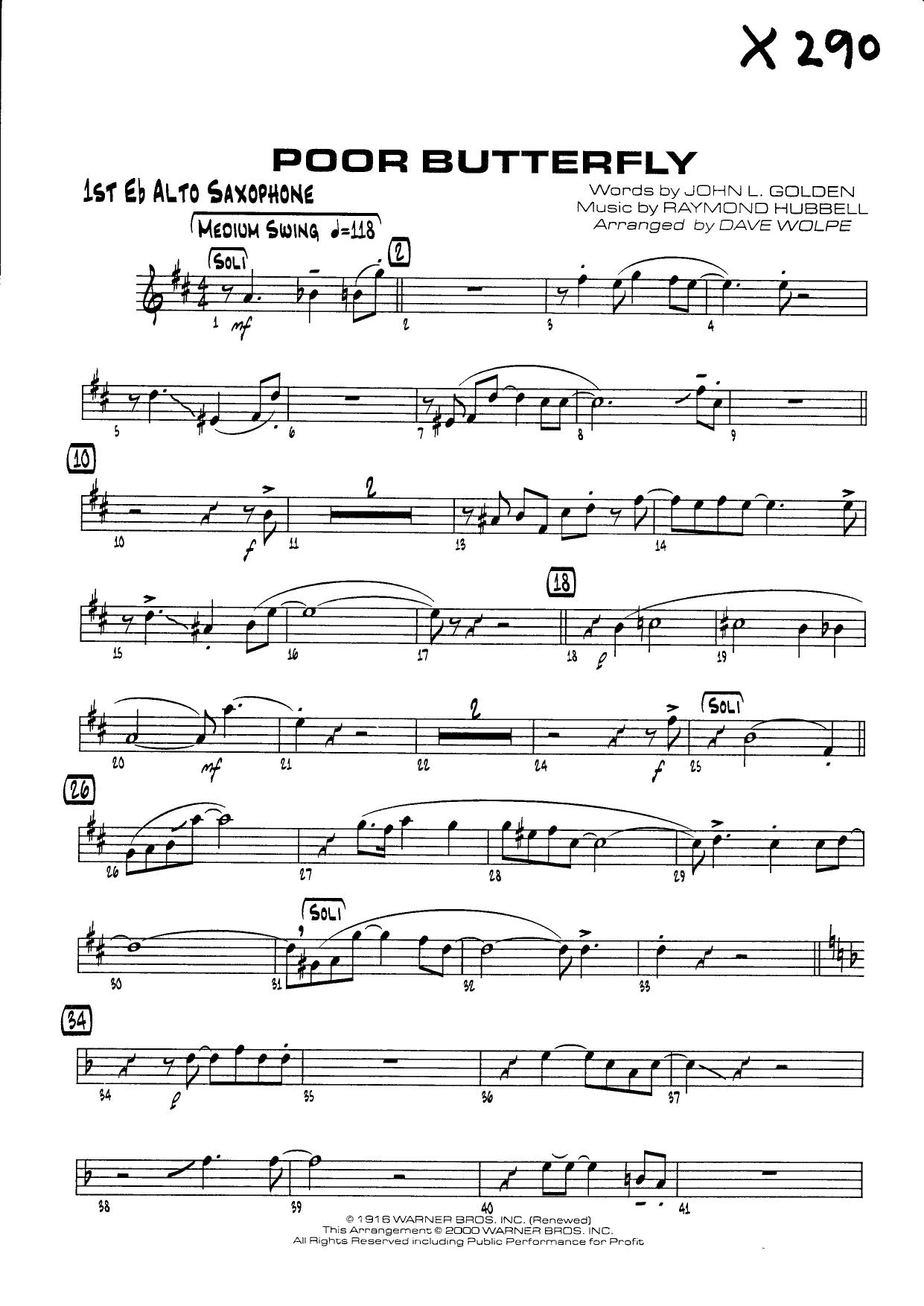
Poor Butterfly (D.Wolpe)
Composed by Raymond Hubbell
Arranged by Dave Wolpe
- Ensemble: Big Band
- Pages: 39
- Instruments (17): 1st Eb Alto Saxophone, 2nd Eb Alto Saxophone, 1st Bb Tenor Saxophone, 2nd Bb Tenor Saxophone, Eb Baritone Saxophone, 1st Bb Trumpet, 2nd Bb Trumpet, 3rd Bb Trumpet, 4th Bb Trumpet, 1st Trombone, 2nd Trombone, 3rd Trombone, Bass Trombone, Guitar, Piano, Bass, Drums
- Difficulty: medium
- Content: Individual Parts
- Format: PDF Download (Instant)
- Price: $24.99
Written originally for the 1915 Broadway production *The Big Show*, "Poor Butterfly" quickly transcended its theatrical origins to become an enduring cornerstone of the Great American Songbook and a beloved vehicle for jazz improvisation. Raymond Hubbell’s melodramatic, pseudo-oriental melody captured the public imagination during the World War I era, but it was the jazz community—cemented by seminal recordings from icons like Sonny Rollins, Benny Goodman, and Art Tatum—that transformed the tune into a sophisticated harmonic playground. Its haunting, asymmetrical phrasing and lush harmonic potential make it a fascinating study in contrasting melancholy with driving rhythmic momentum, bridging early Tin Pan Alley composition with modern jazz sensibilities. Dave Wolpe’s magnificent big band interpretation breathes new life into this classic standard by balancing nostalgic reverence with a crisp, contemporary swing vitality. Unfolding at a comfortable medium-swing tempo, the chart opens with an atmospheric, rubato-leaning introduction that highlights the tender, lyrical nature of Hubbell's melody before settling into a steady, infectious groove. The mood shifts effortlessly from introspective and bittersweet to jubilant and brass-heavy, evoking the sophisticated polish of mid-century studio orchestras. Wolpe’s writing utilizes rich, extended chord voicings that color the ensemble textures with sophisticated chromaticism, giving the saxophones and brass a warm, velvety depth that elevates the emotional resonance of every phrase. Throughout the arrangement, Wolpe demonstrates his masterclass understanding of big band colorimetry, distributing the melodic weight judiciously across the entire ensemble. The saxophones enjoy lush, harmonized soli passages that demand clean articulation and a unified section concept, while the brass section interjects with crisp, punchy counter-melodies and warm, muted backgrounds. A standout feature of the chart is its dynamic pacing, culminating in a robust shout chorus that builds organically from a whisper to a roaring crescendo without ever losing its stylistic poise. Featured improvised solo space allows a standout horn player to stretch out over standard changes, supported by clever, moving comping figures from the rhythm section. Advanced high school ensembles, collegiate jazz orchestras, and professional community big bands will find this arrangement to be an exceptionally rewarding addition to their libraries. While it does not demand the blistering virtuosity of frantic bebop charts, it requires a high degree of maturity, stylistic discipline, and listening awareness to nail the delicate dynamic shifts, subtle swing nuances, and blend required. Directors will appreciate how Wolpe’s masterful scoring naturally exposes the ensemble's strengths, making it an ideal showcase piece for formal concerts, festival adjudications, or sophisticated club performances. The primary technical challenge in Dave Wolpe’s arrangement of "Poor Butterfly" lies in maintaining a relaxed, driving medium-swing feel without rushing the tempo or dragging the syncopated figures. Conductor and rhythm section should establish a deep pocket early, ensuring the quarter-note pulse remains steady and buoyant. The horns must approach the lyrical lines with a legato, vocal-like phrasing style, paying close attention to dynamic markings during the exposed intro and transitional interludes. Saxophones need to focus on intonation and blend during the tight, harmonized soli sections, while brass players should utilize gentle cup or harmon mutes where indicated to achieve the desired vintage coloration without sacrificing projection. Rehearsal should prioritize sectional balance during the build-up to the shout chorus, ensuring the underlying rhythm section comping remains transparent and supportive of the improvised soloists. Q: What instruments and parts are included in this 17-instrument big band arrangement? A: The instrumentation features a standard 17-piece big band layout comprising 5 saxophones (Alto 1, Alto 2, Tenor 1, Tenor 2, Baritone), 4 trumpets, 4 trombones, and a 4-piece rhythm section consisting of piano, guitar, bass, and drums. Q: What is the difficulty level of this Dave Wolpe chart? A: This arrangement is graded as medium to medium-advanced, making it ideal for accomplished high school bands, collegiate jazz ensembles, and professional community big bands looking for a polished, accessible swing chart. Q: What is the historical background and style of "Poor Butterfly"? A: Originally composed by Raymond Hubbell in 1915, the tune evolved from a theatrical novelty into a definitive jazz standard popularized by swing and bebop greats, presented here in a sophisticated, classic medium-swing style. Q: What makes this specific arrangement by Dave Wolpe unique? A: Wolpe distinguishes the chart through his lush, extended harmonic voicings, dynamic pacing that builds from an atmospheric intro to a powerful shout chorus, and clever distribution of melodic material across all sections. Q: What is the performance duration and tempo feel of this piece? A: The arrangement is set in a comfortable, driving 4/4 medium-swing feel with a performance duration of approximately 3 to 4 minutes, depending on the length of the open improvised solos.
Questions and answers
- What is included in the Poor Butterfly (D.Wolpe) PDF?
- The verified current file contains individual parts across 39 pages.
- How many instruments or parts are listed for Poor Butterfly (D.Wolpe)?
- The verified instrumentation list contains 17 entries for this Big Band arrangement.
- Who is credited for Poor Butterfly (D.Wolpe)?
- Composer: Raymond Hubbell. Arranger: Dave Wolpe.
- What difficulty is listed for Poor Butterfly (D.Wolpe)?
- The verified difficulty level is medium.
- Can I preview Poor Butterfly (D.Wolpe) before buying?
- Yes. The product page provides a preview generated from the current PDF file.
- How is Poor Butterfly (D.Wolpe) delivered?
- After successful payment, the digital PDF is made available for download. The displayed price is $24.99.
Musicians Also Search For
Poor Butterfly Dave Wolpe PDF • Poor Butterfly Dave Wolpe sheet music • Poor Butterfly arranged by Dave Wolpe • Dave Wolpe big band charts • Dave Wolpe jazz arrangements PDF • Poor Butterfly Raymond Hubbell sheet music • Poor Butterfly Raymond Hubbell big band arrangements • Raymond Hubbell big band charts • Poor Butterfly big band arrangements • Poor Butterfly big band PDF download • Poor Butterfly jazz sheet music • big band sheet music download • Poor Butterfly individual parts download • Poor Butterfly sheet music PDF • buy Poor Butterfly sheet music • download Poor Butterfly PDF • Poor Butterfly jazz charts • best Dave Wolpe big band arrangements • Raymond Hubbell arranged by Dave Wolpe • Poor Butterfly printable sheet music • big band repertoire PDF