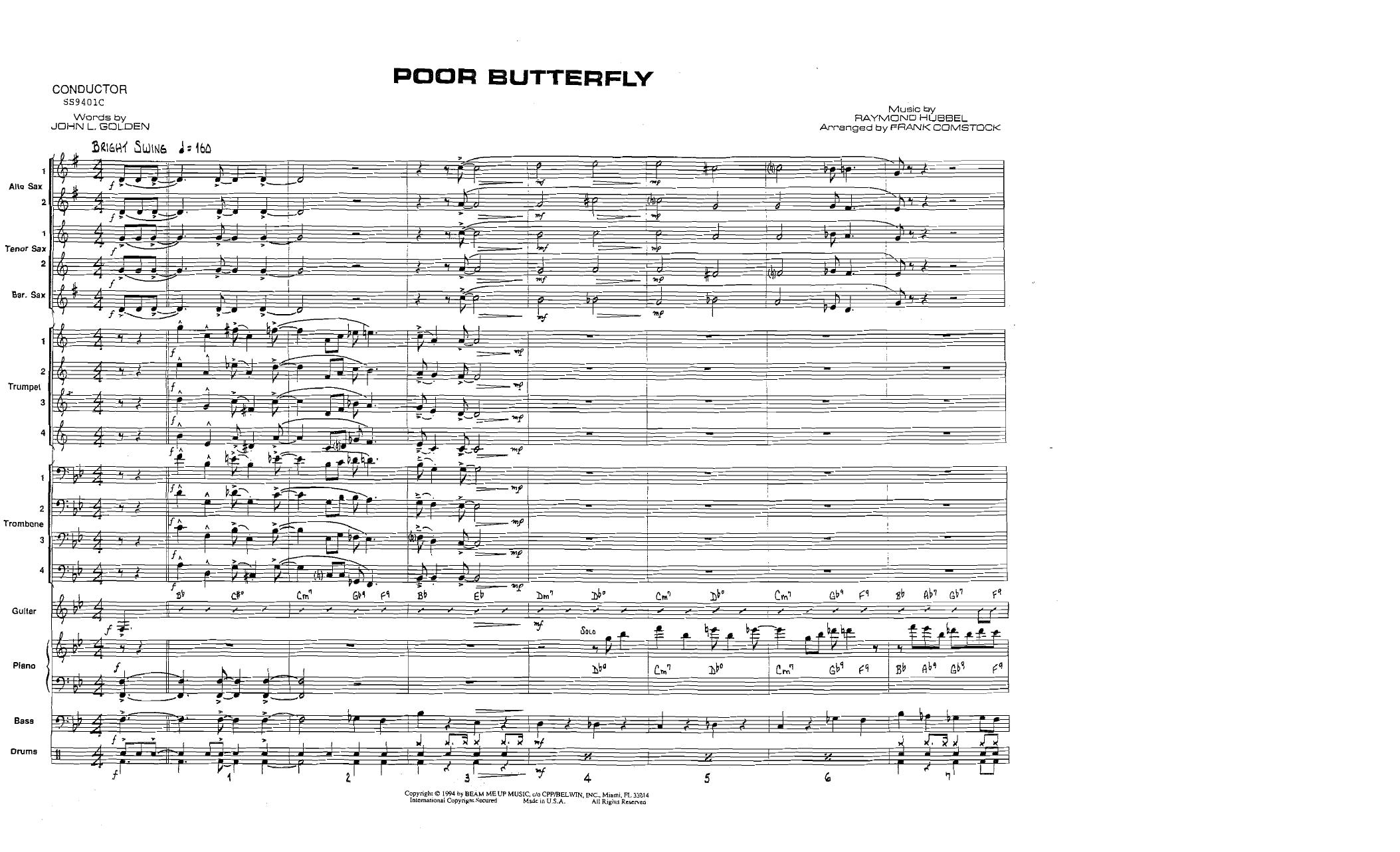
Poor Butterfly (F.Comstock)
Composed by Raymond Hubbell
Arranged by Frank Comstock
- Ensemble: Big Band
- Pages: 63
- Instruments (17): 1st Eb Alto Saxophone, 2nd Eb Alto Saxophone, 1st Bb Tenor Saxophone, 2nd Bb Tenor Saxophone, Eb Baritone Saxophone, 1st Bb Trumpet, 2nd Bb Trumpet, 3rd Bb Trumpet, 4th Bb Trumpet, 1st Trombone, 2nd Trombone, 3rd Trombone, 4th Trombone, Piano, Guitar, Bass, Drums
- Difficulty: advanced
- Content: Individual Parts
- Format: PDF Download (Instant)
- Price: $24.99
Raymond Hubbell and John Golden penned "Poor Butterfly" for the 1916 Broadway production *The Big Show*, where it rapidly transcended its theatrical origins to become a cornerstone of the Great American Songbook. Inspired by Giacomo Puccini’s opera *Madama Butterfly*, the melody captures a poignant, exoticized romantic longing that immediately attracted early jazz pioneers. Throughout the swing era and beyond, legendary interpreters ranging from Benny Goodman and Artie Shaw to Sonny Rollins transformed the tune into a malleable vehicle for improvisation. Its lush, pentatonic-leaning head and sophisticated harmonic roadmap provide an ideal canvas for mid-century jazz arrangers seeking to balance sentimental lyricism with sophisticated orchestral color. Frank Comstock’s masterful big band adaptation reimagines the classic tune through a sophisticated, West Coast-inflected lens, blending cinematic lushness with crisp, modern jazz counterpoint. Unfolding at a poised, reflective medium-ballad tempo, the arrangement begins with an atmospheric, harmonically rich introduction that establishes a bittersweet, nocturnal mood before settling into a supple, flowing swing feel. Comstock utilizes the 8-instrument ensemble—featuring a compact yet potent horn line of alto saxophone, tenor saxophone, baritone saxophone, trumpet, trombone, and rhythm section support—to create an illusion of much larger orchestral depth. The writing relies on tight, harmonized reed and brass solis, elegant line-interweaving, and subtle harmonic reharmonizations that heighten the emotional weight of Hubbell's original melody without ever overcrowding it. Throughout the 63-page score, the musical narrative shifts seamlessly between exposed solo statements and rich, tutti orchestrations. The tenor saxophone and trumpet frequently share primary melodic duties, trading warm, lyrical phrases over a undulating rhythmic foundation provided by the rhythm section. Technical demands center less on raw velocity and much more on intonation, breath control, blend, and stylistic nuance. Players must navigate nuanced dynamic swells, delicate rubato stretches, and precise articulation markings to capture the authentic mid-century West Coast studio sound. The arrangement avoids heavy-handed shout choruses in favor of a gradual, shimmering crescendo that resolves into a peaceful, evocative coda, leaving a lasting emotional impression on both the performers and the audience. Advanced high school ensembles, collegiate jazz labs, and professional pick-up bands will find this arrangement an exceptional vehicle for developing sectional cohesion and mature phrasing. Because of its demanding requirements for lyrical balance and controlled sub-tone playing, it serves as a masterclass in ensemble listening. Directors looking to program a sophisticated, historically resonant ballad that showcases a polished horn section and a mature soloist will discover that Comstock’s treatment offers a rewarding, deeply satisfying alternative to standard high-energy shout charts. Conductors should approach "Poor Butterfly" with an emphasis on transparency, linear momentum, and breath-driven phrasing. The recommended tempo is a relaxed medium ballad (around quarter note = 84-92 BPM), ensuring the underlying swing eighth notes remain buoyant rather than stiff. A primary technical challenge lies in maintaining pristine intonation during the dense, chromatic chord clusters scored for the saxophone section; players should spend dedicated rehearsal time balancing the inner voices. Pay close attention to dynamic markings; the arrangement relies heavily on seamless sub-ito piano drops and gradual swells to generate its cinematic tension. Mutes are generally not required for the brass, allowing for a warm, open tone that matches the rich vibrato of the reed section. In rehearsal, isolate the counter-melodies in the trombone and baritone saxophone to ensure they do not mask the primary thematic material carried by the trumpet and tenor sax. Emphasize a relaxed, behind-the-beat feel in the rhythm section to anchor the ensemble's overall sense of repose. Q: What specific instruments and parts are included in this arrangement? A: This arrangement is scored for an 8-instrument ensemble, which includes alto saxophone, tenor saxophone, baritone saxophone, trumpet, trombone, and a full rhythm section (piano, bass, drums), spanning a comprehensive 63-page conductor and parts manuscript. Q: What is the difficulty level of Frank Comstock's "Poor Butterfly"? A: This chart is best suited for advanced high school, collegiate, and professional jazz ensembles due to its sophisticated harmonic language, demand for mature intonation, and emphasis on lyrical, nuanced phrasing rather than sheer technical speed. Q: What is the musical style and historical context of this piece? A: Originally composed by Raymond Hubbell in 1916, this piece is treated by arranger Frank Comstock as a sophisticated, West Coast-inflected medium swing ballad that bridges early Tin Pan Alley tradition with mid-century modern jazz orchestration. Q: What makes this particular arrangement unique? A: Comstock's arrangement stands out for its cinematic voicings and economical 8-instrument writing that achieves the sonic depth of a full studio orchestra, utilizing lush reharmonizations and delicate counterpoint instead of a traditional heavy shout chorus. Q: What is the approximate performance duration and tempo of the piece? A: The arrangement is performed at a relaxed medium-ballad tempo (approximately quarter note = 84-92 BPM) and typically runs for about 3.5 to 4.5 minutes, depending on the length of the improvised solos.
Questions and answers
- What is included in the Poor Butterfly (F.Comstock) PDF?
- The verified current file contains a conductor score and individual parts across 63 pages.
- How many instruments or parts are listed for Poor Butterfly (F.Comstock)?
- The verified instrumentation list contains 17 entries for this Big Band arrangement.
- Who is credited for Poor Butterfly (F.Comstock)?
- Composer: Raymond Hubbell. Arranger: Frank Comstock.
- What difficulty is listed for Poor Butterfly (F.Comstock)?
- The verified difficulty level is advanced.
- Can I preview Poor Butterfly (F.Comstock) before buying?
- Yes. The product page provides a preview generated from the current PDF file.
- How is Poor Butterfly (F.Comstock) delivered?
- After successful payment, the digital PDF is made available for download. The displayed price is $24.99.
Musicians Also Search For
Poor Butterfly Frank Comstock PDF • Poor Butterfly Frank Comstock sheet music • Poor Butterfly arranged by Frank Comstock • Frank Comstock big band charts • Frank Comstock jazz arrangements PDF • Poor Butterfly Raymond Hubbell sheet music • Poor Butterfly Raymond Hubbell big band arrangements • Raymond Hubbell big band charts • Poor Butterfly big band arrangements • Poor Butterfly big band PDF download • Poor Butterfly jazz sheet music • big band sheet music download • Poor Butterfly conductor score PDF • Poor Butterfly individual parts download • Poor Butterfly sheet music PDF • buy Poor Butterfly sheet music • download Poor Butterfly PDF • Poor Butterfly jazz charts • best Frank Comstock big band arrangements • Raymond Hubbell arranged by Frank Comstock • Poor Butterfly printable sheet music • big band repertoire PDF