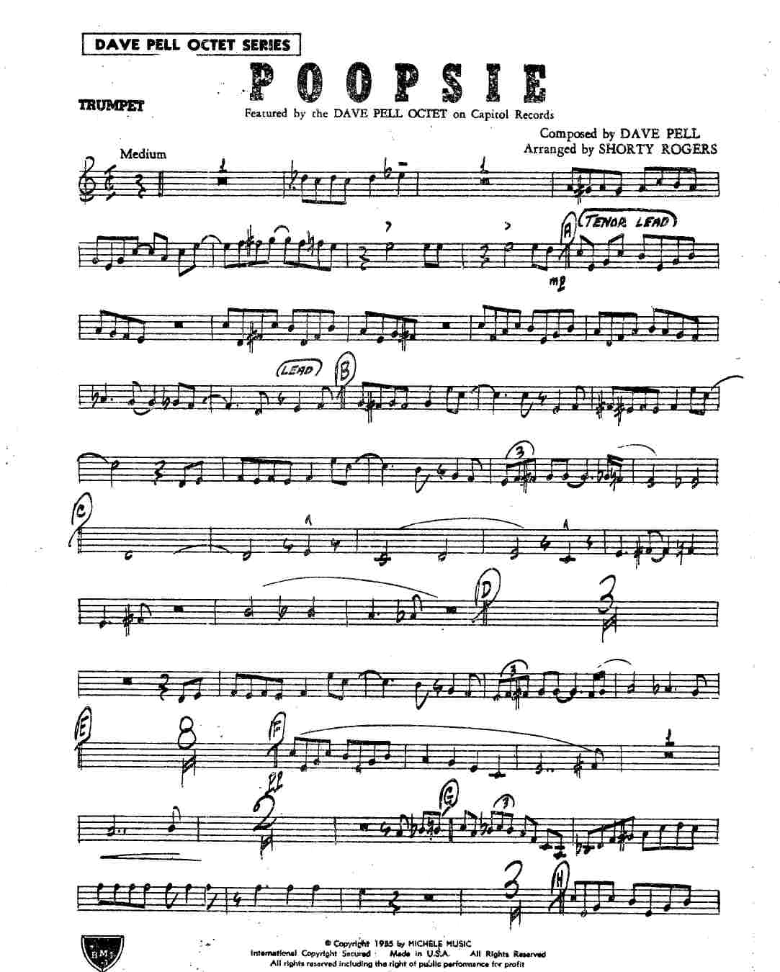
Poopsie (S.Ts,Bs,Trp,Trb+Rhythm)
Composed by Shorty Rogers
Arranged by Shorty Rogers - Dave Pell Octet - Ts,Bs,Trp,Trb+Rhythm
- Ensemble: Small Ensemble
- Style: Jazz Standard
- Pages: 15
- Instruments (8): Trumpet, Tenor Saxophone, Baritone Saxophone, Trombone, Piano, Guitar, Bass, Drums
- Difficulty: easy
- Content: Individual Parts
- Format: PDF Download (Instant)
- Price: $12.99
"Poopsie," originally composed by Shorty Rogers, is a quintessential example of the West Coast Jazz style that flourished in the 1950s. This era, characterized by its laid-back, sophisticated, and often intricate approach to jazz, emerged as a counterpoint to the more frenetic East Coast Bebop. Shorty Rogers, a trumpeter and prolific arranger, was a pivotal figure in shaping this sound, known for his ability to craft arrangements that swung without ostentation and featured complex structures with a relaxed, comfortable flow. The Dave Pell Octet, for whom this arrangement was created, was a highly successful small ensemble that epitomized the West Coast aesthetic, often drawing its members from the ranks of Les Brown's big band. Their music was designed to be both danceable and genuinely jazzy, making them exceptionally popular at college proms and jazz clubs alike. This arrangement of "Poopsie" captures the bright, optimistic, and subtly complex musical character synonymous with Rogers and the Dave Pell Octet. It typically features a medium swing tempo, allowing for both rhythmic propulsion and harmonic clarity. The mood is generally light and engaging, evoking the sun-drenched, cool sophistication of 1950s Los Angeles. Shorty Rogers's arranging style, which Dave Pell credited as instrumental in developing the Octet's distinctive sound, is evident throughout. Rogers was known for his ingeniously voiced arrangements that gave a small group the feel of a big band, often using the guitar in unison with the trumpet to create a fuller sound. This approach results in tightly scored ensembles with deft styling, concealing excellent musicianship beneath a smooth surface. The arrangement features the saxophone section (tenor and baritone) and brass (trumpet and trombone) carrying the melodic statements, often in intricate soli passages that showcase Rogers's harmonic ingenuity. While specific solo sections are integral to the West Coast style, they are typically concise, one-chorus solos that emphasize melodic invention and a "cool" tone rather than extended virtuosic displays. The technical challenges lie in achieving precise ensemble blend and articulation, navigating the often-contrapuntal lines, and maintaining a consistent, relaxed swing feel. The reward for performers is the satisfaction of executing a sophisticated, swinging chart that is both musically intelligent and highly accessible to audiences. The arrangement's clarity and engaging nature make it a rewarding experience for both musicians and listeners. This arrangement is ideally suited for college, community, and professional jazz ensembles seeking to explore the nuanced and sophisticated sounds of West Coast Jazz. Its octet format provides an excellent opportunity for developing musicians to hone their ensemble playing, intonation, and stylistic understanding within a smaller, more exposed setting. The clear melodic lines and structured improvisation sections offer a perfect balance for bands looking to perform historically significant jazz that remains fresh and appealing. The demand for cooperative and precise executive skill, a hallmark of Rogers's writing, makes this piece a valuable educational tool for fostering tight ensemble cohesion. Conductors should emphasize a relaxed, yet precise, medium swing feel throughout "Poopsie." The rhythmic foundation from the rhythm section is paramount; drummers should focus on a crisp, driving ride cymbal pattern, while bassists and pianists maintain a steady, articulate groove. Technical challenges include achieving tight ensemble blend and intonation in the interwoven horn lines, particularly during the soli sections where the saxophone and brass voices interact closely. Articulation should be light and precise, avoiding overly aggressive attacks to maintain the characteristic "cool" aesthetic. There are no special techniques like plunger mutes or extended effects required, allowing musicians to focus on core jazz performance skills. Rehearsal time should be dedicated to balancing the horn sections, ensuring that the guitar's unison lines with the trumpet are clearly audible without overpowering the ensemble. Encourage soloists to embrace melodic improvisation with a focus on tone and phrasing, rather than purely technical fireworks, staying true to the concise, lyrical nature of West Coast Jazz solos. Q: What instruments are included in this arrangement of "Poopsie"? A: This arrangement is scored for a small ensemble, specifically an octet: Tenor Saxophone, Baritone Saxophone, Trumpet, Trombone, Piano, Bass, Drums, and Guitar. Q: What is the difficulty level of this arrangement? A: This arrangement is suitable for college, community, and professional jazz ensembles. It presents technical challenges in ensemble precision and articulation, requiring competent sight-reading and stylistic understanding. Q: What musical style and historical context does "Poopsie" represent? A: "Poopsie" is a jazz standard from the West Coast Jazz era of the 1950s, composed by Shorty Rogers. It embodies the cool, sophisticated, and harmonically rich sound characteristic of that period. Q: What makes this particular arrangement unique? A: This arrangement, by Shorty Rogers for the Dave Pell Octet, is known for its ingeniously voiced horn lines, giving the small octet a larger, "big band" sound, and its emphasis on concise, melodic solos. Q: What is the typical performance duration or tempo for "Poopsie"? A: "Poopsie" is typically performed at a medium swing tempo, which usually results in a performance duration of approximately 3-5 minutes, depending on the number and length of improvised solos.
Questions and answers
- What is included in the Poopsie (S.Ts,Bs,Trp,Trb+Rhythm) PDF?
- The verified current file contains individual parts across 15 pages.
- How many instruments or parts are listed for Poopsie (S.Ts,Bs,Trp,Trb+Rhythm)?
- The verified instrumentation list contains 8 entries for this Small Ensemble arrangement.
- Who is credited for Poopsie (S.Ts,Bs,Trp,Trb+Rhythm)?
- Composer: Shorty Rogers. Arranger: Shorty Rogers - Dave Pell Octet - Ts,Bs,Trp,Trb+Rhythm.
- What difficulty is listed for Poopsie (S.Ts,Bs,Trp,Trb+Rhythm)?
- The verified difficulty level is easy.
- What style is listed for Poopsie (S.Ts,Bs,Trp,Trb+Rhythm)?
- The catalog lists the style as Jazz Standard.
- Can I preview Poopsie (S.Ts,Bs,Trp,Trb+Rhythm) before buying?
- Yes. The product page provides a preview generated from the current PDF file.
- How is Poopsie (S.Ts,Bs,Trp,Trb+Rhythm) delivered?
- After successful payment, the digital PDF is made available for download. The displayed price is $12.99.
Musicians Also Search For
Poopsie Shorty Rogers - Dave Pell Octet - Ts,Bs,Trp,Trb+Rhythm PDF • Poopsie Shorty Rogers - Dave Pell Octet - Ts,Bs,Trp,Trb+Rhythm sheet music • Poopsie arranged by Shorty Rogers - Dave Pell Octet - Ts,Bs,Trp,Trb+Rhythm • Shorty Rogers - Dave Pell Octet - Ts,Bs,Trp,Trb+Rhythm small ensemble charts • Shorty Rogers - Dave Pell Octet - Ts,Bs,Trp,Trb+Rhythm jazz arrangements PDF • Poopsie Shorty Rogers sheet music • Poopsie Shorty Rogers small ensemble arrangements • Shorty Rogers small ensemble charts • Poopsie small ensemble arrangements • Poopsie small ensemble PDF download • Poopsie jazz sheet music • small ensemble sheet music download • Poopsie individual parts download • Poopsie sheet music PDF • Poopsie Jazz Standard charts • Jazz Standard small ensemble arrangements • buy Poopsie sheet music • download Poopsie PDF • Poopsie jazz charts • best Shorty Rogers - Dave Pell Octet - Ts,Bs,Trp,Trb+Rhythm small ensemble arrangements • Shorty Rogers arranged by Shorty Rogers - Dave Pell Octet - Ts,Bs,Trp,Trb+Rhythm • Poopsie printable sheet music • small ensemble repertoire PDF