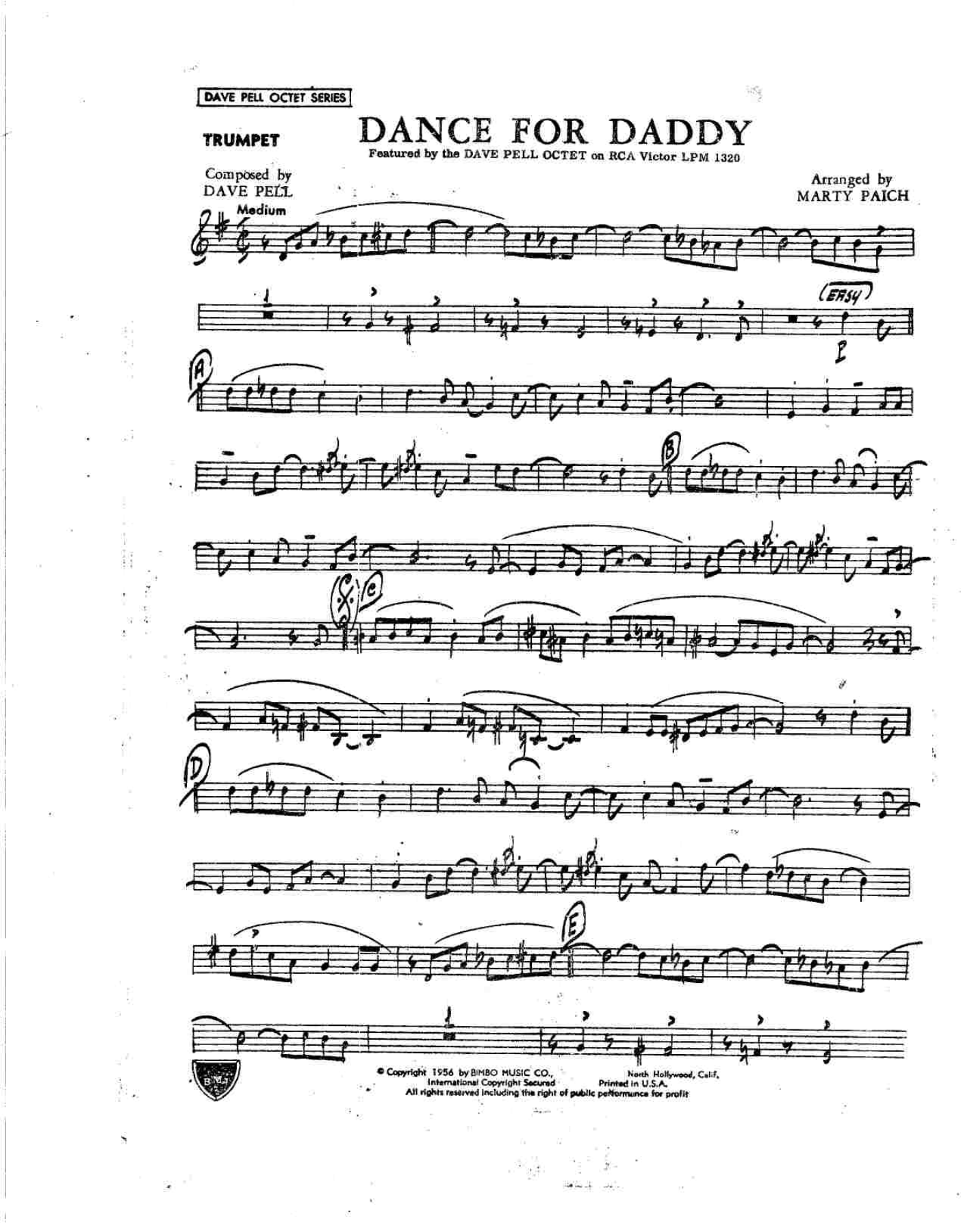
Dance For Daddy (P.Ts,Bs,Trp,Trb+Rhythm)
Composed by Marty Paich
Arranged by Paich - Dave Pell Octet - Ts,Bs,Trp,Trb+Rhythm
- Ensemble: Small Ensemble
- Style: Jazz Standard
- Pages: 16
- Instruments (8): Trumpet, Tenor Saxophone, Baritone Saxophone, Trombone, Piano, Guitar, Bass, Drums
- Difficulty: easy
- Content: Individual Parts
- Format: PDF Download (Instant)
- Price: $12.99
"Dance For Daddy" is a quintessential jazz standard from the West Coast Cool era, originally composed by the legendary Marty Paich. Paich, a prolific pianist, composer, and arranger, was a pivotal figure in the 1950s Los Angeles jazz scene, renowned for his sophisticated and innovative arrangements that blended cool jazz aesthetics with orchestral depth. This particular arrangement, recorded by the Dave Pell Octet in 1956 on their album *Jazz Goes Dancing*, exemplifies the refined, yet swinging, sound that defined this influential period in jazz history. The Dave Pell Octet, formed by tenor saxophonist Dave Pell while he was still with the Les Brown band, carved out a unique niche by focusing on sophisticated arrangements of the Great American Songbook and original compositions, aiming for a sound that was both jazz-oriented and commercially appealing. This arrangement captures the bright, articulate, and often understated energy characteristic of the West Coast style, making it a notable piece for its harmonic ingenuity and melodic clarity. Musically, "Dance For Daddy" is a medium-swing jazz standard, typically performed at a comfortable, danceable tempo that encourages a relaxed yet propulsive groove. The piece is characterized by its bright, optimistic mood and an engaging, flowing melodic line. Paich's arranging style is immediately recognizable through his use of airy voicings, often featuring close-knit harmonies and counterpoint within the small ensemble. His arrangements for the Dave Pell Octet were known for their "polished chrome" sound, emphasizing clarity and precision over raw power. The piece often features intricate interplay between the horn sections, creating a rich texture despite the octet's smaller size compared to a full big band. The overall effect is one of effortless swing and sophisticated charm, evoking the cool, laid-back atmosphere of 1950s California jazz clubs. This specific arrangement by Paich for the Dave Pell Octet showcases his mastery of small ensemble writing. The melody is initially carried by the tenor saxophone, often in unison or harmonized with other horns, before transitioning to a full ensemble soli. There are ample opportunities for featured solos, typically for tenor saxophone, trumpet, and piano, allowing individual musicians to demonstrate their improvisational prowess within the structured framework of Paich's chart. The technical challenges lie in maintaining the crisp articulation and precise ensemble blend that are hallmarks of Paich's writing, particularly in the tightly voiced horn sections and dynamic contrasts. The rewarding aspect of performing this piece comes from achieving that seamless, swinging ensemble sound and navigating the elegant harmonic progressions. It's a piece that demands musicality and attention to detail, offering a deeply satisfying experience when executed with finesse. This arrangement is ideally suited for college and advanced high school jazz ensembles, as well as community and professional small jazz groups. Its demands for precise intonation, rhythmic accuracy, and sophisticated phrasing make it an excellent vehicle for developing ensemble cohesion and stylistic understanding. The solos are challenging but accessible, providing a platform for developing improvisers. Professional groups will appreciate the nuanced writing and the opportunity to delve into the historical significance and musical depth of a classic West Coast jazz arrangement. The compact instrumentation (tenor saxophone, baritone saxophone, trumpet, trombone, plus rhythm section) makes it practical for groups that may not have a full big band complement but still desire a rich, orchestrated sound. Conductors should emphasize a consistent, relaxed medium-swing feel throughout "Dance For Daddy," ensuring the rhythm section lays down a solid, unhurried foundation. Pay close attention to articulation, aiming for a light, detached approach in the horn lines to achieve the characteristic West Coast "cool" sound. Horn players should focus on precise attacks and releases, particularly in unison and harmonized passages, to maintain clarity within Paich's intricate voicings. Dynamic contrasts are crucial; subtle swells and diminuendos will enhance the musicality, especially in the ensemble sections. Solos for tenor saxophone, trumpet, and piano should be encouraged to embody the cool jazz aesthetic – melodic, harmonically informed, and rhythmically precise. Rehearsal time should be dedicated to balancing the horn section, ensuring each voice is heard without overwhelming the others, and perfecting the transitions between ensemble figures and solo sections. No special techniques like plunger mutes or falls are explicitly required, allowing the focus to remain on clean execution and stylistic integrity. Q: What instruments are included in this arrangement of "Dance For Daddy"? A: This arrangement is scored for a small ensemble featuring Tenor Saxophone, Baritone Saxophone, Trumpet, Trombone, and a standard Rhythm Section (Piano, Bass, Drums). Q: What is the difficulty level of this arrangement? A: This arrangement is considered advanced intermediate to advanced, suitable for college, community, and professional jazz ensembles due to its demands for precise ensemble playing, intricate voicings, and nuanced interpretation. Q: What is the musical style and historical context of "Dance For Daddy"? A: "Dance For Daddy" is a jazz standard composed by Marty Paich, representing the West Coast Cool Jazz style of the mid-1950s, characterized by its sophisticated harmonies, lighter swing feel, and emphasis on melodic clarity. Q: What makes this Marty Paich arrangement unique? A: Paich's arrangement is unique for its signature airy voicings, intricate counterpoint, and the way it achieves a full, orchestrated sound with a compact octet instrumentation, providing rich harmonic textures and ample solo opportunities. Q: What is the typical performance duration and tempo of this piece? A: The typical performance duration for "Dance For Daddy" is approximately 3-5 minutes, performed at a medium-swing tempo, encouraging a relaxed yet propulsive groove.
Questions and answers
- What is included in the Dance For Daddy (P.Ts,Bs,Trp,Trb+Rhythm) PDF?
- The verified current file contains individual parts across 16 pages.
- How many instruments or parts are listed for Dance For Daddy (P.Ts,Bs,Trp,Trb+Rhythm)?
- The verified instrumentation list contains 8 entries for this Small Ensemble arrangement.
- Who is credited for Dance For Daddy (P.Ts,Bs,Trp,Trb+Rhythm)?
- Composer: Marty Paich. Arranger: Paich - Dave Pell Octet - Ts,Bs,Trp,Trb+Rhythm.
- What difficulty is listed for Dance For Daddy (P.Ts,Bs,Trp,Trb+Rhythm)?
- The verified difficulty level is easy.
- What style is listed for Dance For Daddy (P.Ts,Bs,Trp,Trb+Rhythm)?
- The catalog lists the style as Jazz Standard.
- Can I preview Dance For Daddy (P.Ts,Bs,Trp,Trb+Rhythm) before buying?
- Yes. The product page provides a preview generated from the current PDF file.
- How is Dance For Daddy (P.Ts,Bs,Trp,Trb+Rhythm) delivered?
- After successful payment, the digital PDF is made available for download. The displayed price is $12.99.
Musicians Also Search For
Dance For Daddy Paich - Dave Pell Octet - Ts,Bs,Trp,Trb+Rhythm PDF • Dance For Daddy Paich - Dave Pell Octet - Ts,Bs,Trp,Trb+Rhythm sheet music • Dance For Daddy arranged by Paich - Dave Pell Octet - Ts,Bs,Trp,Trb+Rhythm • Paich - Dave Pell Octet - Ts,Bs,Trp,Trb+Rhythm small ensemble charts • Paich - Dave Pell Octet - Ts,Bs,Trp,Trb+Rhythm jazz arrangements PDF • Dance For Daddy Marty Paich sheet music • Dance For Daddy Marty Paich small ensemble arrangements • Marty Paich small ensemble charts • Dance For Daddy small ensemble arrangements • Dance For Daddy small ensemble PDF download • Dance For Daddy jazz sheet music • small ensemble sheet music download • Dance For Daddy individual parts download • Dance For Daddy sheet music PDF • Dance For Daddy Jazz Standard charts • Jazz Standard small ensemble arrangements • buy Dance For Daddy sheet music • download Dance For Daddy PDF • Dance For Daddy jazz charts • best Paich - Dave Pell Octet - Ts,Bs,Trp,Trb+Rhythm small ensemble arrangements • Marty Paich arranged by Paich - Dave Pell Octet - Ts,Bs,Trp,Trb+Rhythm • Dance For Daddy printable sheet music • small ensemble repertoire PDF