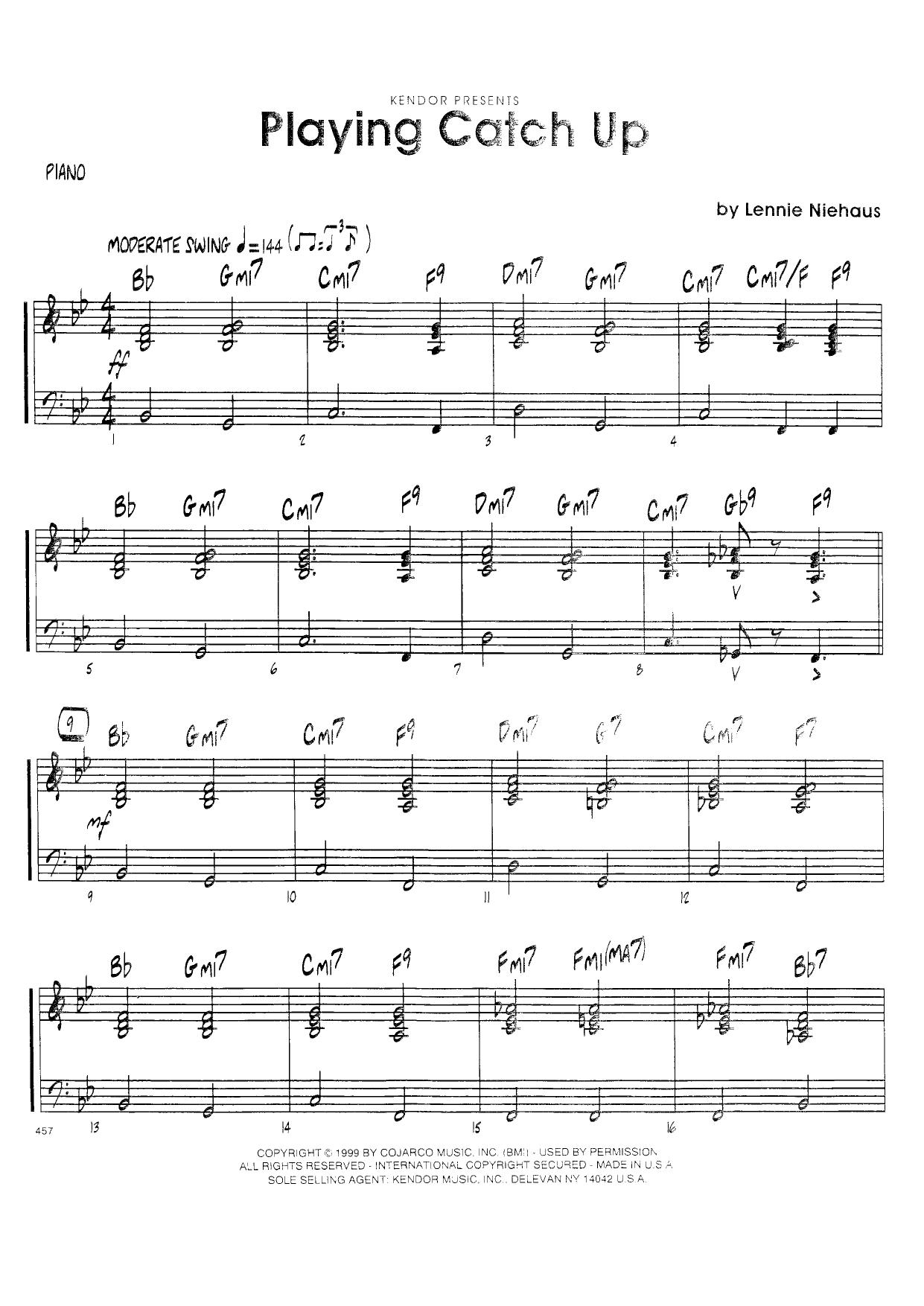
Playing Catch Up (L.Niehaus) sheet music preview

Playing Catch Up (L.Niehaus)

Composed by Lennie Niehaus

Arranged by Lennie Niehaus

  • Ensemble: Big Band
  • Pages: 36
  • Instruments (17): Piano, Bass, Drums, Guitar, 1st Eb Alto Sax, 2nd Eb Alto Sax, 1st Bb Tenor Sax, 2nd Bb Tenor Sax, Eb Baritone Sax, 1st Bb Trumpet, 2nd Bb Trumpet, 3rd Bb Trumpet, 4th Bb Trumpet, Trombone 1, Trombone 2, Trombone 3, Trombone 4
  • Difficulty: medium
  • Content: Individual Parts
  • Format: PDF Download (Instant)
  • Price: $24.99

West Coast cool jazz pioneer Lennie Niehaus crafted "Playing Catch Up" as a masterclass in linear writing, harmonic sophistication, and driving momentum. Emerging from the vibrant Los Angeles jazz scene of the 1950s where Niehaus was a central figure—notably as an alto saxophonist and arranger for the Stan Kenton Orchestra—this composition reflects the intellectual rigor, contrapuntal clarity, and understated intensity that defined the West Coast movement. While East Coast bop leaned heavily into raw aggression, Niehaus infused his writing with a refined, classically influenced elegance without ever sacrificing rhythmic drive or blues-soaked authenticity. Driven by an infectious, bright medium-up swing feel in 4/4 time, "Playing Catch Up" opens with an energetic, interlocking thematic statement that immediately establishes a playful yet demanding musical dialog across the ensemble. The harmonic language is rich with sophisticated extended chords, modal colorations, and tight chromatic voice-leading typical of Niehaus's writing style. The mood is relentlessly upbeat, characterized by crisp articulation, buoyant syncopation, and a brisk conversational interplay between the brass and reed sections that evokes the bustling urban energy of mid-century modernism. Niehaus structures the arrangement to showcase the entire big band through transparent textures and brilliant sectional balance. Rather than relying on dense, wall-of-sound orchestration, the writing emphasizes nimble sax solis and punchy, harmonically rich brass counterlines. The melody is shared fluidly, requiring absolute precision in articulation and dynamic control, particularly during fast unison and harmonized passages. Featured improvised solo spaces allow standout performers on alto saxophone and trumpet to stretch out over changes that demand a strong command of bebop vocabulary. The chart builds dynamically toward a brilliant, structurally cohesive shout chorus that reincorporates the primary motifs before driving cleanly to an abrupt, high-energy ending. Advanced high school, collegiate, and professional big bands will find this arrangement an ideal vehicle for developing ensemble cohesion, lightweight swing phrasing, and technical agility. Because Niehaus avoids excessive volume demands in favor of intricate linear interplay, success with this chart hinges on immaculate section blend, rhythmic exactitude, and a light, forward-moving ride cymbal feel. It stands as an exceptional showcase for bands looking to explore the sophisticated, swinging vernacular of West Coast jazz history. Rehearsing "Playing Catch Up" requires a disciplined approach to lightweight, driving swing articulation. Conductor focus should center on the foundational rhythm section; the drummer must maintain a crisp, unforced medium-up swing groove with a prominent feathering of the bass drum and a steady, articulate ride cymbal pattern that anchors the brisk tempo. Horn players must practice all eighth-note passages with a traditional jazz articulation style—treating downbeats with length and accentuating the upbeats cleanly without heavy tonguing. Pay close attention to dynamic markings during the dense contrapuntal sections to ensure that inner-voice harmonies do not obscure the primary melodic line. Special techniques are minimal, relying instead on pure tone quality, accurate intonation on altered dominants, and controlled breath support through extended phrases. Sectional rehearsals isolating the sax soli and the brass counter-melodies will yield the tightest results before combining the ensemble at full tempo. Q: What instruments and parts are included in this big band arrangement? A: The instrumentation features an 8-instrument core structure standard for concise or flexible big band configurations, explicitly including Alto Saxophone, Tenor Saxophone, Baritone Saxophone, Trumpet, and Trombone parts, fully supported by a complete rhythm section. Q: What is the difficulty level of this Lennie Niehaus chart? A: This arrangement is graded as advanced, making it best suited for accomplished high school, collegiate, and professional jazz ensembles due to its fast tempo, intricate linear writing, and sophisticated harmonic demands. Q: What musical style and historical era does "Playing Catch Up" represent? A: Composed by Lennie Niehaus, the piece firmly represents the West Coast cool jazz and bebop movements of the 1950s, emphasizing contrapuntal clarity, buoyant swing feels, and refined harmonic voicings. Q: What makes this specific Lennie Niehaus arrangement unique? A: It showcases Niehaus's signature compositional style, which blends classical counterpoint and transparent textures with driving West Coast swing, avoiding heavy brass shouting in favor of nimble sax solis and sharp, conversational phrasing. Q: What is the recommended performance tempo and duration for this piece? A: The arrangement is designed to be performed at a bright, driving medium-up swing tempo (approximately quarter note = 192-208 BPM), resulting in an engaging performance duration of around 3 to 4 minutes.

Questions and answers

What is included in the Playing Catch Up (L.Niehaus) PDF?
The verified current file contains individual parts across 36 pages.
How many instruments or parts are listed for Playing Catch Up (L.Niehaus)?
The verified instrumentation list contains 17 entries for this Big Band arrangement.
Who is credited for Playing Catch Up (L.Niehaus)?
Composer: Lennie Niehaus. Arranger: Lennie Niehaus.
What difficulty is listed for Playing Catch Up (L.Niehaus)?
The verified difficulty level is medium.
Can I preview Playing Catch Up (L.Niehaus) before buying?
Yes. The product page provides a preview generated from the current PDF file.
How is Playing Catch Up (L.Niehaus) delivered?
After successful payment, the digital PDF is made available for download. The displayed price is $24.99.

Musicians Also Search For

Playing Catch Up Lennie Niehaus PDFPlaying Catch Up Lennie Niehaus sheet musicPlaying Catch Up arranged by Lennie NiehausLennie Niehaus big band chartsLennie Niehaus jazz arrangements PDFPlaying Catch Up Lennie Niehaus big band arrangementsPlaying Catch Up big band arrangementsPlaying Catch Up big band PDF downloadPlaying Catch Up jazz sheet musicbig band sheet music downloadPlaying Catch Up individual parts downloadPlaying Catch Up sheet music PDFbuy Playing Catch Up sheet musicdownload Playing Catch Up PDFPlaying Catch Up jazz chartsbest Lennie Niehaus big band arrangementsPlaying Catch Up printable sheet musicbig band repertoire PDF

All arrangements by Lennie Niehaus All Lennie Niehaus sheet music