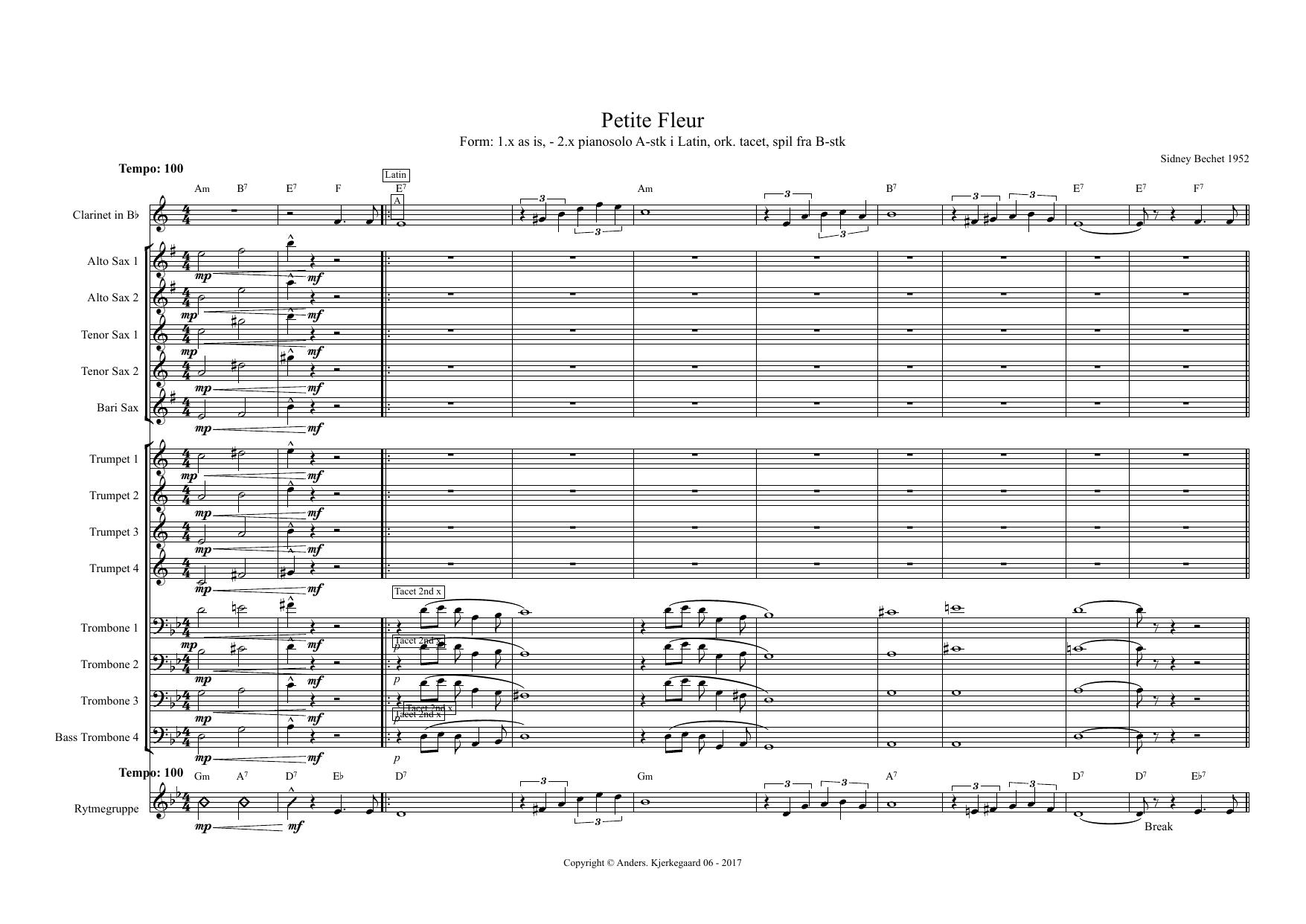
Petite Fleur-Clarinet feature (A.Kjerkegaard)
Composed by Sidney Bechet
Arranged by Anders. Kjerkegaard
- Ensemble: Big Band
- Style: Jazz Standard
- Pages: 19
- Instruments (15): Clarinet in Bb, Alto Sax 1, Alto Sax 2, Tenor Sax 1, Tenor Sax 2, Bari Sax, Trumpet 1, Trumpet 2, Trumpet 3, Trumpet 4, Trombone 1, Trombone 2, Trombone 3, Bass Trombone 4, Rytmegruppe
- Difficulty: easy
- Content: Individual Parts
- Format: PDF Download (Instant)
- Price: $24.99
Sidney Bechet’s immortal jazz standard "Petite Fleur" stands as one of the definitive masterpieces of early jazz and New Orleans revivalism. Composed in 1952 during Bechet’s self-imposed exile in France, the tune immediately captured the European imagination, merging the lush, romantic lyricism of the French cabaret tradition with the driving, emotive blues-drenched phrasing of New Orleans soprano saxophone. While originally recorded as a showcase for Bechet's virtuosic soprano, the melody's sublime structural symmetry and hauntingly nostalgic harmonic progression quickly transformed it into an international canvas for jazz clarinetists worldwide. Anders Kjerkegaard’s sophisticated big band adaptation honors this rich stylistic lineage while breathing fresh life into the standard through a vibrant, mid-century modern jazz orchestral lens. Set at a comfortable, swinging medium tempo, the arrangement opens with an inviting warmth that immediately establishes an intimate yet swinging atmosphere. Kjerkegaard balances transparent ensemble textures with rich, Ellingtonian reed voicings, allowing the underlying harmonic movement to unfold naturally. The mood shifts effortlessly between melancholic introspection and buoyant, toe-tapping swing energy, evoking the smoky ambiance of a Parisian jazz club infused with classic American big band swing. The primary focal point of the chart is a prominent, extended feature for Bb clarinet, remaining faithful to the spirit of Bechet’s original woodwind-driven conception while expanding the sonic architecture to support a full 15-piece jazz ensemble. Kjerkegaard utilizes clever counterpoint in the lower brass and subtle sax solis to frame the featured soloist without ever obscuring them. The background figures are tastefully written, utilizing warm chordal pads and gentle rhythmic nudges that elevate the soloist. Technical demands for the ensemble are moderate, though the chart requires an exceptional sense of stylistic phrasing, dynamic control, and a deep appreciation for traditional jazz articulation from both the rhythm section and the horn lines. Advanced high school ensembles, collegiate jazz orchestras, and professional community big bands will find this arrangement an exceptionally rewarding addition to their repertoire. It provides a masterclass in ensemble balance and stylistic versatility, offering a refreshing departure from high-octane up-tempo burners or dense contemporary charts. For audiences, the familiar strains of "Petite Fleur" presented through Kjerkegaard's lush, thoughtful orchestration offer an unforgettable concert highlight that bridges traditional jazz warmth with refined big band sophistication. Achieving an authentic performance of this arrangement requires a disciplined approach to stylistic phrasing and dynamic restraint. The tempo should remain a steady, relaxed medium swing; avoid rushing the pulse, as the charm of the piece relies heavily on its unhurried, conversational groove. The rhythm section must lay back, driving the beat with a light, feather-bass feel and subtle ride cymbal articulation rather than heavy, modern comping. For the featured Bb clarinetist, tone quality is paramount—aim for a warm, centered sound that cuts through the ensemble without forcing. Pay close attention to the dynamic markings in the brass and reed sections; backgrounds behind the soloist must remain strictly subservient, operating as a warm cushion. Brass players should utilize a warm, open tone with minimal vibrato, reserving any expressive scoops or falls for authentic period flavor. Rehearsals should initially focus on the breath support and intonation of the harmonized reed passages before integrating the soloist, ensuring the big band breathes together as a unified chamber unit. Q: What instruments and parts are included in this arrangement? A: This 15-instrument big band arrangement includes a featured Clarinet in Bb, Alto Saxophone 1, Alto Saxophone 2, Tenor Saxophone 1, Tenor Saxophone 2, plus standard big band brass and rhythm section instrumentation, accompanied by a comprehensive 19-page conductor score. Q: What is the difficulty level of this chart? A: This arrangement is graded as intermediate, making it well-suited for advanced high school, collegiate, and professional community big bands looking for a strong soloist feature that emphasizes phrasing over sheer technical velocity. Q: What is the stylistic and historical context of the piece? A: Based on Sidney Bechet's 1952 classic, this arrangement captures the essence of the New Orleans jazz revival in France, blending European cabaret romanticism with classic American medium-swing big band traditions. Q: What makes Anders Kjerkegaard’s arrangement unique? A: Kjerkegaard successfully scales down the iconic soprano saxophone vehicle into a rich, full big band setting while maintaining intimate chamber-like textures, tasteful counterpoint, and Ellington-esque reed voicings that never overpower the featured clarinetist. Q: What is the performance duration and tempo feel? A: The arrangement is set at a relaxed, steady medium swing tempo (approx. 112–120 BPM) and typically runs for about 4 to 5 minutes depending on the length of the improvised clarinet solo choruses.
Questions and answers
- What is included in the Petite Fleur-Clarinet feature (A.Kjerkegaard) PDF?
- The verified current file contains a conductor score and individual parts across 19 pages.
- How many instruments or parts are listed for Petite Fleur-Clarinet feature (A.Kjerkegaard)?
- The verified instrumentation list contains 15 entries for this Big Band arrangement.
- Who is credited for Petite Fleur-Clarinet feature (A.Kjerkegaard)?
- Composer: Sidney Bechet. Arranger: Anders. Kjerkegaard.
- What difficulty is listed for Petite Fleur-Clarinet feature (A.Kjerkegaard)?
- The verified difficulty level is easy.
- What style is listed for Petite Fleur-Clarinet feature (A.Kjerkegaard)?
- The catalog lists the style as Jazz Standard.
- Can I preview Petite Fleur-Clarinet feature (A.Kjerkegaard) before buying?
- Yes. The product page provides a preview generated from the current PDF file.
- How is Petite Fleur-Clarinet feature (A.Kjerkegaard) delivered?
- After successful payment, the digital PDF is made available for download. The displayed price is $24.99.
Musicians Also Search For
Petite Fleur-Clarinet feature Anders. Kjerkegaard PDF • Petite Fleur-Clarinet feature Anders. Kjerkegaard sheet music • Petite Fleur-Clarinet feature arranged by Anders. Kjerkegaard • Anders. Kjerkegaard big band charts • Anders. Kjerkegaard jazz arrangements PDF • Petite Fleur-Clarinet feature Sidney Bechet sheet music • Petite Fleur-Clarinet feature Sidney Bechet big band arrangements • Sidney Bechet big band charts • Petite Fleur-Clarinet feature big band arrangements • Petite Fleur-Clarinet feature big band PDF download • Petite Fleur-Clarinet feature jazz sheet music • big band sheet music download • Petite Fleur-Clarinet feature conductor score PDF • Petite Fleur-Clarinet feature individual parts download • Petite Fleur-Clarinet feature sheet music PDF • Petite Fleur-Clarinet feature Jazz Standard charts • Jazz Standard big band arrangements • buy Petite Fleur-Clarinet feature sheet music • download Petite Fleur-Clarinet feature PDF • Petite Fleur-Clarinet feature jazz charts • best Anders. Kjerkegaard big band arrangements • Sidney Bechet arranged by Anders. Kjerkegaard • Petite Fleur-Clarinet feature printable sheet music • big band repertoire PDF