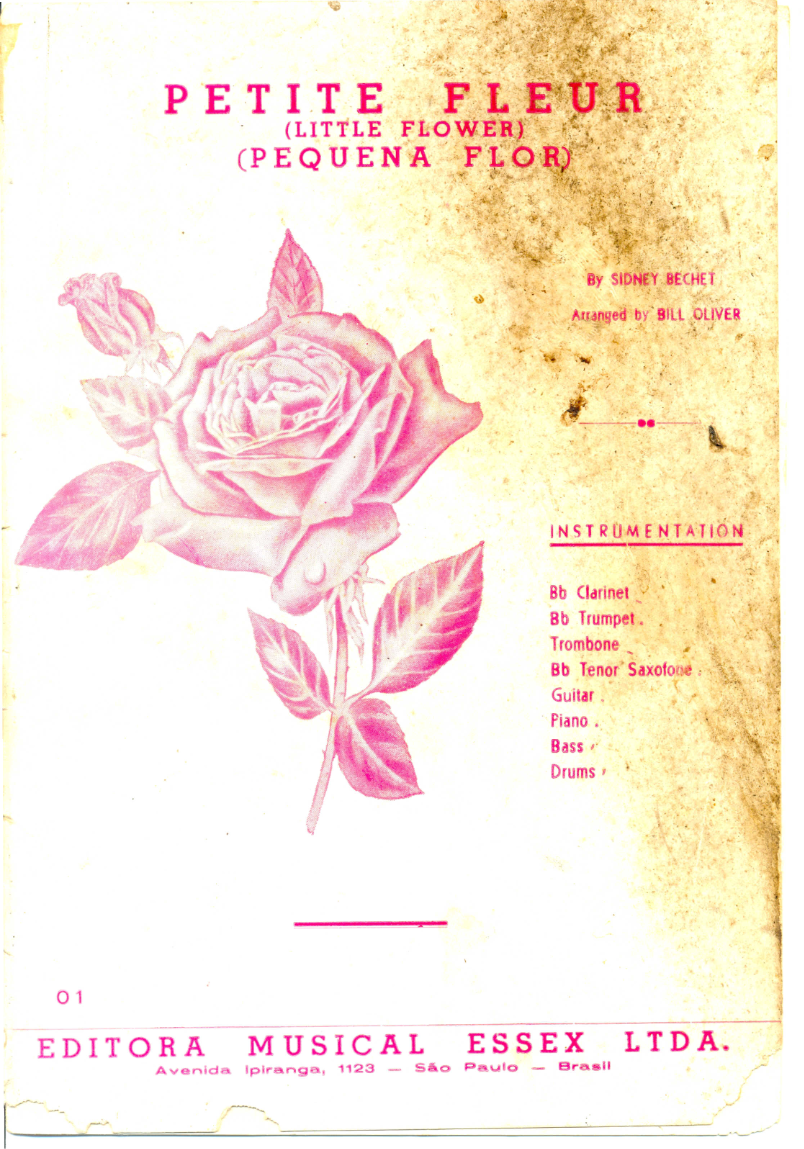
Petite Fleur (B.Oliver) sheet music preview

Petite Fleur (B.Oliver)

Composed by SIDNEY BECHET

Arranged by Bill Oliver

  • Ensemble: Small Ensemble
  • Style: Jazz Standard
  • Pages: 11
  • Instruments (8): Bb Clarinet, Bb Trumpet, Trombone, Bb Tenor Saxophone, Guitar, Piano, Bass, Drums
  • Difficulty: easy
  • Content: Individual Parts
  • Format: PDF Download (Instant)
  • Price: $12.99

"Petite Fleur," French for "Little Flower," is a timeless jazz standard originally composed by the pioneering New Orleans soprano saxophonist and clarinetist Sidney Bechet in 1952. Bechet, a foundational figure in early jazz, penned this instrumental while residing in Paris, a period of renewed acclaim for the artist. The piece quickly became one of his most iconic works, embodying the lyrical, expressive, and fervent spirit of the New Orleans tradition, blended with a romantic, song-like sensibility. Its widespread popularity was cemented not only by Bechet's original recording but also by the 1959 international hit version by Chris Barber's Jazz Band, featuring Monty Sunshine on clarinet, which introduced the tune to a broader audience and solidified its place as an enduring standard. The composition's simple, flowing melody and accessible AABA form contribute to its lasting appeal, making it a staple in jazz repertoires worldwide. This arrangement of "Petite Fleur" by Bill Oliver captures the nostalgic charm and gentle swing of the original, presenting it as a medium-tempo jazz standard. Set in the key of Bb major, it maintains the wistful, romantic character that has made the piece beloved for decades. The musical character is one of understated elegance, evoking a sense of sweet melancholy and graceful movement. Oliver's approach emphasizes clear melodic lines and rich, yet transparent, voicings suitable for a small ensemble. The arrangement allows the inherent beauty of Bechet's melody to shine through, supported by harmonic textures that are both familiar and subtly sophisticated, avoiding overly complex reharmonizations to preserve the tune's classic feel. Bill Oliver's treatment of "Petite Fleur" thoughtfully distributes the melodic duties, ensuring engagement across the ensemble. The primary melody is typically carried by the lead voice, often the clarinet or soprano saxophone, echoing Bechet's original instrumentation. Opportunities for featured solos are integrated naturally, allowing improvisers to explore the tune's inviting harmonic landscape. Technical challenges are primarily centered around achieving a cohesive ensemble sound, maintaining a consistent, relaxed medium swing feel, and executing the lyrical phrasing with sensitivity. The arrangement is rewarding to perform because it allows musicians to connect with a deeply emotional and historically significant piece of jazz, fostering expressive playing and a unified musical statement. This small ensemble arrangement is ideally suited for college-level jazz combos, community jazz groups, or professional ensembles seeking a classic, well-crafted addition to their repertoire. Its moderate difficulty level makes it approachable for musicians with solid instrumental proficiency and a good understanding of jazz phrasing and articulation. The clear notation and thoughtful scoring provide an excellent framework for developing ensemble dynamics and musical interpretation, making it an invaluable piece for both performance and educational settings. The 11 pages of score and parts ensure a comprehensive and well-organized presentation for all musicians involved. This arrangement of "Petite Fleur" thrives on a relaxed, medium swing feel, typically around 90-100 beats per minute. Conductors should emphasize a gentle, flowing pulse rather than a rigid metronomic tempo. The key technical challenge lies in achieving a unified, lyrical phrasing across the ensemble, particularly in the melodic sections. Encourage musicians to listen intently to each other, blending their sounds to create a seamless melodic line, especially during the A sections. Articulation should be soft and connected, with a focus on shaping phrases rather than individual notes. There are no special techniques like plunger mutes or extreme falls required, allowing the ensemble to concentrate on musicality and expression. Rehearsal time should be dedicated to balancing dynamics, ensuring the accompaniment supports the melody without overpowering it, and refining the subtle rhythmic nuances that define a true swing feel. **Q: What instruments/parts are included in this arrangement?** A: This small ensemble arrangement typically includes parts for a lead melodic instrument (e.g., clarinet, soprano saxophone, or trumpet), a harmony instrument (e.g., alto saxophone, trombone), piano, bass, and drums. Specific instrumentation may vary slightly but will always support the core small ensemble format. **Q: What is the difficulty level of this arrangement?** A: This arrangement is rated as moderate difficulty. It is suitable for college-level jazz combos, advanced high school ensembles, or experienced community and professional groups, requiring solid instrumental technique and an understanding of jazz improvisation and ensemble playing. **Q: What is the musical style and historical context of "Petite Fleur"?** A: "Petite Fleur" is a classic jazz standard in the traditional jazz or "trad jazz" style, composed by Sidney Bechet in 1952. It embodies the lyrical and expressive qualities of New Orleans jazz, later gaining international fame through its gentle, nostalgic melody. **Q: What makes Bill Oliver's arrangement of "Petite Fleur" unique?** A: Bill Oliver's arrangement distinguishes itself by preserving the original's nostalgic charm and medium swing feel while offering clear, rich voicings and thoughtful melodic distribution for a small ensemble. It provides natural solo opportunities and emphasizes lyrical phrasing and cohesive ensemble playing. **Q: What is the typical performance duration or tempo for this piece?** A: "Petite Fleur" is typically performed at a medium swing tempo, approximately 90-100 beats per minute. The performance duration will vary depending on the number and length of improvised solos, but generally ranges from 3 to 5 minutes.

Questions and answers

What is included in the Petite Fleur (B.Oliver) PDF?
The verified current file contains a conductor score and individual parts across 11 pages.
How many instruments or parts are listed for Petite Fleur (B.Oliver)?
The verified instrumentation list contains 8 entries for this Small Ensemble arrangement.
Who is credited for Petite Fleur (B.Oliver)?
Composer: SIDNEY BECHET. Arranger: Bill Oliver.
What difficulty is listed for Petite Fleur (B.Oliver)?
The verified difficulty level is easy.
What style is listed for Petite Fleur (B.Oliver)?
The catalog lists the style as Jazz Standard.
Can I preview Petite Fleur (B.Oliver) before buying?
Yes. The product page provides a preview generated from the current PDF file.
How is Petite Fleur (B.Oliver) delivered?
After successful payment, the digital PDF is made available for download. The displayed price is $12.99.

Musicians Also Search For

Petite Fleur Bill Oliver PDFPetite Fleur Bill Oliver sheet musicPetite Fleur arranged by Bill OliverBill Oliver small ensemble chartsBill Oliver jazz arrangements PDFPetite Fleur SIDNEY BECHET sheet musicPetite Fleur SIDNEY BECHET small ensemble arrangementsSIDNEY BECHET small ensemble chartsPetite Fleur small ensemble arrangementsPetite Fleur small ensemble PDF downloadPetite Fleur jazz sheet musicsmall ensemble sheet music downloadPetite Fleur conductor score PDFPetite Fleur individual parts downloadPetite Fleur sheet music PDFPetite Fleur Jazz Standard chartsJazz Standard small ensemble arrangementsbuy Petite Fleur sheet musicdownload Petite Fleur PDFPetite Fleur jazz chartsbest Bill Oliver small ensemble arrangementsSIDNEY BECHET arranged by Bill OliverPetite Fleur printable sheet musicsmall ensemble repertoire PDF

All arrangements by Bill Oliver All SIDNEY BECHET sheet music