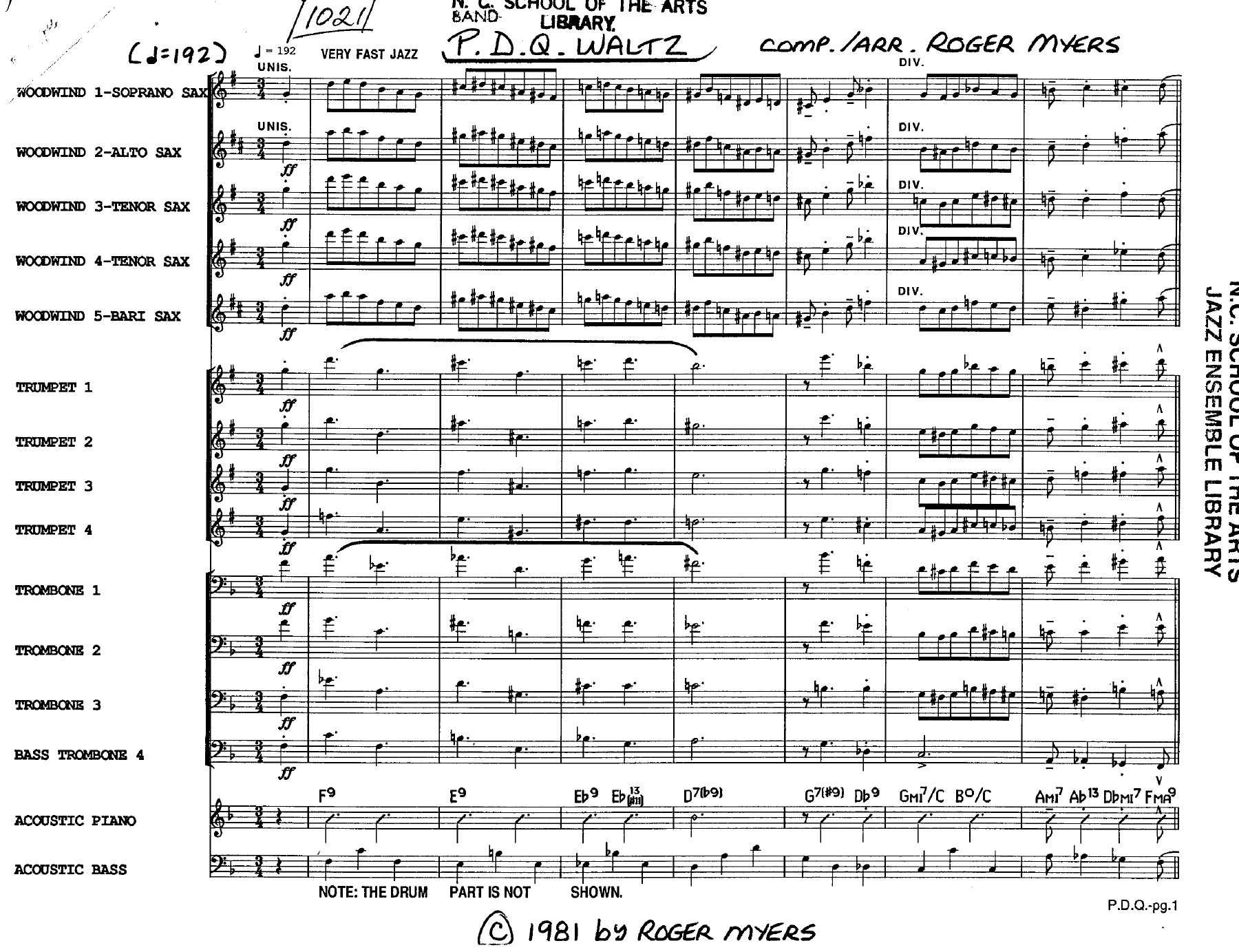
P.D.Q. Waltz (R.Myers)
Composed by Frank Mantooth
Arranged by R. Myers
- Ensemble: Big Band Dance
- Style: Waltz
- Pages: 90
- Instruments (16): 1st Woodwind (Soprano Sax), 2nd Woodwind (Alto Sax), 3rd Woodwind (Tenor Sax), 4th Woodwind (Tenor Sax), 5th Woodwind (Bari Sax), 1st Trumpet, 2nd Trumpet, 3rd Trumpet, 4th Trumpet, 1st Trombone, 2nd Trombone, 3rd Trombone, 4th Bass Trombone, Acoustic Piano, Acoustic Bass, Drums
- Difficulty: advanced
- Content: Individual Parts
- Format: PDF Download (Instant)
- Price: $24.99
Frank Mantooth's "P.D.Q. Waltz" emerges from the rich tradition of jazz waltzes, a subgenre that gained significant traction in the mid-20th century, offering a sophisticated alternative to the predominant 4/4 swing feel. While not a traditional "standard" in the sense of being covered by countless artists, Mantooth, a revered pianist, composer, and arranger known for his impeccable craftsmanship and harmonic ingenuity, established this piece as a notable contribution to the jazz waltz canon. His compositions are often characterized by their melodic accessibility coupled with harmonically rich progressions and intelligent orchestration, making them staples in academic and professional big band libraries. "P.D.Q. Waltz" itself embodies this blend, presenting a flowing, lyrical melody over a buoyant 3/4 rhythm that invites both dancers and listeners into its elegant embrace. This arrangement by R. Myers captures the essence of Mantooth's original vision while imbuing it with a distinctive big band dance sensibility. Set at a medium-slow waltz tempo, the piece maintains a relaxed yet propulsive feel, avoiding any hint of drag. The primary key of F major provides a bright, inviting sound, though Myers masterfully navigates through various harmonic landscapes, employing sophisticated voicings and subtle modulations that keep the listener engaged without ever sounding overly academic. The mood is one of understated elegance and gentle swing, evoking images of a sophisticated ballroom or a late-night club performance where the focus is on melodic beauty and rhythmic grace. The energy builds subtly through the arrangement, culminating in moments of collective power rather than explosive shouts, maintaining its refined character throughout. Myers's approach to "P.D.Q. Waltz" is marked by his intelligent use of the full 17-piece big band palette. The melody is initially carried by the alto saxophone, offering a smooth, vocal quality, before being passed to other sections, often in rich, harmonized soli passages that highlight the band's blend. The brass sections are treated with particular care, providing warm, sustained pads and precise, articulate figures that complement the woodwinds without overpowering them. There are ample opportunities for featured solos, typically for tenor saxophone and trumpet, allowing individual voices to shine within the ensemble context. Technical challenges include maintaining a consistent, flowing waltz feel, precise articulation in the soli sections, and achieving a balanced dynamic range across the full ensemble. The rewarding aspect lies in the piece's sheer musicality and the satisfaction of delivering its beautiful melodies and sophisticated harmonies with precision and warmth. This arrangement is ideally suited for college-level jazz ensembles, advanced community bands, and professional big bands. Its demands for nuanced phrasing, excellent section blend, and sophisticated harmonic understanding make it an excellent vehicle for developing musical maturity. While high school bands with strong lead players and a solid rhythm section could certainly tackle it, the subtle intricacies and extended harmonies would best be realized by more experienced musicians. The piece's substantial length (131 pages of score and parts) reflects its depth and the detailed orchestration, offering a significant and fulfilling performance experience. Conductors should emphasize a consistent, flowing medium-slow waltz feel, avoiding any tendency to rush or drag the tempo. A metronome marking around quarter note = 120-132 (or dotted half note = 40-44) should provide the desired relaxed yet forward motion. Encourage the rhythm section to establish a light, buoyant 3/4 groove from the outset, with the bass providing a walking waltz line and the drums maintaining a crisp, understated brush or stick pattern. Key technical challenges include achieving precise articulation in the saxophone soli sections, particularly where lines are intertwined. Brass players must focus on clean attacks and releases, especially in sustained chordal passages, ensuring excellent intonation. Dynamics are crucial; guide the band to build energy through subtle crescendos rather than sudden bursts, maintaining the piece's elegant character. There are no special techniques like plunger mutes or falls indicated, but a smooth, legato approach to phrasing is paramount for the melodic lines. Rehearsal time should be dedicated to balancing the ensemble during harmonized melody statements and ensuring the soloists are seamlessly integrated into the texture. Q: What instruments are included in this arrangement? A: This arrangement is scored for a standard 17-piece big band: Alto Saxophone 1 & 2, Tenor Saxophone 1 & 2, Baritone Saxophone, Trumpet 1-4, Trombone 1-4, Piano, Bass, and Drums. Q: What is the difficulty level of "P.D.Q. Waltz (R. Myers)"? A: This arrangement is considered advanced intermediate to advanced, suitable for college-level jazz ensembles, advanced community bands, and professional big bands due to its harmonic sophistication, demand for precise articulation, and nuanced phrasing. Q: What is the musical style and historical context of this piece? A: "P.D.Q. Waltz" is a jazz waltz, a subgenre popular since the mid-20th century. Originally composed by Frank Mantooth, a renowned jazz pianist and arranger, it embodies a refined, elegant jazz aesthetic with a flowing 3/4 meter. Q: What makes R. Myers's arrangement of "P.D.Q. Waltz" unique? A: Myers's arrangement maintains the original's elegance while adding a distinctive big band dance sensibility. It features sophisticated voicings, intelligent orchestration across the full 17-piece ensemble, and ample opportunities for featured solos, all contributing to a rich and rewarding performance. Q: What is the typical performance duration and tempo for this arrangement? A: While specific duration can vary with solo length, this medium-slow waltz typically performs for approximately 4-6 minutes. The ideal tempo is a relaxed yet flowing waltz, around quarter note = 120-132 (or dotted half note = 40-44).
Questions and answers
- What is included in the P.D.Q. Waltz (R.Myers) PDF?
- The verified current file contains a conductor score and individual parts across 90 pages.
- How many instruments or parts are listed for P.D.Q. Waltz (R.Myers)?
- The verified instrumentation list contains 16 entries for this Big Band Dance arrangement.
- Who is credited for P.D.Q. Waltz (R.Myers)?
- Composer: Frank Mantooth. Arranger: R. Myers.
- What difficulty is listed for P.D.Q. Waltz (R.Myers)?
- The verified difficulty level is advanced.
- What style is listed for P.D.Q. Waltz (R.Myers)?
- The catalog lists the style as Waltz.
- Can I preview P.D.Q. Waltz (R.Myers) before buying?
- Yes. The product page provides a preview generated from the current PDF file.
- How is P.D.Q. Waltz (R.Myers) delivered?
- After successful payment, the digital PDF is made available for download. The displayed price is $24.99.
Musicians Also Search For
P.D.Q. Waltz R. Myers PDF • P.D.Q. Waltz R. Myers sheet music • P.D.Q. Waltz arranged by R. Myers • R. Myers big band dance charts • R. Myers jazz arrangements PDF • P.D.Q. Waltz Frank Mantooth sheet music • P.D.Q. Waltz Frank Mantooth big band dance arrangements • Frank Mantooth big band dance charts • P.D.Q. Waltz big band dance arrangements • P.D.Q. Waltz big band dance PDF download • P.D.Q. Waltz jazz sheet music • big band dance sheet music download • P.D.Q. Waltz conductor score PDF • P.D.Q. Waltz individual parts download • P.D.Q. Waltz sheet music PDF • P.D.Q. Waltz Waltz charts • Waltz big band dance arrangements • buy P.D.Q. Waltz sheet music • download P.D.Q. Waltz PDF • P.D.Q. Waltz jazz charts • best R. Myers big band dance arrangements • Frank Mantooth arranged by R. Myers • P.D.Q. Waltz printable sheet music • big band dance repertoire PDF