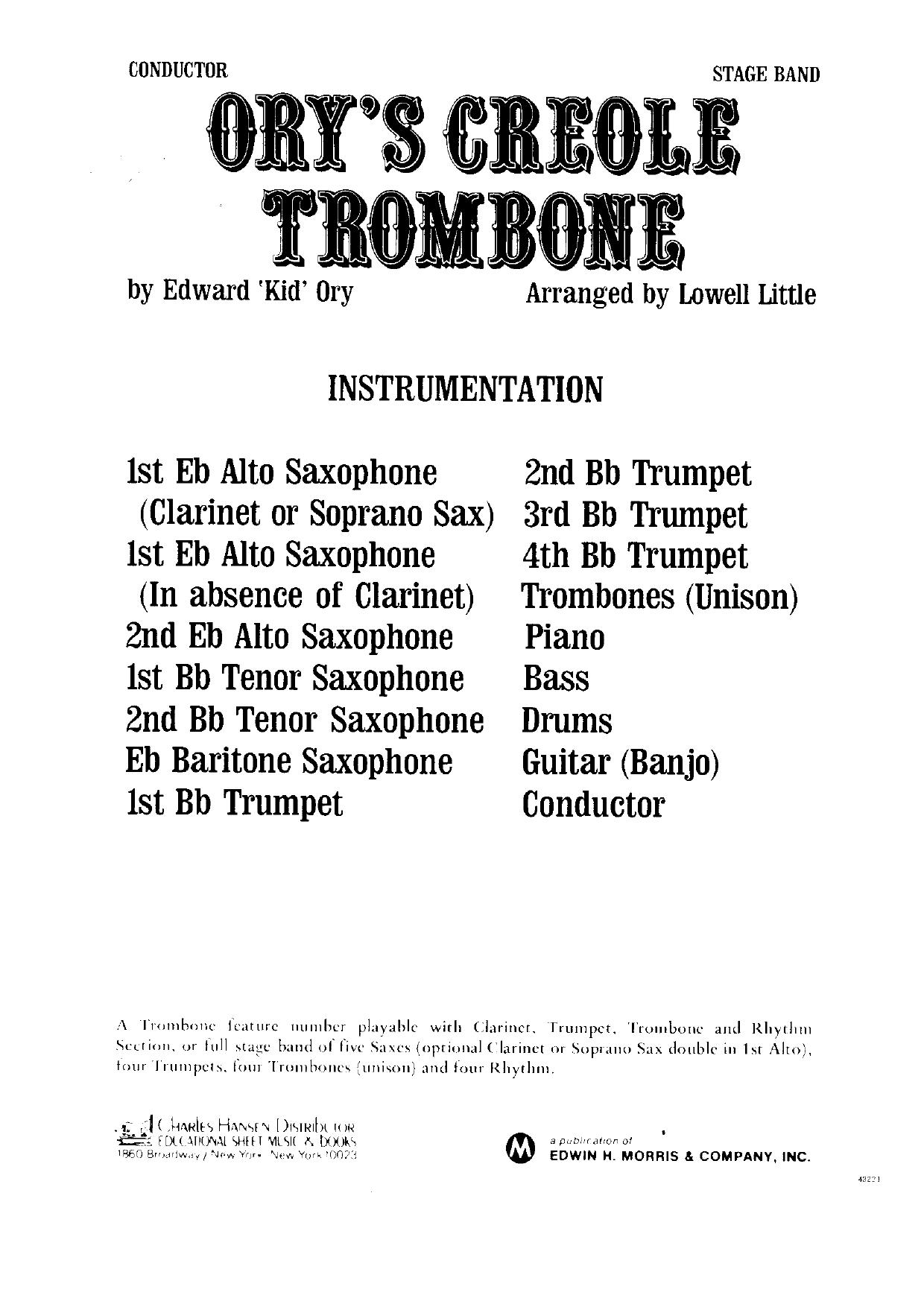
Ory's Creole Trombone (L.Little) sheet music preview

Ory's Creole Trombone (L.Little)

Composed by Edward Ory

Arranged by L.Little

  • Ensemble: Big Band
  • Style: Jazz Standard
  • Pages: 31
  • Instruments (16): Conductor, Trombones (Unison), 1st Eb Alto Saxophone (Clarinet - Soprano Sax), 1st Eb Alto Saxophone (Optional), 2nd Eb Alto Saxophone, 1st Bb Tenor Saxophone, 2nd Bb Tenor Saxophone, Eb Baritone Saxophone, 1st Bb Trumpet, 2nd Bb Trumpet, 3rd Bb Trumpet, 4th Bb Trumpet, Piano, Bass, Guitar (Banjo), Drums
  • Difficulty: medium
  • Content: Individual Parts
  • Format: PDF Download (Instant)
  • Price: $24.99

Kid Ory’s 1922 composition "Ory's Creole Trombone" stands as a monumental milestone in early jazz history, recorded by Ory's Sunshine Orchestra and widely recognized as one of the very first jazz arrangements featuring a trombone lead to be captured on disk. Emerging directly from the rich, polyphonic traditions of New Orleans, this quintessential Dixieland standard laid the structural and harmonic groundwork for the Chicago jazz boom of the 1920s. Edward "Kid" Ory's pioneering tailgating trombone style defined an entire era of collective improvisation, characterized by glissandos, gritty countermelodies, and an infectious, high-energy drive that immediately captivated early jazz audiences. Translating this seminal small-group masterpiece into a contemporary big band canvas, arranger L.Little brilliantly recontextualizes the historic New Orleans counterpoint into a robust, swinging 14-instrument framework. The arrangement pulses with a vibrant, driving traditional jazz feel set in 4/4 time, maintaining the joyous, freewheeling spirit of Bourbon Street while injecting modern harmonic color and dynamic contrast. From the bouncy, two-beat sections that evoke early marching bands to roaring, full-ensemble polyphonic romps, the chart evokes an atmosphere of celebratory jubilation and historical reverence, balancing authentic period flavor with the sheer power of a modern horn section. L.Little’s treatment cleverly distributes the iconic contrapuntal lines traditionally held by trumpet, clarinet, and trombone across the expanded saxophones, brass, and rhythm section without losing the transparent clarity essential to early jazz. Rather than burying the melody under thick modern chord clusters, the arrangement utilizes clever sectional interleavings, call-and-response figures, and energetic shout choruses that build progressively in intensity. The woodwinds handle agile, ornamented figures, while the brass section injects punchy, rhythmic accents that mimic the characteristic tailgate style of the original recordings, creating a rich sonic tapestry that honors the roots of jazz while fully engaging a standard big band. The melody is shared dynamically across multiple sections, giving both reeds and brass a chance to pilot the historic thematic material before opening up into dedicated solo spaces designed to showcase improvisers in a traditional collective or modal swing setting. Technical challenges center primarily on articulation, stylistic integrity, and stylistic phrasing rather than extreme ranges; players must master crisp, buoyant swing eighths and clean stylistic drops. Advanced high school, collegiate, and community jazz orchestras will find this chart deeply rewarding, as it provides an exceptional educational vehicle for exploring the transition from early New Orleans polyphony to big band swing while delivering an absolute showstopper for festival programs and standard concert sets. Success with this arrangement hinges on achieving an authentic early jazz articulation style combined with the precision of a tight big band. The tempo should remain bright and driving, avoiding any tendency to drag; a steady, buoyant medium-up two-beat or four-beat swing feel is essential to capture the original New Orleans momentum. Conductors should pay close attention to the balance between the rhythm section and the horn lines, ensuring that countermelodies remain clear and uncluttered beneath the primary thematic material. Technically, brass players should incorporate appropriate stylistic devices such as subtle plunger effects, lip slurs, and expressive falls where indicated, mirroring the vocalized quality of Kid Ory's original trombone phrasing. Reeds need to keep their tonguing light, agile, and transparent, avoiding heavy, modern bebop accents. Rehearsal should begin slowly with the rhythm section establishing a rock-solid, minimalist foundation before layering in the horn sections section by section to lock in the intricate ensemble polyphony. Q: What instruments and parts are included in this arrangement? A: This 14-instrument big band arrangement includes parts for Eb Alto Saxophone 1, Eb Alto Saxophone 2, Bb Tenor Saxophone 1, Bb Tenor Saxophone 2, and Eb Baritone Saxophone, alongside a comprehensive conductor score. Q: What is the difficulty level of this chart? A: This arrangement is well-suited for advanced high school, collegiate, and community jazz ensembles, presenting moderate technical demands centered heavily on articulation, stylistic phrasing, and ensemble balance rather than extreme technical range. Q: What is the historical style and context of the piece? A: Based on Edward "Kid" Ory's seminal 1922 New Orleans jazz standard, this arrangement captures the joyous, polyphonic spirit of early Dixieland and translates its historic counterpoint into a swinging big band setting. Q: What makes L.Little's arrangement unique? A: L.Little successfully adapts traditional New Orleans tailgating counterpoint for a full 14-piece big band, utilizing clever sectional interleavings and dynamic call-and-response figures that preserve the transparency of early jazz. Q: What is the typical performance duration and tempo feel? A: The arrangement is designed for a bright, driving medium-up tempo with a buoyant, infectious swing feel, typically clocking in around 3 to 4 minutes depending on the length of the incorporated solo sections.

Questions and answers

What is included in the Ory's Creole Trombone (L.Little) PDF?
The verified current file contains a conductor score and individual parts across 31 pages.
How many instruments or parts are listed for Ory's Creole Trombone (L.Little)?
The verified instrumentation list contains 16 entries for this Big Band arrangement.
Who is credited for Ory's Creole Trombone (L.Little)?
Composer: Edward Ory. Arranger: L.Little.
What difficulty is listed for Ory's Creole Trombone (L.Little)?
The verified difficulty level is medium.
What style is listed for Ory's Creole Trombone (L.Little)?
The catalog lists the style as Jazz Standard.
Can I preview Ory's Creole Trombone (L.Little) before buying?
Yes. The product page provides a preview generated from the current PDF file.
How is Ory's Creole Trombone (L.Little) delivered?
After successful payment, the digital PDF is made available for download. The displayed price is $24.99.

Musicians Also Search For

Ory's Creole Trombone L.Little PDFOry's Creole Trombone L.Little sheet musicOry's Creole Trombone arranged by L.LittleL.Little big band chartsL.Little jazz arrangements PDFOry's Creole Trombone Edward Ory sheet musicOry's Creole Trombone Edward Ory big band arrangementsEdward Ory big band chartsOry's Creole Trombone big band arrangementsOry's Creole Trombone big band PDF downloadOry's Creole Trombone jazz sheet musicbig band sheet music downloadOry's Creole Trombone conductor score PDFOry's Creole Trombone individual parts downloadOry's Creole Trombone sheet music PDFOry's Creole Trombone Jazz Standard chartsJazz Standard big band arrangementsbuy Ory's Creole Trombone sheet musicdownload Ory's Creole Trombone PDFOry's Creole Trombone jazz chartsbest L.Little big band arrangementsEdward Ory arranged by L.LittleOry's Creole Trombone printable sheet musicbig band repertoire PDF

All arrangements by L.Little All Edward Ory sheet music