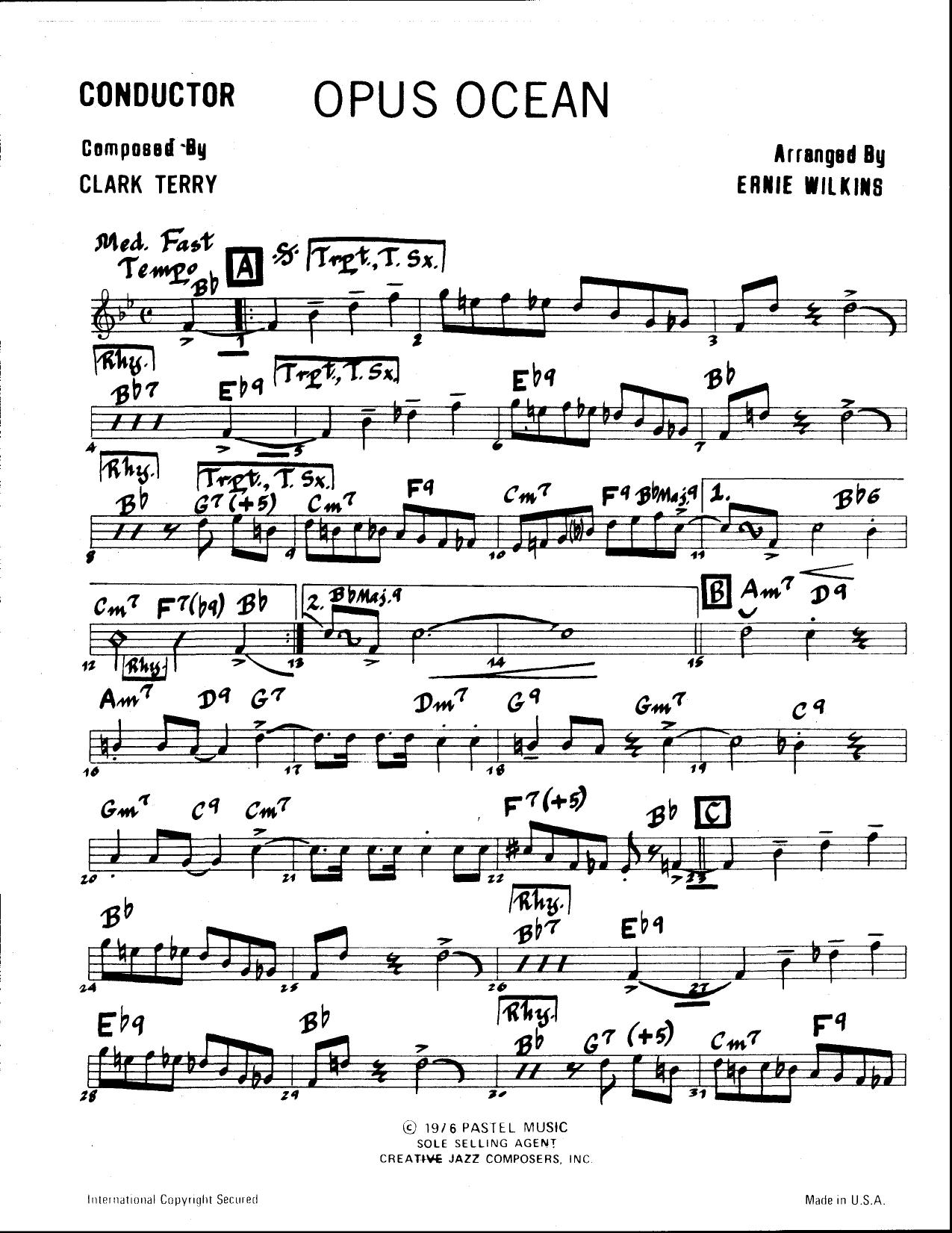
Opus Ocean (E.Wilkins)
Composed by Ernie Wilkins
Arranged by Ernie Wilkins
- Ensemble: Big Band
- Pages: 22
- Instruments (10): Conductor (Lead Sheet), Alto Saxophone, Baritone Saxophone, Tenor Saxophone, Trumpet, Trombone, Bass, Drums, Piano, Guitar
- Difficulty: medium
- Content: Individual Parts
- Format: PDF Download (Instant)
- Price: $24.99
Ernie Wilkins stands as one of the most formidable architects of the post-war big band sound, earning his legendary status through vital, swinging contributions to the Count Basie Orchestra and his own relentless pursuit of dynamic, blues-soaked modern jazz. "Opus Ocean" captures the quintessential mid-century jazz orchestra aesthetic, bridging the sophisticated harmonic vocabulary of late-bop with the visceral, driving momentum of Kansas City swing. Composed during an era when big bands had to adapt to smaller footprints without losing their thunder, Wilkins’ writing reflects a masterclass in economy and power, prioritizing punchy brass interventions, rich saxophone textures, and an irrepressible groove that defines the zenith of 1950s and 1960s modern jazz arranging. Propelled by an assertive, driving medium-up swing feel, "Opus Ocean" opens with an arresting harmonic statement that immediately establishes an atmosphere of aquatic breadth and restless motion. The arrangement balances cool, sophisticated modal-leaning lines with hot, shouting brass counter-melodies, evoking the ebb and flow of crashing tides through shifting dynamic terraces. Wilkins masterfully exploits the contrasting colors of the ensemble, utilizing tight, interlocking sax solis to cut through the texture while deploying brass drops and swells to create an expansive, cinematic soundscape. The emotional trajectory shifts seamlessly from sophisticated, cool-school introspection during the transitional passages to an unbridled, foot-tapping communal joy during the climactic ensemble choruses. True to Wilkins' signature style, the arrangement relies on clever voicing techniques rather than sheer volume to achieve its massive impact, often stacking upper-structure extensions in the trumpets while the trombones anchor a warm, blues-inflected foundation. The melody is shared fluidly across sections, preventing textural fatigue and giving every player a moment in the spotlight before converging into a roaring shout chorus that demands absolute precision and articulation uniformity. Solo opportunities are thoughtfully integrated into the form, providing ample space for both horn and rhythm section improvisers to stretch out over crisp, sophisticated changes. The rhythm section functions as the engine room, requiring a steady, feather-light ride cymbal approach combined with assertive, interactive comping that locks tightly with the horn section's rhythmic punches. Advanced high school, collegiate, and professional jazz ensembles will find "Opus Ocean" to be a deeply rewarding centerpiece for festival repertoires or formal concerts. The technical demands reside primarily in stylistic consistency—specifically maintaining a relaxed, driving swing feel at faster tempos and executing clean, synchronized articulation across the entire ensemble. Because the chart relies heavily on ensemble interplay and rhythmic crispness rather than breakneck technical displays, it serves as an exceptional vehicle for developing a band’s collective time-feel, dynamic control, and stylistic authenticity. Conductors tackling "Opus Ocean" should first establish a resilient, forward-moving medium-up swing tempo, ensuring the underlying pulse remains relaxed yet intensely driven by the ride cymbal and hi-hat (on beats 2 and 4). A primary technical challenge lies in the execution of the tight saxophone soli; players must meticulously match vibrato widths, articulation lengths, and phrasing to achieve a singular, unified voice. The brass section should approach muted passages with a clear, projecting tone, ensuring that stylistic effects like falls and doits enhance rather than muddy the harmonic clarity. Rehearsal time is best divided between isolating the rhythm section to lock in the groove and sectional work for the intricate syncopated figures in the ensemble interludes. Balance is critical during the shout chorus: the lead trumpet must soar effortlessly over a dense, roaring lower brass and sax background without forcing the tone. Emphasize dynamic contrasts written on the page—the sudden shifts from whispered cool textures to blazing, full-ensemble roars are what give this Wilkins masterpiece its enduring dramatic tension. Q: What instruments and parts are included in this arrangement? A: This arrangement is scored for an 8-instrument ensemble comprising Alto Saxophone, Tenor Saxophone, Baritone Saxophone, Trumpet, Trombone, and a standard rhythm section, spanning 22 comprehensive pages of score and parts. Q: What is the difficulty level of this chart? A: It is suited for advanced high school, collegiate, and professional jazz ensembles due to its demands on stylistic consistency, ensemble tightness, and medium-up swing endurance. Q: What is the musical style and historical context of "Opus Ocean"? A: Written by master arranger Ernie Wilkins, it represents the pinnacle of mid-century big band jazz, seamlessly blending sophisticated bop harmonies with the driving momentum of traditional swing. Q: What makes this Ernie Wilkins arrangement unique? A: Its uniqueness lies in Wilkins' signature approach to voicing—utilizing upper-structure trumpet extensions and interlocking saxophone solis to create a massive, dynamic soundscape with a relatively compact 8-instrument line-up. Q: What is the performance duration and tempo feel of the piece? A: The arrangement is built around an assertive, driving medium-up swing feel in 4/4 time, typically clocking in at an energetic performance duration of approximately 4 to 5 minutes depending on solo choruses.
Questions and answers
- What is included in the Opus Ocean (E.Wilkins) PDF?
- The verified current file contains individual parts across 22 pages.
- How many instruments or parts are listed for Opus Ocean (E.Wilkins)?
- The verified instrumentation list contains 10 entries for this Big Band arrangement.
- Who is credited for Opus Ocean (E.Wilkins)?
- Composer: Ernie Wilkins. Arranger: Ernie Wilkins.
- What difficulty is listed for Opus Ocean (E.Wilkins)?
- The verified difficulty level is medium.
- Can I preview Opus Ocean (E.Wilkins) before buying?
- Yes. The product page provides a preview generated from the current PDF file.
- How is Opus Ocean (E.Wilkins) delivered?
- After successful payment, the digital PDF is made available for download. The displayed price is $24.99.
Musicians Also Search For
Opus Ocean Ernie Wilkins PDF • Opus Ocean Ernie Wilkins sheet music • Opus Ocean arranged by Ernie Wilkins • Ernie Wilkins big band charts • Ernie Wilkins jazz arrangements PDF • Opus Ocean Ernie Wilkins big band arrangements • Opus Ocean big band arrangements • Opus Ocean big band PDF download • Opus Ocean jazz sheet music • big band sheet music download • Opus Ocean individual parts download • Opus Ocean sheet music PDF • buy Opus Ocean sheet music • download Opus Ocean PDF • Opus Ocean jazz charts • best Ernie Wilkins big band arrangements • Opus Ocean printable sheet music • big band repertoire PDF