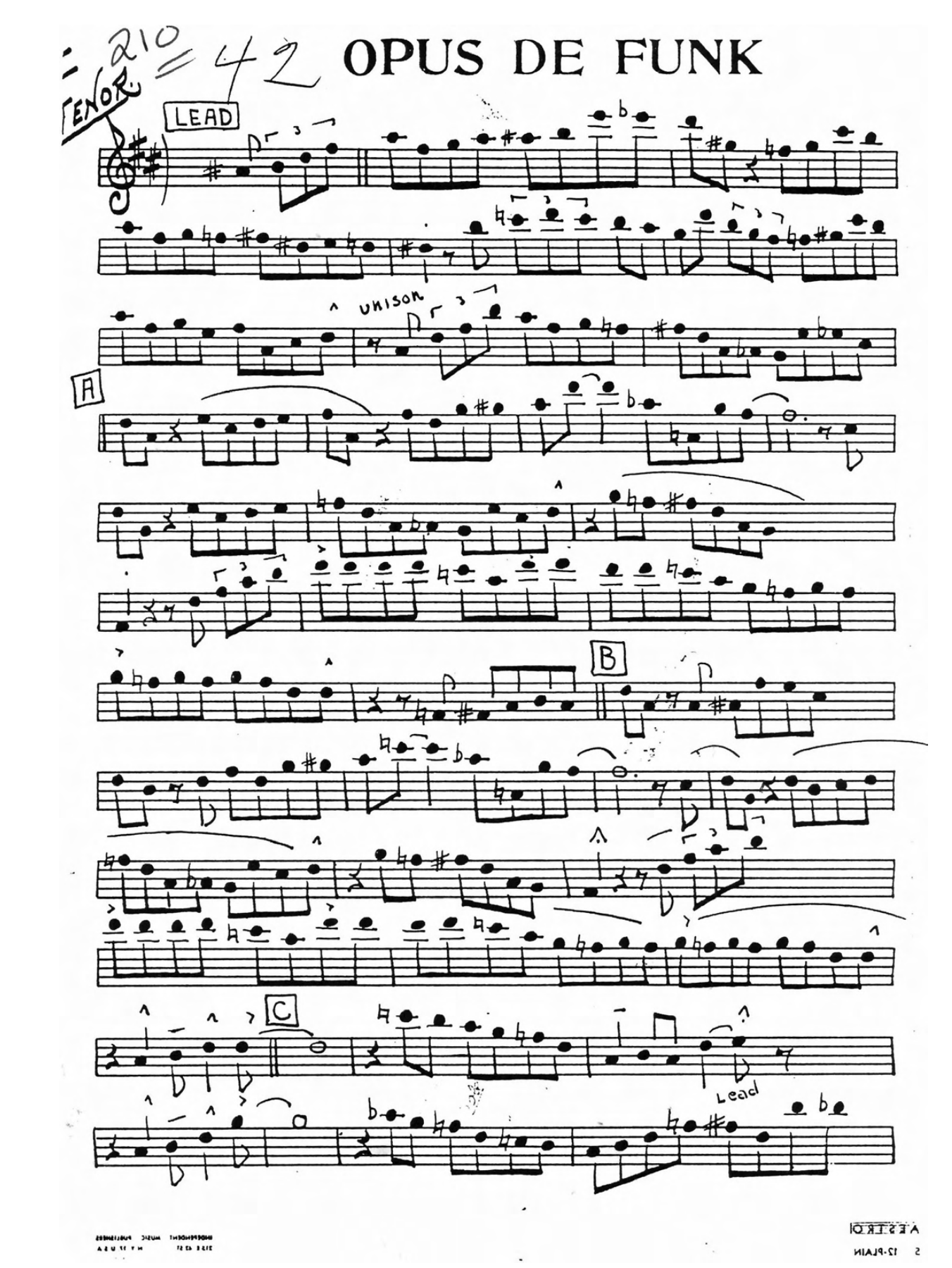
Opus De Funk (B.Holman)
Composed by Horace Silver
Arranged by Bill Holman
- Ensemble: Big Band
- Style: Jazz Standard
- Pages: 48
- Instruments (18): I Alto Saxophone, II Alto Saxophone, I Tenor Saxophone, II Tenor Saxophone, III Tenor Saxophone, Baritone Saxophone, I Trumpet, II Trumpet, III Trumpet, IV Trumpet, I Trombone, II Trombone, III Trombone, IV Trombone, Piano, Guitar, Bass, Drums
- Difficulty: medium
- Content: Individual Parts
- Format: PDF Download (Instant)
- Price: $24.99
Horace Silver's "Opus De Funk," a quintessential hard bop anthem, emerged from the vibrant mid-1950s jazz scene, a period defined by its soulful grooves, blues-infused melodies, and infectious rhythmic drive. First recorded in 1953, this composition quickly cemented its status as a jazz standard, embodying the very essence of the burgeoning hard bop movement. Silver, a pioneering pianist and composer, was instrumental in shaping this style, blending bebop's harmonic sophistication with gospel and rhythm and blues influences. "Opus De Funk" is characterized by its memorable, singable melody, its driving medium-up tempo swing feel, and its accessible yet sophisticated harmonic progression, making it a perennial favorite for both performers and audiences. It evokes a feeling of joyous, sophisticated swagger, a perfect blend of intellectual prowess and undeniable groove that defines the era. Bill Holman, a titan of big band arranging, brings his unparalleled genius to this classic, transforming Silver's quartet gem into a monumental big band showpiece. Holman's signature approach, known for its intricate counterpoint, sophisticated voicings, and unexpected harmonic twists, is evident throughout this arrangement. Rather than merely orchestrating the original, Holman reimagines it, crafting a dynamic narrative that showcases the full power and color of the 17-piece ensemble. Expect his characteristic layered soli sections, where different instrumental families intertwine with breathtaking precision, and a masterfully constructed shout chorus that builds to an exhilarating climax. Holman’s treatment often features a unique blend of tight ensemble writing with moments of controlled chaos, pushing the boundaries of traditional big band sound while maintaining the original's soulful core. This arrangement of "Opus De Funk" is a tour de force for the modern big band. The iconic melody is initially carried by the saxophones, later passed to the brass, creating a rich textural tapestry. There are ample opportunities for featured soloists, typically over the original's blues-inflected changes, allowing improvisers to stretch out and engage with Silver's timeless harmonic landscape. Technical challenges include precise articulation in the fast-moving soli passages, maintaining the driving medium-up swing feel with unwavering rhythmic accuracy, and navigating Holman's often dense and harmonically adventurous voicings. The rewarding aspect lies in the sheer exhilaration of performing such a meticulously crafted and powerful arrangement, experiencing the interplay of Holman's genius with Silver's enduring composition, and delivering a performance that truly swings. Given its complexity and demands for precision, this arrangement is ideally suited for advanced high school, collegiate, community, and professional jazz ensembles. Bands with strong lead players, capable section work, and experienced soloists will find this piece incredibly rewarding. It serves as an excellent vehicle for developing ensemble blend, rhythmic tightness, and an understanding of sophisticated big band writing, while also providing a thrilling concert experience for both musicians and listeners. Conductors should emphasize a consistent, driving medium-up swing feel from the outset, ensuring the rhythm section lays down a solid, unyielding foundation. Articulation is paramount, particularly in the sax soli sections and brass figures; strive for crisp, unified attacks and releases, paying close attention to Holman's specific markings. The intricate counterpoint in the ensemble passages requires careful balance, ensuring that all lines are heard without any one voice dominating. Pay particular attention to the dynamics, as Holman uses them to build tension and release. Soloists should be encouraged to embrace the hard bop aesthetic, drawing inspiration from Horace Silver's soulful, bluesy vocabulary. Rehearsal time should be allocated to isolating and perfecting the layered soli sections, as their precision is key to the arrangement's impact. No special techniques beyond standard jazz articulations (falls, doits, scoops) are explicitly notated, but their judicious application will enhance the authentic jazz feel. Q: What instruments are included in this arrangement? A: This arrangement is scored for a standard 17-piece big band, including five saxophones (Alto 1, Alto 2, Tenor 1, Tenor 2, Baritone), four trumpets, four trombones, and a full rhythm section (piano, bass, drums). Q: What is the difficulty level of this arrangement? A: This arrangement is considered advanced, suitable for collegiate, professional, or highly skilled high school jazz ensembles due to its intricate voicings, demanding soli sections, and requirements for precise ensemble playing. Q: What is the musical style and historical context of "Opus De Funk"? A: "Opus De Funk" is a classic hard bop jazz standard composed by Horace Silver in the mid-1950s, characterized by its soulful, blues-infused melodies and driving medium-up swing feel. Q: What makes Bill Holman's arrangement of "Opus De Funk" unique? A: Holman's arrangement is unique for its sophisticated reinterpretation of the original, featuring his signature intricate counterpoint, layered soli sections, and a powerful shout chorus that elevates the piece into a dynamic big band showpiece. Q: What is the approximate performance tempo and duration of this piece? A: The piece is intended to be performed at a medium-up swing tempo, typically around 180-200 BPM. The duration will vary based on the number and length of improvised solos, but generally ranges from 5 to 7 minutes.
Questions and answers
- What is included in the Opus De Funk (B.Holman) PDF?
- The verified current file contains individual parts across 48 pages.
- How many instruments or parts are listed for Opus De Funk (B.Holman)?
- The verified instrumentation list contains 18 entries for this Big Band arrangement.
- Who is credited for Opus De Funk (B.Holman)?
- Composer: Horace Silver. Arranger: Bill Holman.
- What difficulty is listed for Opus De Funk (B.Holman)?
- The verified difficulty level is medium.
- What style is listed for Opus De Funk (B.Holman)?
- The catalog lists the style as Jazz Standard.
- Can I preview Opus De Funk (B.Holman) before buying?
- Yes. The product page provides a preview generated from the current PDF file.
- How is Opus De Funk (B.Holman) delivered?
- After successful payment, the digital PDF is made available for download. The displayed price is $24.99.
Musicians Also Search For
Opus De Funk Bill Holman PDF • Opus De Funk Bill Holman sheet music • Opus De Funk arranged by Bill Holman • Bill Holman big band charts • Bill Holman jazz arrangements PDF • Opus De Funk Horace Silver sheet music • Opus De Funk Horace Silver big band arrangements • Horace Silver big band charts • Opus De Funk big band arrangements • Opus De Funk big band PDF download • Opus De Funk jazz sheet music • big band sheet music download • Opus De Funk individual parts download • Opus De Funk sheet music PDF • Opus De Funk Jazz Standard charts • Jazz Standard big band arrangements • buy Opus De Funk sheet music • download Opus De Funk PDF • Opus De Funk jazz charts • best Bill Holman big band arrangements • Horace Silver arranged by Bill Holman • Opus De Funk printable sheet music • big band repertoire PDF