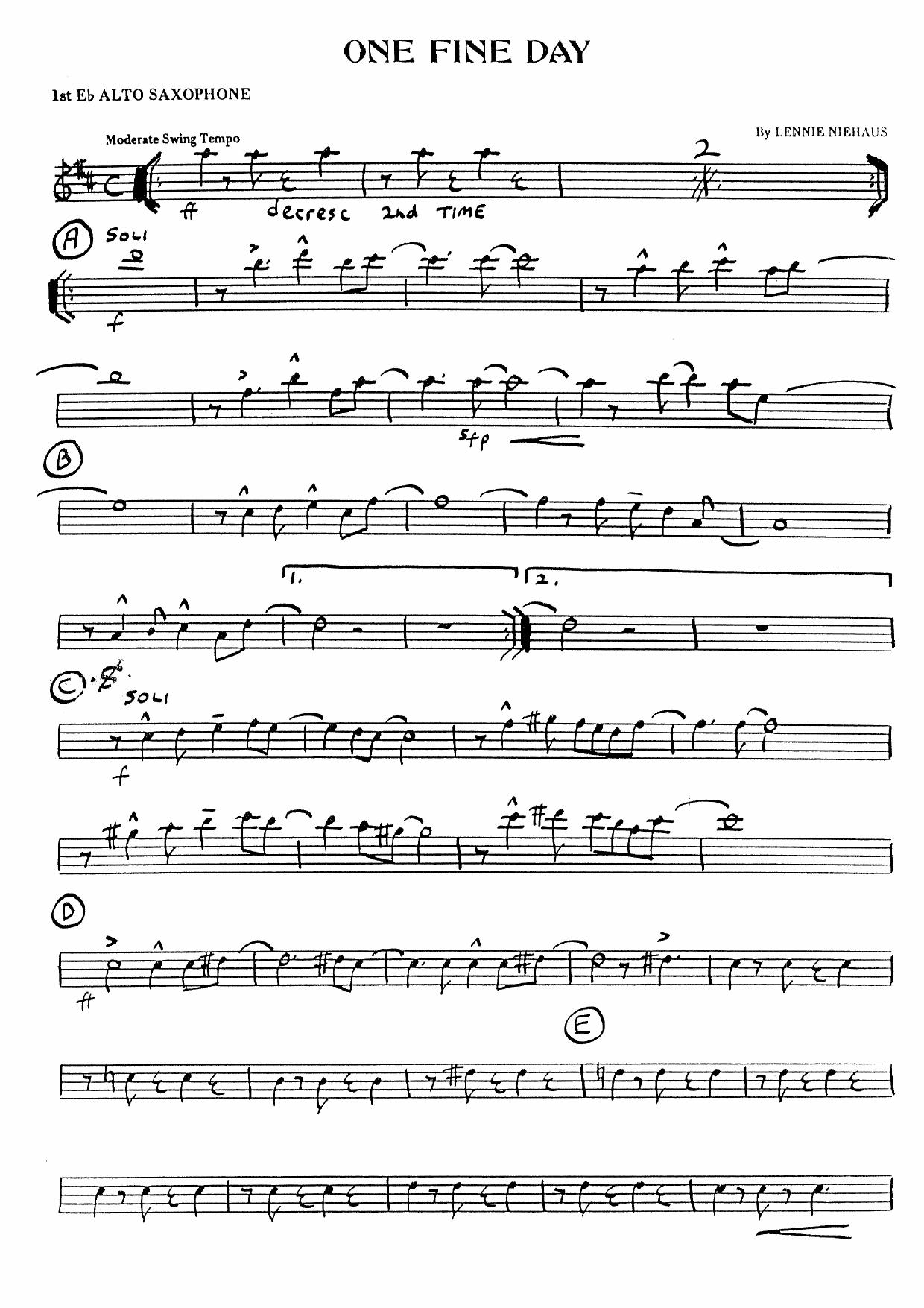
One Fine Day L.Niehaus) (L.Niehaus)
Composed by Lennie Niehaus
Arranged by Lennie Niehaus
- Ensemble: Big Band
- Pages: 34
- Instruments (17): 1st Eb Alto Saxophone, 2nd Eb Alto Saxophone, 1st Bb Tenor Saxophone, 2nd Bb Tenor Saxophone, Eb Baritone Saxophone, 1st Bb Trumpet, 2nd Bb Trumpet, 3rd Bb Trumpet, 4th Bb Trumpet, 1st Trombone, 2nd Trombone, 3rd Trombone, 4th Trombone, Piano, Bass, Guitar, Drums
- Difficulty: medium
- Content: Individual Parts
- Format: PDF Download (Instant)
- Price: $24.99
Lennie Niehaus’s "One Fine Day" stands as a quintessential exemplar of West Coast cool jazz, capturing the sophisticated, counterpoint-driven aesthetic that defined the California jazz scene in the 1950s and 1960s. Emerging from Niehaus’s prolific tenure as an alto saxophonist and arranger for the Stan Kenton Orchestra—as well as his extensive work in motion picture and television scoring—this composition reflects a masterful synthesis of modern harmonic vocabulary and transparent, West Coast orchestration. Rather than relying on the dense, thunderous brass walls typical of mid-century East Coast big bands, Niehaus champions linear clarity, nimble contrapuntal movement, and an immaculate balance between the reed and brass sections. Driven by an infectious, buoyant medium-swing feel, "One Fine Day" radiates an effortless optimism and sophisticated urban cool. The harmonic language is rich with extended chord structures—major sevenths, ninths, and subtle chromatic alterations—yet the overall mood remains bright, accessible, and remarkably breezy. The thematic material unfolds with conversational ease, establishing a cheerful yet intellectually engaging atmosphere. The arrangement avoids heavy-handed emotional weight in favor of crisp articulation, sparkling ensemble interplay, and a relentless forward momentum that keeps both performers and listeners thoroughly engaged from the downbeat. Niehaus’s signature compositional fingerprint is immediately evident in his peerless handling of the saxophone section. The arrangement features tightly knit, harmonically sophisticated sax solis that demand absolute precision, weightless articulation, and a unified sectional concept of intonation. Brass writing is economical yet incredibly punchy, functioning as dynamic punctuation rather than overwhelming sonic force. Instead of a massive, bombastic shout chorus, Niehaus constructs a clever, developmental climax that reworks the primary motivic cells through shifting counterpoint and crisp ensemble unisons, showcasing his deep roots in bebop coupled with a modernist’s eye for structural economy. Tailored primarily for advanced high school, collegiate, and professional community jazz orchestras, this 34-page chart strikes an ideal pedagogical and artistic balance. The primary technical challenges lie in maintaining a lightweight, authentic cool-jazz swing feel at a moderate tempo, executing swift chromatic passages within the reed section, and balancing the delicate dynamic interplay between sections. Horn players will find the chart deeply rewarding for its emphasis on clean phrasing, sectional blend, and stylistic integrity. It serves as an exceptional vehicle for showcasing a band's refinement, rhythmic precision, and stylistic versatility. Achieving an authentic rendition of "One Fine Day" requires a meticulous approach to the West Coast cool jazz aesthetic, demanding restraint, impeccable intonation, and a lightweight swing feel. Conductors should establish a comfortable, driving medium-swing tempo, ensuring the rhythm section maintains an unhurried, laying-back-on-the-beat pulse without dragging. The primary technical challenge for the brass and reed sections is the execution of rapid, linear bebop-inflected passages with uniform articulation; notes should be cleanly detached rather than heavily accented or over-blasted. Rehearsal should begin by isolating the saxophone soli, having the section practice at a reduced tempo to lock in the intricate harmonic blend and delicate dynamic shifts. The rhythm section—particularly the drummer—must keep the ride cymbal prominent and crisp, using sparse, tasteful comping that avoids crowding the open textures of Niehaus's voicings. Ensure that dynamic peaks are achieved through balance and blend rather than sheer volume, preserving the sophisticated, chamber-jazz clarity that makes this Lennie Niehaus chart a timeless masterclass in big band arranging. Q: What instruments and parts are included in this arrangement? A: This 34-page chart is scored for a standard 8-instrument big band core configuration, specifically featuring parts for Alto Saxophone, Tenor Saxophone, Baritone Saxophone, Trumpet, and Trombone, alongside a complete rhythm section. Q: What is the difficulty level of this arrangement? A: This piece is best suited for advanced high school, collegiate, and professional jazz ensembles due to its intricate linear writing, sophisticated cool-jazz harmonies, and high demands for sectional blend and articulation. Q: What style and historical context does "One Fine Day" represent? A: Composed and arranged by Lennie Niehaus, this piece firmly represents the 1950s and 1960s West Coast cool jazz movement, blending modern bebop harmonic sensibilities with transparent, counterpoint-driven orchestration. Q: What makes this particular Lennie Niehaus arrangement unique? A: It showcases Niehaus's signature compositional style, characterized by intricately voiced saxophone solis, economical and punchy brass writing, and a sophisticated avoidance of dense, thunderous walls of sound in favor of linear clarity. Q: What is the recommended performance tempo and duration? A: The arrangement is set to a buoyant medium-swing tempo, and while duration varies slightly with solo extensions, it typically spans roughly 3 to 4 minutes of engaging, high-craft ensemble playing.
Questions and answers
- What is included in the One Fine Day L.Niehaus) (L.Niehaus) PDF?
- The verified current file contains individual parts across 34 pages.
- How many instruments or parts are listed for One Fine Day L.Niehaus) (L.Niehaus)?
- The verified instrumentation list contains 17 entries for this Big Band arrangement.
- Who is credited for One Fine Day L.Niehaus) (L.Niehaus)?
- Composer: Lennie Niehaus. Arranger: Lennie Niehaus.
- What difficulty is listed for One Fine Day L.Niehaus) (L.Niehaus)?
- The verified difficulty level is medium.
- Can I preview One Fine Day L.Niehaus) (L.Niehaus) before buying?
- Yes. The product page provides a preview generated from the current PDF file.
- How is One Fine Day L.Niehaus) (L.Niehaus) delivered?
- After successful payment, the digital PDF is made available for download. The displayed price is $24.99.
Musicians Also Search For
One Fine Day L.Niehaus) Lennie Niehaus PDF • One Fine Day L.Niehaus) Lennie Niehaus sheet music • One Fine Day L.Niehaus) arranged by Lennie Niehaus • Lennie Niehaus big band charts • Lennie Niehaus jazz arrangements PDF • One Fine Day L.Niehaus) Lennie Niehaus big band arrangements • One Fine Day L.Niehaus) big band arrangements • One Fine Day L.Niehaus) big band PDF download • One Fine Day L.Niehaus) jazz sheet music • big band sheet music download • One Fine Day L.Niehaus) individual parts download • One Fine Day L.Niehaus) sheet music PDF • buy One Fine Day L.Niehaus) sheet music • download One Fine Day L.Niehaus) PDF • One Fine Day L.Niehaus) jazz charts • best Lennie Niehaus big band arrangements • One Fine Day L.Niehaus) printable sheet music • big band repertoire PDF