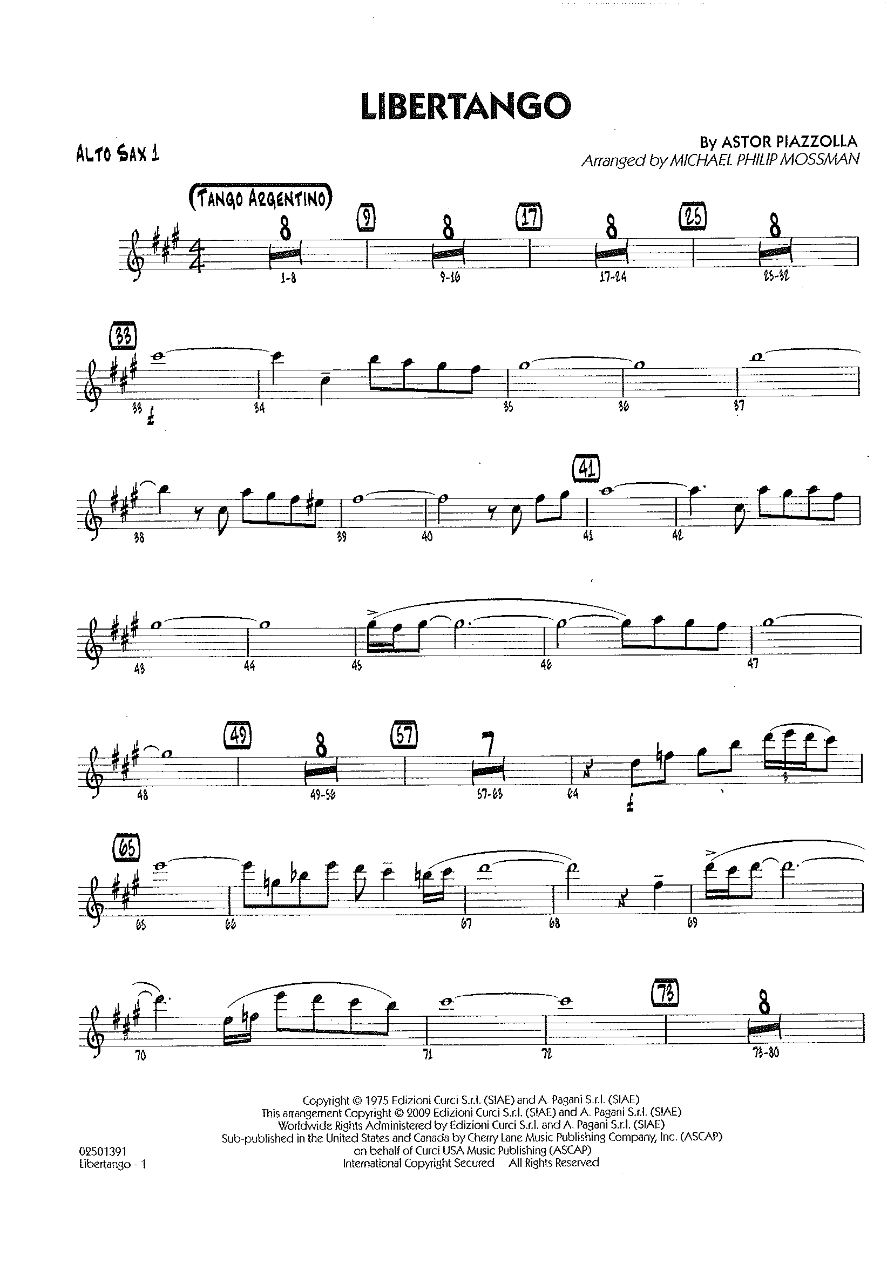
Libertango (M.P.Mossman) sheet music preview

Libertango (M.P.Mossman)

Composed by Astor Piazzolla

Arranged by M. P.Mossman

  • Ensemble: Big Band
  • Style: Tango
  • Pages: 40
  • Instruments (17): Alto Saxophone 1, Alto Saxophone 2, Tenor Saxophone 1, Tenor Saxophone 2, Baritone Saxophone, Trumpet 1, Trumpet 2, Trumpet 3, Trumpet 4, Trombone 1, Trombone 2, Trombone 3, Bass Trombone, Piano, Bass, Drums, Guitar
  • Difficulty: medium
  • Content: Individual Parts
  • Format: PDF Download (Instant)
  • Price: $24.99

Astor Piazzolla's "Libertango," composed in 1974, stands as a seminal work in the *Nuevo Tango* movement, a revolutionary fusion that injected elements of jazz and classical music into traditional Argentine tango. Piazzolla, a bandoneón virtuoso and composer, sought to liberate tango from its dance-hall origins, elevating it to a concert art form. While not a jazz standard in the traditional sense, its complex harmonies, syncopated rhythms, and passionate melodic lines have made it a favorite among jazz musicians and arrangers, who appreciate its inherent improvisational spirit and dramatic flair. The piece's iconic, driving bass ostinato and soaring melodic themes have resonated globally, transcending genre boundaries and cementing its place as a modern classic. M. P. Mossman's big band arrangement of "Libertango" masterfully translates Piazzolla's fiery tango into a compelling jazz orchestra setting, maintaining the original's intense Latin groove while infusing it with sophisticated big band voicings and dynamic contrasts. The arrangement is set at a vibrant Latin tempo, typically around a lively quarter note = 132-144, driven by the iconic, relentless bass line often doubled by baritone saxophone and bass trombone, providing a rock-solid foundation. Mossman's signature approach is evident in the rich, often dense harmonic structures, utilizing extended chords and nuanced counterpoint that give the ensemble a powerful, full-bodied sound. The mood oscillates between passionate intensity and moments of lyrical beauty, evoking the dramatic narrative inherent in Piazzolla's work. This arrangement showcases Mossman's adeptness at orchestrating for the full big band palette. The primary melodic statements are initially carried by the alto saxophone section, often in unison or tight harmonies, before being passed to the trumpets and trombones, building in intensity. A standout feature is the meticulously crafted soli sections, particularly for the saxophones, which navigate intricate rhythmic figures and lush harmonies, demanding precision and blend. While the arrangement is largely through-composed, there are opportunities for optional improvised solos, typically over the main harmonic progression, allowing a tenor saxophone or trumpet to add a jazz voice to the tango framework. The technical challenges lie in maintaining rhythmic precision in the driving Latin groove, executing the complex soli passages cleanly, and achieving the dramatic dynamic shifts essential to the piece's character. "Libertango" (M. P. Mossman) is ideally suited for advanced high school, collegiate, community, and professional jazz ensembles. Its demands in terms of rhythmic accuracy, ensemble blend, and dynamic control push musicians to a higher level, while its inherent musicality and dramatic impact make it incredibly rewarding to perform. The arrangement offers a unique opportunity to explore a cornerstone of Latin American music through a contemporary big band lens, providing a fresh and exciting addition to any concert program. This arrangement demands a precise and energetic approach to its Latin groove. Establish the relentless bass ostinato early, ensuring the bass, baritone sax, and bass trombone are locked in for the entire piece. Emphasize rhythmic accuracy, particularly in the intricate saxophone soli sections; woodwind players should practice these passages slowly with a metronome to ensure clean articulation and unified attacks. Dynamic contrasts are crucial: exaggerate the sudden shifts from *forte* to *piano* and vice versa to capture the dramatic essence of Piazzolla's original. Encourage a passionate, almost aggressive, tone from the brass, especially during the powerful shout sections, but balance this with lyrical phrasing in the melodic lines. No special mutes or extended techniques are explicitly required, but a strong, vibrant tone from all sections is paramount. Rehearsal time should focus on rhythmic cohesion, dynamic shaping, and the precise execution of the challenging soli passages. Q: What instruments and parts are included in this arrangement? A: This arrangement includes parts for a standard 17-piece big band: Alto Saxophone 1, Alto Saxophone 2, Tenor Saxophone 1, Tenor Saxophone 2, Baritone Saxophone, Trumpet 1, Trumpet 2, Trumpet 3, Trumpet 4, Trombone 1, Trombone 2, Trombone 3, Trombone 4, Piano, Bass, Drums, and Guitar. Q: What is the difficulty level of M. P. Mossman's "Libertango" for big band? A: This arrangement is considered advanced, suitable for collegiate, community, or professional jazz ensembles. It features complex rhythmic figures, intricate soli passages, and demands strong ensemble precision and dynamic control. Q: What is the musical style and historical context of "Libertango"? A: "Libertango" was composed by Astor Piazzolla in 1974, pioneering the *Nuevo Tango* style. It fuses traditional Argentine tango with elements of jazz and classical music, liberating tango from its dance-hall origins and elevating it to a concert art form. Q: What makes M. P. Mossman's arrangement of "Libertango" unique? A: Mossman's arrangement uniquely translates Piazzolla's intense tango into a sophisticated big band setting, maintaining the original's driving Latin groove while incorporating rich, dense harmonic voicings, meticulously crafted soli sections, and dynamic contrasts characteristic of his arranging style. Q: What is the typical performance duration and tempo for this piece? A: The typical performance duration for this arrangement is approximately 3-4 minutes. It is set at a vibrant Latin tempo, generally around quarter note = 132-144, maintaining the energetic and driving feel of the original composition.

Musicians Also Search For

Libertango M. P.Mossman PDFLibertango M. P.Mossman sheet musicLibertango arranged by M. P.MossmanM. P.Mossman big band chartsM. P.Mossman jazz arrangements PDFLibertango Astor Piazzolla sheet musicLibertango Astor Piazzolla big band arrangementAstor Piazzolla big band chartsLibertango big band arrangementLibertango big band PDF downloadLibertango jazz ensemble sheet musicbig band sheet music instant downloadLibertango individual parts downloadLibertango sheet music with partsLibertango Tango chartTango big band arrangementsbuy Libertango sheet music onlinedownload Libertango PDFLibertango jazz chartbest M. P.Mossman big band arrangementsAstor Piazzolla songs arranged by M. P.MossmanLibertango printable sheet musicbig band repertoire PDF

All arrangements by M. P.Mossman All Astor Piazzolla sheet music