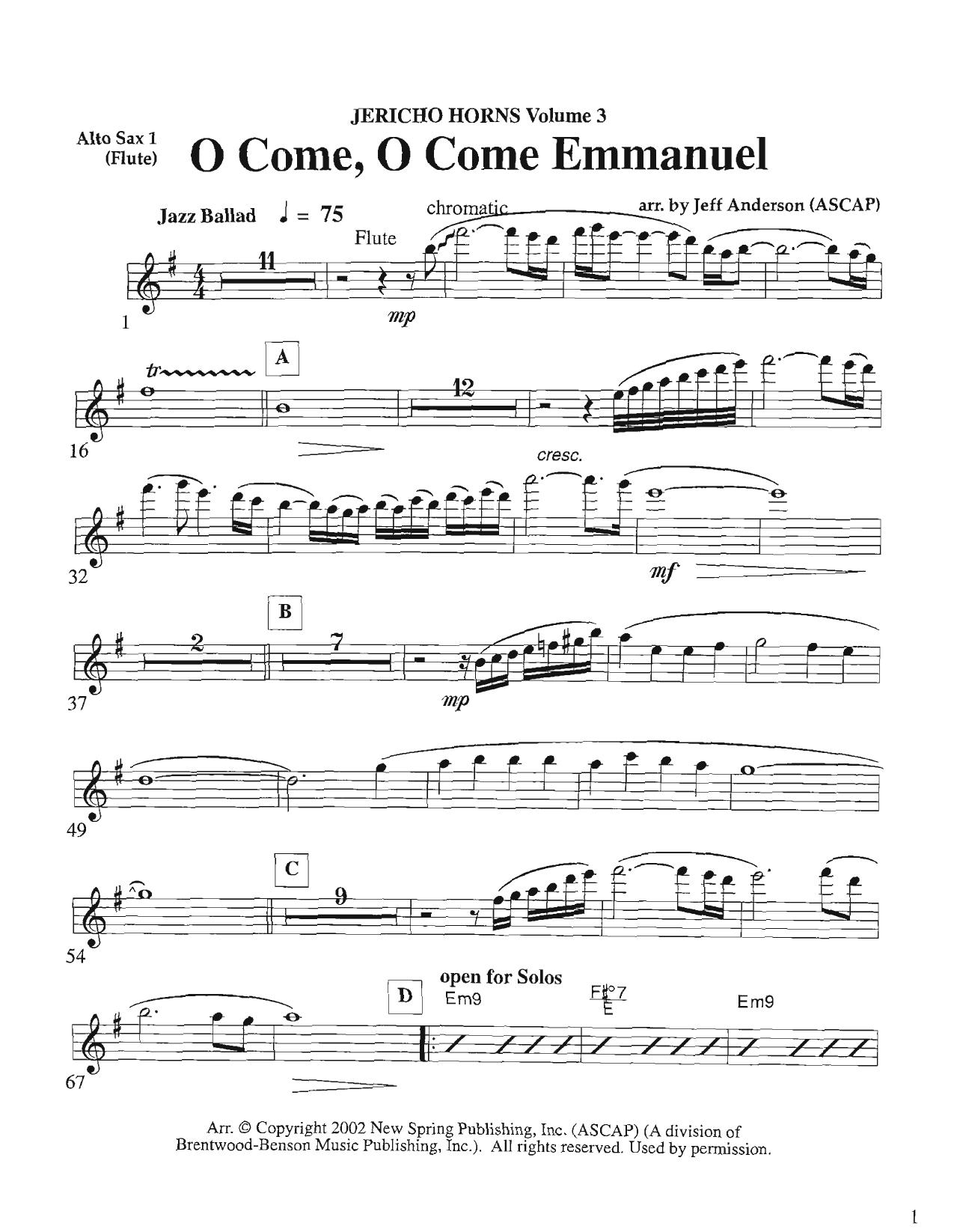
O Come, O Come Emmanuel (J.Anderson) sheet music preview

O Come, O Come Emmanuel (J.Anderson)

Composed by Johnnie Lee Wills and Deacon Anderson

Arranged by J.Anderson

  • Ensemble: Big Band
  • Style: Jazz Standard
  • Pages: 42
  • Instruments (21): Alto Sax 1 (Flute), Alto Sax 2 (Flute), Tenor Sax 1, Tenor Sax 2, Bari Sax, Trumpet 1 (Flugel), Trumpet 2 (Flugel), Trumpet 3 (Flugel), Trumpet 4 (Flugel), Trombone 1, Trombone 2, Trombone 3, Trombone 4, Rhythm (Piano, Bass, Drums, Guitar), Trumpet sub for Alto (Alternate Part), Tenor Sax sub for Trombone (Alternate Part), Trombone sub for Tenor Sax (Alternate Part), Solo Sheet (C Treble Clef), Solo Sheet (Bb Treble Clef), Solo Sheet (Eb Treble Clef), Solo Sheet (C Bass Clef)
  • Difficulty: medium
  • Content: Individual Parts
  • Format: PDF Download (Instant)
  • Price: $24.99

Blending ancient contemplative modal melodies with the sophisticated harmonic vocabulary of mid-century modern jazz, J.Anderson’s big band interpretation of the traditional Advent hymn "O Come, O Come Emmanuel" transforms a centuries-old plainchant into a striking contemporary jazz masterwork. While the original 9th-century Latin hymn *Veni, Veni Emmanuel* has been adapted through generations—and famously intersected with various American roots and gospel traditions by mid-century composers and folk revivalists—this modern big band setting reimagines the haunting, minor-mode melody through a sophisticated lens reminiscent of the Gil Evans or Bob Brookmeyer textural schools. The resulting sonic landscape moves far beyond standard holiday repertoire, offering a brooding, atmospheric, and harmonically rich exploration that sits comfortably within the contemporary jazz standard idiom. Anchored by a smoldering, modal jazz waltz feel in 3/4 time before opening up into an expansive, driving 4/4 swing groove, the arrangement evokes a mood of solemn anticipation that gradually builds into triumphant, brass-heavy euphoria. The piece opens with a delicate, rubato atmospheric introduction featuring atmospheric flutes and muted brasses, establishing a melancholic yet hopeful minor key palette. As the rhythm section locks into a persistent, pulsing bassline, the textures thicken with lush, extended chord voicings—utilizing major sevenths, minor ninths, and sharpened elevenths—that imbue the familiar melody with a poignant, bittersweet emotional gravity. J.Anderson’s compositional approach relies heavily on shifting instrumental colors and rich counterpoint rather than standard block-chord writing. The woodwind doublings—featuring prominent parts for flute alongside the traditional saxophone section—allow for impressionistic, orchestral textures that recall West Coast cool jazz sensibilities. Melodic responsibility is shared democratically across the ensemble: the lead alto saxophone and flutes introduce the fragile theme, while the lower reeds and trombones provide a warm, subterranean counter-melody. A soaring, modal-inflected improvised solo section provides a focal point for a capable tenor saxophone or piano soloist, framed by cascading background figures from the full brass section. The climax of the chart is a masterclass in dynamic architecture, culminating in a towering shout chorus that utilizes upper-structure triads and staggered syncopation before dissolving back into the quiet, haunting introspection of the opening motif. Advanced high school ensembles with strong section players, as well as collegiate and professional big bands, will find this chart to be an exceptionally rewarding addition to their libraries. While the rhythm section must possess a mature command of subtle tempo pacing and dynamic restraint, the horn parts demand precise intonation, blend, and a refined sense of modern harmonic awareness. It stands out as an intellectually and emotionally engaging centerpiece for winter concerts or contemporary jazz festival programs, offering audiences a radical yet reverent reimagining of a timeless theme. Success with this chart hinges upon the ensemble's ability to balance rich, extended-tertian harmonies without letting the dense voicings sound muddy. The conductor should pay meticulous attention to the opening 3/4 section, ensuring the tempo remains elastic yet grounded before the transition into the driving 4/4 swing groove. Key technical challenges include maintaining pristine intonation in the brass during sustained, high-register altered dominant chords, and executing the delicate, impressionistic woodwind passages with chamber-music precision. Saxophone doublings (specifically flute on Alto 1) require a bright, cutting tone to project over the rhythm section. Drummers should approach the chart with a nuanced touch, utilizing ride cymbal textures and subtle brushwork during the exposition, avoiding heavy-handed backbeats until the dynamic swell of the shout chorus. Rehearsals should initially isolate the rhythm section to lock in the hypnotic underlying groove before layering in the horn sections to balance the intricate dynamic swells. Q: What instruments and parts are included in this big band arrangement? A: The arrangement is scored for a standard 19-instrument big band instrumentation, featuring Alto Saxophone 1 (with flute doubling), Alto Saxophone 2, Tenor Saxophone 1, Tenor Saxophone 2, Baritone Saxophone, 4 Trumpets, 4 Trombones, Guitar, Piano, Bass, Drums, and a dedicated Flute part. Q: What is the difficulty level of this chart? A: This arrangement is graded as advanced, making it best suited for collegiate, advanced high school, and professional jazz ensembles due to its dense extended harmonies, complex meter shifts, and required woodwind doublings. Q: What is the style and historical context of this piece? A: Written by J.Anderson, this arrangement frames the ancient 9th-century hymn melody within a contemporary jazz standard framework, drawing stylistic inspiration from the moody, impressionistic arranging traditions of Gil Evans and modern modal jazz. Q: What makes this particular arrangement unique? A: It breaks away from traditional, predictable holiday big band charts by utilizing lush, extended harmonies, shifting metric feels (moving between 3/4 and 4/4), and impressionistic woodwind scoring that highlights atmospheric textures alongside driving swing grooves. Q: What is the performance duration and tempo feel of the arrangement? A: The piece runs approximately 5 to 6 minutes in duration, featuring an opening atmospheric, rubato-feeling 3/4 modal waltz that transitions into a dynamic, medium-up 4/4 swing tempo.

Questions and answers

What is included in the O Come, O Come Emmanuel (J.Anderson) PDF?
The verified current file contains individual parts across 42 pages.
How many instruments or parts are listed for O Come, O Come Emmanuel (J.Anderson)?
The verified instrumentation list contains 21 entries for this Big Band arrangement.
Who is credited for O Come, O Come Emmanuel (J.Anderson)?
Composer: Johnnie Lee Wills and Deacon Anderson. Arranger: J.Anderson.
What difficulty is listed for O Come, O Come Emmanuel (J.Anderson)?
The verified difficulty level is medium.
What style is listed for O Come, O Come Emmanuel (J.Anderson)?
The catalog lists the style as Jazz Standard.
Can I preview O Come, O Come Emmanuel (J.Anderson) before buying?
Yes. The product page provides a preview generated from the current PDF file.
How is O Come, O Come Emmanuel (J.Anderson) delivered?
After successful payment, the digital PDF is made available for download. The displayed price is $24.99.

Musicians Also Search For

O Come, O Come Emmanuel J.Anderson PDFO Come, O Come Emmanuel J.Anderson sheet musicO Come, O Come Emmanuel arranged by J.AndersonJ.Anderson big band chartsJ.Anderson jazz arrangements PDFO Come, O Come Emmanuel Johnnie Lee Wills and Deacon Anderson sheet musicO Come, O Come Emmanuel Johnnie Lee Wills and Deacon Anderson big band arrangementsJohnnie Lee Wills and Deacon Anderson big band chartsO Come, O Come Emmanuel big band arrangementsO Come, O Come Emmanuel big band PDF downloadO Come, O Come Emmanuel jazz sheet musicbig band sheet music downloadO Come, O Come Emmanuel individual parts downloadO Come, O Come Emmanuel sheet music PDFO Come, O Come Emmanuel Jazz Standard chartsJazz Standard big band arrangementsbuy O Come, O Come Emmanuel sheet musicdownload O Come, O Come Emmanuel PDFO Come, O Come Emmanuel jazz chartsbest J.Anderson big band arrangementsJohnnie Lee Wills and Deacon Anderson arranged by J.AndersonO Come, O Come Emmanuel printable sheet musicbig band repertoire PDF

All arrangements by J.Anderson All Johnnie Lee Wills and Deacon Anderson sheet music