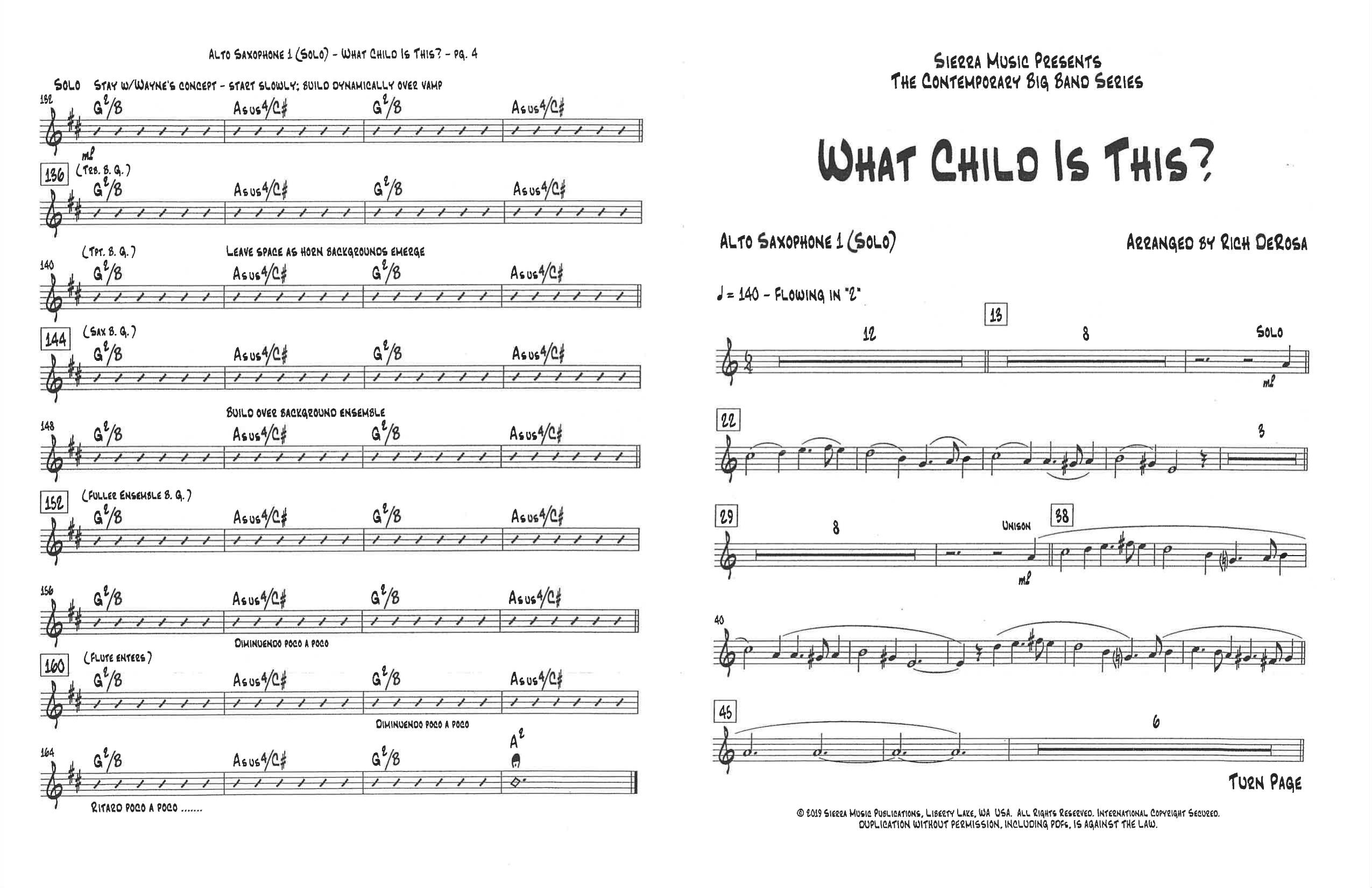
What Child Is This (R.DeRosa) sheet music preview

What Child Is This (R.DeRosa)

Composed by R. DeRosa

Arranged by R.DeRosa

  • Ensemble: Big Band
  • Style: Jazz Standard
  • Pages: 48
  • Instruments (18): Alto Saxophone 1 (Solo), Alto Saxophone 2, Flute / Tenor Saxophone 1, Tenor Saxophone 2, Baritone Saxophone, Flugelhorn 1, Flugelhorn 2, Flugelhorn 3, Flugelhorn 4, Trombone 1, Trombone 2, Trombone 3, Bass Trombone 4, Vibraphone (Opt.), Drums, Bass, Guitar, Piano
  • Difficulty: medium
  • Content: Individual Parts
  • Format: PDF Download (Instant)
  • Price: $24.99

Rooted in the timeless English traditional melody "Greensleeves"—which dates back to the Elizabethan era—"What Child Is This" has evolved into one of the most beloved and enduring holiday themes in the Western canon. When filtered through the lens of modern jazz arrangement, this classic 6/8 carol undergoes a profound harmonic and rhythmic transformation, bridging centuries of musical heritage with sophisticated contemporary big band vocabulary. The piece occupies a unique space in the seasonal jazz repertoire, offering ensembles a chance to explore a moody, reflective atmosphere without relying on standard, over-played holiday cheer. Rich, contemporary modal harmonies and an evocative, flowing tempo define the musical character of this chart. R.DeRosa reimagines the familiar melody by subverting traditional expectations, casting the piece in a sophisticated jazz waltz or supple compound meter feel that emphasizes lush saxophone voicings and atmospheric brass textures. The mood shifts masterfully from introspective and melancholic to soaring and triumphant, evoking the crisp, quiet wonder of a winter night before expanding into expansive, harmonically rich climaxes. The arrangement relies heavily on seamless transitions between dense, impressionistic chord clusters and driving, linear counterpoint, giving the entire ensemble a cinematic depth of sound. DeRosa’s signature arranging style shines through in the meticulous voice-leading and inventive reharmonizations that underpin the entire chart. Rather than treating the melody as a simple head arrangement, DeRosa weaves the theme through various sections of the ensemble, utilizing a gorgeous sax soli that highlights intricate inner voices and contemporary extensions. The brass writing employs subtle mutes and warm, open-horn chorale textures that provide a rich backdrop, while a powerful, dynamically contoured shout chorus elevates the emotional peak of the chart before winding down into a tranquil, haunting resolution. Advanced high school, collegiate, and professional big bands will find this chart exceptionally rewarding to prepare and perform. The instrumentation is standard for a full 18-piece jazz ensemble—featuring two altos, two tenors (with flute doubling on Tenor 1), baritone saxophone, four trumpets, four trombones, and a full rhythm section—spanning a substantial 48-page manuscript score and parts collection. While the technical demands require disciplined section playing, precise intonation on altered dominants, and a mature command of rubato-to-tempo transitions, the payoff is a deeply sophisticated performance piece that commands audience attention and elevates any seasonal or contemporary jazz program. Success with this arrangement hinges on establishing a fluid, highly communicative rhythmic pulse that honors the subtle shifts between compound meter feels and straight-ahead swing sensibilities. Conductors should emphasize relaxed yet precise subdivision, particularly during the rubato intro and transitional modulations where ensemble breath control is vital. The saxophones must blend meticulously during the soli section, ensuring that inner-voice alterations speak clearly without overpowering the lead alto. Brass players should focus on a warm, vocal tone quality rather than aggressive volume, utilizing gentle vibrato where appropriate to enhance the modal harmony. In the rhythm section, the drummer should avoid heavy-handed backbeats, opting instead for textural cymbal work and a flowing, interactive brush or light stick approach that propels the harmonic movement forward. Rehearsals should initially isolate the complex chord clusters at slow tempos to lock in intonation before introducing the intended performance velocity and dynamic sweep. Q: What specific instruments and parts are included in this arrangement? A: The chart is scored for a standard 18-piece big band, including Alto Saxophone 1, Alto Saxophone 2, Flute/Tenor Saxophone 1, Tenor Saxophone 2, Baritone Saxophone, four trumpets, four trombones, and a complete rhythm section (piano, bass, drums, and optional guitar), backed by a comprehensive 48-page score. Q: What is the difficulty level of this big band chart? A: This arrangement is graded as advanced, making it ideal for skilled collegiate ensembles, professional big bands, and top-tier high school jazz orchestras capable of navigating sophisticated extended harmonies and nuanced dynamic shifts. Q: What is the musical style and historical background of this piece? A: It is a modern jazz arrangement of the classic holiday standard "What Child Is This" (derived from the English melody "Greensleeves"), blending traditional seasonal themes with contemporary modal jazz composition and sophisticated harmonic voicings. Q: What makes this specific arrangement by R.DeRosa unique? A: DeRosa’s treatment stands out for its impressionistic reharmonizations, seamless meter manipulation, intricate saxophone solis, and a dynamic architectural arc that transforms a familiar carol into a major modern jazz ensemble work. Q: What is the expected performance duration and tempo feel of the piece? A: The arrangement typically runs between 4 to 5 minutes in duration and features a flexible, expressive tempo built around a flowing jazz waltz and compound meter feel that demands careful pacing from the conductor.

Questions and answers

What is included in the What Child Is This (R.DeRosa) PDF?
The verified current file contains individual parts across 48 pages.
How many instruments or parts are listed for What Child Is This (R.DeRosa)?
The verified instrumentation list contains 18 entries for this Big Band arrangement.
Who is credited for What Child Is This (R.DeRosa)?
Composer: R. DeRosa. Arranger: R.DeRosa.
What difficulty is listed for What Child Is This (R.DeRosa)?
The verified difficulty level is medium.
What style is listed for What Child Is This (R.DeRosa)?
The catalog lists the style as Jazz Standard.
Can I preview What Child Is This (R.DeRosa) before buying?
Yes. The product page provides a preview generated from the current PDF file.
How is What Child Is This (R.DeRosa) delivered?
After successful payment, the digital PDF is made available for download. The displayed price is $24.99.

Musicians Also Search For

What Child Is This R.DeRosa PDFWhat Child Is This R.DeRosa sheet musicWhat Child Is This arranged by R.DeRosaR.DeRosa big band chartsR.DeRosa jazz arrangements PDFWhat Child Is This R. DeRosa sheet musicWhat Child Is This R. DeRosa big band arrangementsR. DeRosa big band chartsWhat Child Is This big band arrangementsWhat Child Is This big band PDF downloadWhat Child Is This jazz sheet musicbig band sheet music downloadWhat Child Is This individual parts downloadWhat Child Is This sheet music PDFWhat Child Is This Jazz Standard chartsJazz Standard big band arrangementsbuy What Child Is This sheet musicdownload What Child Is This PDFWhat Child Is This jazz chartsbest R.DeRosa big band arrangementsR. DeRosa arranged by R.DeRosaWhat Child Is This printable sheet musicbig band repertoire PDF

All arrangements by R.DeRosa