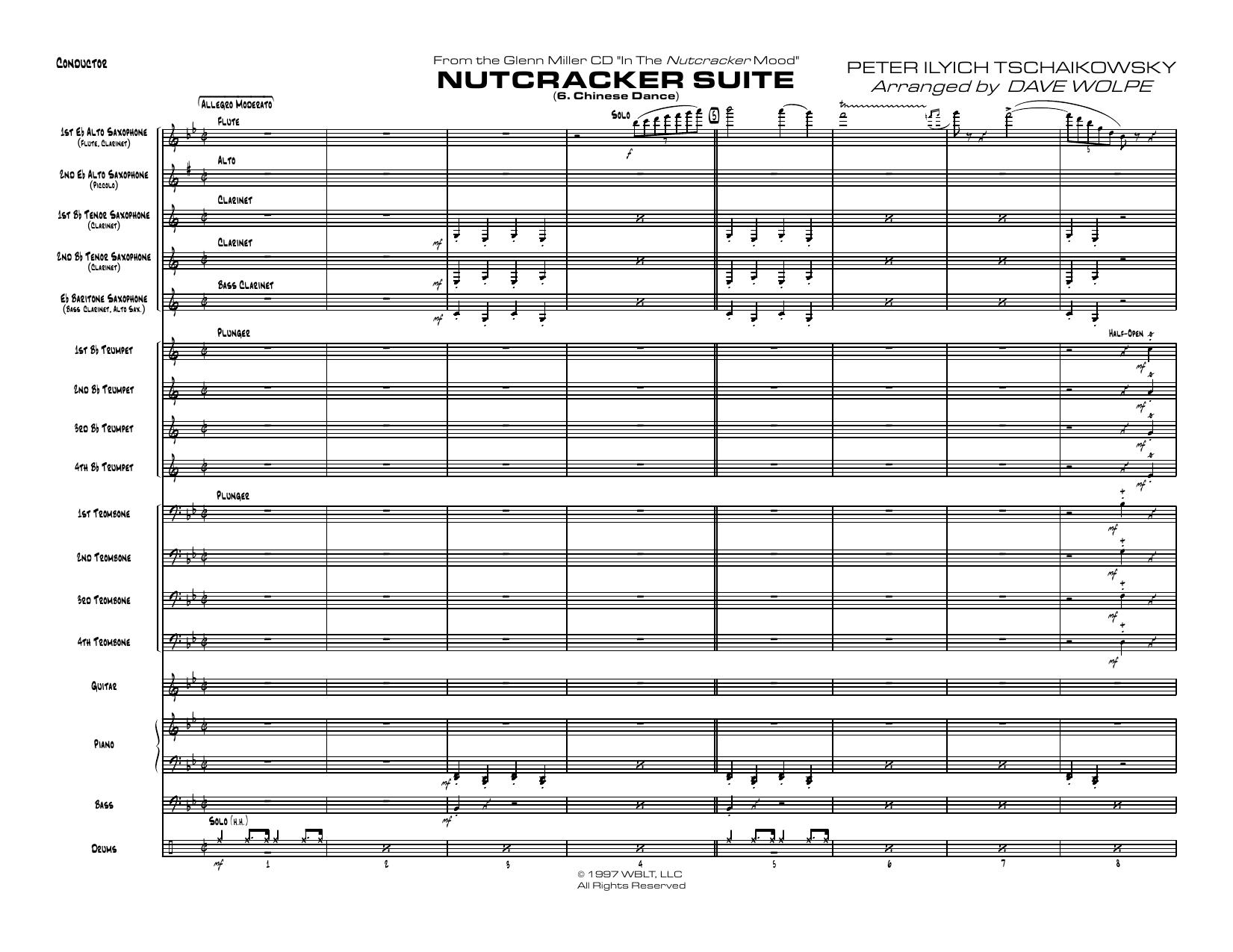
Nutcracker Suite - 6. Chinese Dance - P. I. Tchaikovsky (D.Wolpe)
Composed by Pyotr Ilyich Tchaikovsky
Arranged by Dave Wolpe
- Ensemble: Big Band
- Pages: 51
- Instruments (17): 1st Eb Alto Saxophone (Flute, Clarinet), 2nd Eb Alto Saxophone (Piccolo), 1st Bb Tenor Saxophone (Clarinet), 2nd Bb Tenor Saxophone (Clarinet), Eb Baritone Saxophone (Bass Clarinet, Alto Sax), 1st Bb Trumpet, 2nd Bb Trumpet, 3rd Bb Trumpet, 4th Bb Trumpet, 1st Trombone, 2nd Trombone, 3rd Trombone, 4th Trombone (Bass Trombone), Guitar, Piano, Bass, Drums
- Difficulty: advanced
- Content: Individual Parts
- Format: PDF Download (Instant)
- Price: $24.99
Pyotr Ilyich Tchaikovsky originally introduced European audiences to the exotic, high-velocity charm of "Chinese Dance" within his legendary 1892 ballet, *The Nutcracker*. Over a century later, master jazz arranger Dave Wolpe brilliantly reimagined this whimsical staple for the contemporary big band, transforming Tchaikovsky’s delicate orchestral miniatures into a swinging, high-energy tour de force. While Duke Ellington and Billy Strayhorn famously pioneered jazz interpretations of Tchaikovsky’s suite in 1960, Wolpe’s contemporary concert band treatment stands out for its clever integration of traditional big band voicings with the classical suite's inherent mischievous character. Propelled by a brisk, light-footed tempo and an infectious swing feel, this arrangement captures the sparkling, comedic tension of the original bassoon and flute lines while giving them a distinctly modern jazz overhaul. The mood is playful, buoyant, and relentlessly driving, evoking a sense of theatrical mischief. Wolpe utilizes crisp, staccato articulations across the full ensemble to mimic the plucked strings and flute flutter-tonguing of Tchaikovsky’s orchestration, blending classical programmatic imagery with classic swing-era swagger. Wolpe’s signature arranging style shines through ingenious section writing and transparent texture layering, avoiding heavy-handedness to preserve the nimble charm of the original melody. The chart opens with the signature high-register motif passed deftly between woodwinds and muted brass, gradually expanding into rich, harmonically sophisticated shout choruses featuring extended extensions and clever chromatic passing tones. Alto saxophones and flutes predominantly carry the rapid-fire thematic material, demanding immaculate finger dexterity and pristine articulation, while the rhythm section lays down an understated, conversational groove that keeps the momentum effortlessly buoyant. Advanced high school, collegiate, and professional big bands will find this arrangement an absolute delight to rehearse and perform. It serves as an ideal, unexpected showstopper for holiday concerts or pops programs, offering a refreshing departure from standard seasonal fare. The primary technical challenges lie in maintaining clean, unified articulation at high speeds and balancing the lighter woodwind textures against the brass, making it a masterclass in ensemble precision, lightness of touch, and stylistic versatility. Success with this arrangement hinges on achieving a feather-light, buoyant swing feel without sacrificing rhythmic precision. The tempo must remain strictly controlled; pushing it too fast will muddy the intricate scalar passages, while dragging will destroy the inherent playful momentum. Conductors should pay close attention to dynamic balance, ensuring the crisp woodwind and muted brass lines project clearly over a driving, yet restrained, rhythm section. Saxophone sections must execute their rapid-fire unison lines with uniform articulation, treating staccato notes with a dry, clipped punch rather than heavy accents. Trumpets and trombones should utilize harmon or cup mutes where indicated to replicate the nasally, whimsical timbre reminiscent of Tchaikovsky's original bassoon and flute dialogue. Rehearsal should begin slowly, isolating the tricky chromatic interludes at half-tempo before gradually ramping up to performance speed. Q: What instruments and parts are included in this arrangement? A: The 51-page publication includes a full conductor score and 18 distinct instrumental parts tailored for a standard big band lineup, featuring Flute, Alto Saxophone 1 & 2, Tenor Saxophone 1 & 2, Baritone Saxophone, Trumpets 1-4, Trombones 1-4, Piano, Guitar, Bass, and Drums. Q: What is the difficulty level of this big band chart? A: This arrangement is graded as medium-advanced, making it best suited for accomplished high school, collegiate, and professional jazz ensembles due to its fast tempo and intricate woodwind articulation demands. Q: How does this chart fit into the jazz and classical repertoire? A: It bridges classical programmatic music and traditional big band jazz, continuing the historic lineage of jazz reinterpretations of Tchaikovsky's *Nutcracker Suite* pioneered by icons like Duke Ellington. Q: What makes Dave Wolpe’s arrangement unique? A: Wolpe cleverly translates Tchaikovsky’s delicate, pointillistic orchestration into swinging big band idioms, using transparent textures, witty muted brass writing, and sophisticated extended harmonies without losing the original's whimsical charm. Q: What is the performance duration and tempo feel of the piece? A: The arrangement runs approximately 2 to 3 minutes and is performed at a brisk, light-footed tempo with a driving, energetic swing feel.
Questions and answers
- What is included in the Nutcracker Suite - 6. Chinese Dance - P. I. Tchaikovsky (D.Wolpe) PDF?
- The verified current file contains a conductor score and individual parts across 51 pages.
- How many instruments or parts are listed for Nutcracker Suite - 6. Chinese Dance - P. I. Tchaikovsky (D.Wolpe)?
- The verified instrumentation list contains 17 entries for this Big Band arrangement.
- Who is credited for Nutcracker Suite - 6. Chinese Dance - P. I. Tchaikovsky (D.Wolpe)?
- Composer: Pyotr Ilyich Tchaikovsky. Arranger: Dave Wolpe.
- What difficulty is listed for Nutcracker Suite - 6. Chinese Dance - P. I. Tchaikovsky (D.Wolpe)?
- The verified difficulty level is advanced.
- Can I preview Nutcracker Suite - 6. Chinese Dance - P. I. Tchaikovsky (D.Wolpe) before buying?
- Yes. The product page provides a preview generated from the current PDF file.
- How is Nutcracker Suite - 6. Chinese Dance - P. I. Tchaikovsky (D.Wolpe) delivered?
- After successful payment, the digital PDF is made available for download. The displayed price is $24.99.
Musicians Also Search For
Nutcracker Suite - 6. Chinese Dance - P. I. Tchaikovsky Dave Wolpe PDF • Nutcracker Suite - 6. Chinese Dance - P. I. Tchaikovsky Dave Wolpe sheet music • Nutcracker Suite - 6. Chinese Dance - P. I. Tchaikovsky arranged by Dave Wolpe • Dave Wolpe big band charts • Dave Wolpe jazz arrangements PDF • Nutcracker Suite - 6. Chinese Dance - P. I. Tchaikovsky Pyotr Ilyich Tchaikovsky sheet music • Nutcracker Suite - 6. Chinese Dance - P. I. Tchaikovsky Pyotr Ilyich Tchaikovsky big band arrangements • Pyotr Ilyich Tchaikovsky big band charts • Nutcracker Suite - 6. Chinese Dance - P. I. Tchaikovsky big band arrangements • Nutcracker Suite - 6. Chinese Dance - P. I. Tchaikovsky big band PDF download • Nutcracker Suite - 6. Chinese Dance - P. I. Tchaikovsky jazz sheet music • big band sheet music download • Nutcracker Suite - 6. Chinese Dance - P. I. Tchaikovsky conductor score PDF • Nutcracker Suite - 6. Chinese Dance - P. I. Tchaikovsky individual parts download • Nutcracker Suite - 6. Chinese Dance - P. I. Tchaikovsky sheet music PDF • buy Nutcracker Suite - 6. Chinese Dance - P. I. Tchaikovsky sheet music • download Nutcracker Suite - 6. Chinese Dance - P. I. Tchaikovsky PDF • Nutcracker Suite - 6. Chinese Dance - P. I. Tchaikovsky jazz charts • best Dave Wolpe big band arrangements • Pyotr Ilyich Tchaikovsky arranged by Dave Wolpe • Nutcracker Suite - 6. Chinese Dance - P. I. Tchaikovsky printable sheet music • big band repertoire PDF