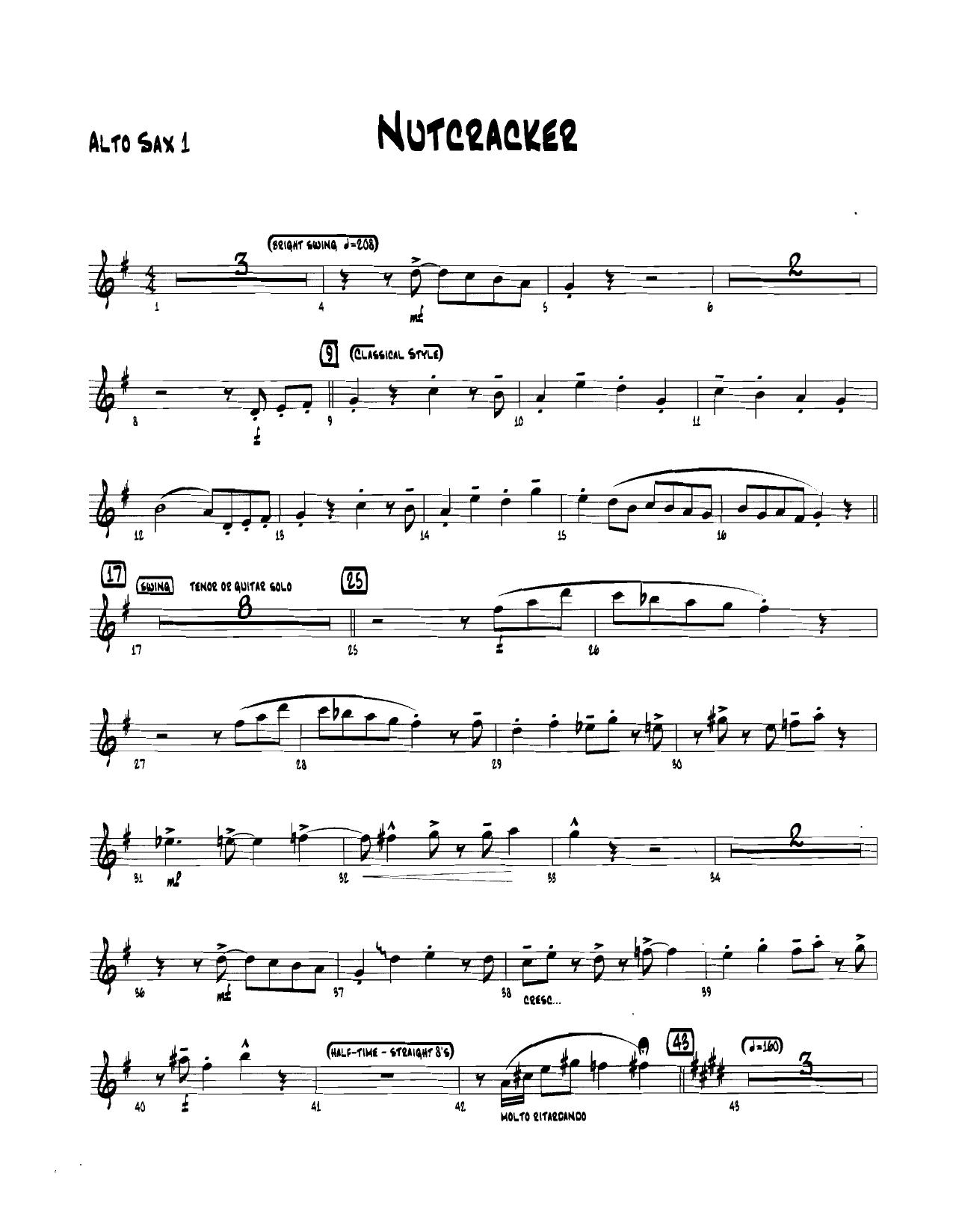
Nutcracker Suite (L.Brown)
Composed by Pyotr Ilyich Tchaikovsky
Arranged by Les Brown
- Ensemble: Big Band
- Pages: 84
- Instruments (17): Alto Sax 1, Alto Sax 2, Tenor Sax 1, Tenor Sax 2, Bari Sax, Trumpet 1, Trumpet 2, Trumpet 3, Trumpet 4, Trombone 1, Trombone 2, Trombone 3, Trombone 4, Piano, Guitar, Bass, Drums
- Difficulty: advanced
- Content: Individual Parts
- Format: PDF Download (Instant)
- Price: $24.99
Pyotr Ilyich Tchaikovsky’s timeless 1892 ballet masterwork underwent a radical transformation when legendary bandleader Les Brown and his "Band of Renown" infused the classical themes with mid-century West Coast swing. Recorded during the height of the big band era's sophisticated orchestral jazz movement, this adaptation bridges the gap between 19th-century Russian romanticism and sleek, high-energy American dance jazz. Les Brown’s treatment strips away the heavy symphonic padding of the original orchestrations, replacing them with crisp, interlocking brass voicings, swinging rhythmic drives, and the trademark precision that made the Brown orchestra one of the most enduring institutions in jazz history. Swinging at a brisk, infectious medium-up tempo, the arrangement opens with a bright, instantly recognizable motif before plunging into a dynamic 4/4 groove characterized by walking basslines and light, shimmering cymbal work. The emotional trajectory shifts seamlessly from whimsical and playful to swinging and brass-heavy, evoking the polished glamour of a 1950s supper club or a sophisticated theater stage. Les Brown utilizes the full spectrum of his ensemble's color palette, pitting rich, warm saxophone solids against sharp, punctuated brass stabs. The harmonic language remains faithful to Tchaikovsky’s original chromaticism while subtly incorporating extended jazz chords, diminished passing tones, and clever blues inflections that give the classical melodies an authentic, idiomatic jazz bite. Throughout the chart, the melody is democratically shared across the sections, though the woodwinds—anchored by soaring alto saxophone leads and velvety tenor counterlines—frequently take charge of the intricate, dance-like themes. Solos are strategically placed to highlight lead horn players, demanding a fluent command of major and minor bebop vocabulary over the underlying classical chord progressions. Technical challenges center primarily on articulation uniformity and rhythmic crispness; the sixteenth-note runs derived from Tchaikovsky's original string and woodwind parts must be articulated with a clean, lightweight jazz swing tongue rather than a heavy classical approach. The rhythm section acts as the engine, requiring a steady, driving swing feel that never rushes, allowing the intricate horn counterpoint to breathe and sparkle. Advanced high school, collegiate, and professional big bands will find this 84-page publication an exceptional showcase for concert programs, holiday jazz revues, or festival appearances. Because of its demanding ensemble blend, dynamic control, and stylistic duality, it rewards groups that possess disciplined section playing and a strong sense of swing subdivision. Performing this chart offers audiences a delightful, unexpected collision of two musical worlds, testing a band's versatility while delivering pure, high-octane entertainment from the first downbeat to the final resounding chord. Navigating Les Brown’s clever adaptation requires meticulous attention to articulation and dynamic contrast. The primary technical hurdle lies in transforming Tchaikovsky's classical scalar passages into swinging, idiomatic jazz lines without sacrificing rhythmic precision. Conductors should insist on a lightweight, detached tongue on all fast-moving eighth and sixteenth-note figures, ensuring the swing eighth-notes remain even and relaxed rather than stiff or rushed. The tempo should be maintained with a driving, forward-moving medium-swing feel—avoiding any tendency to drag during the more intricate, harmonically dense ensemble passages. Section leaders must unify their vibrato; saxophones should utilize a controlled, modern jazz vibrato, while the brass keep their tone bright, focused, and piercing during shout choruses. Special attention must be paid to dynamic markings: when the rhythm section drops to a whisper behind a exposed saxophone soli, the accompanying horns must back off completely to let the melody lines project clearly. Rehearsal should begin by isolating the rhythm section to lock in the underlying groove before layering in the saxophones and brass section by section. Q: What instruments and parts are included in this publication? A: This 84-page arrangement is scored for a 9-instrument core big band instrumentation, featuring Alto Saxophone, Tenor Saxophone, Baritone Saxophone, Trumpet, Trombone, and a fully realized rhythm section framework. Q: What is the difficulty level of this arrangement? A: This chart is best suited for advanced high school, collegiate, and professional big bands due to its intricate ensemble interplay, fast scalar passages, and requirement for precise stylistic articulation. Q: What is the musical style and historical context of this chart? A: Arranged by Les Brown, this piece translates Pyotr Ilyich Tchaikovsky's 1892 classical ballet themes into the sophisticated, high-energy language of mid-century West Coast swing. Q: What makes this specific Les Brown arrangement unique? A: It brilliantly merges classical Russian romanticism with polished jazz harmony, utilizing clever chord substitutions, driving swing feels, and dynamic saxophone solos that reinvent traditional holiday motifs. Q: What is the performance duration and recommended tempo? A: The arrangement is designed to be performed at a bright, energetic medium-swing tempo, typically running between 3 to 4 minutes depending on the chosen soloist extensions and overall conductor pacing.
Questions and answers
- What is included in the Nutcracker Suite (L.Brown) PDF?
- The verified current file contains a conductor score and individual parts across 84 pages.
- How many instruments or parts are listed for Nutcracker Suite (L.Brown)?
- The verified instrumentation list contains 17 entries for this Big Band arrangement.
- Who is credited for Nutcracker Suite (L.Brown)?
- Composer: Pyotr Ilyich Tchaikovsky. Arranger: Les Brown.
- What difficulty is listed for Nutcracker Suite (L.Brown)?
- The verified difficulty level is advanced.
- Can I preview Nutcracker Suite (L.Brown) before buying?
- Yes. The product page provides a preview generated from the current PDF file.
- How is Nutcracker Suite (L.Brown) delivered?
- After successful payment, the digital PDF is made available for download. The displayed price is $24.99.
Musicians Also Search For
Nutcracker Suite Les Brown PDF • Nutcracker Suite Les Brown sheet music • Nutcracker Suite arranged by Les Brown • Les Brown big band charts • Les Brown jazz arrangements PDF • Nutcracker Suite Pyotr Ilyich Tchaikovsky sheet music • Nutcracker Suite Pyotr Ilyich Tchaikovsky big band arrangements • Pyotr Ilyich Tchaikovsky big band charts • Nutcracker Suite big band arrangements • Nutcracker Suite big band PDF download • Nutcracker Suite jazz sheet music • big band sheet music download • Nutcracker Suite conductor score PDF • Nutcracker Suite individual parts download • Nutcracker Suite sheet music PDF • buy Nutcracker Suite sheet music • download Nutcracker Suite PDF • Nutcracker Suite jazz charts • best Les Brown big band arrangements • Pyotr Ilyich Tchaikovsky arranged by Les Brown • Nutcracker Suite printable sheet music • big band repertoire PDF