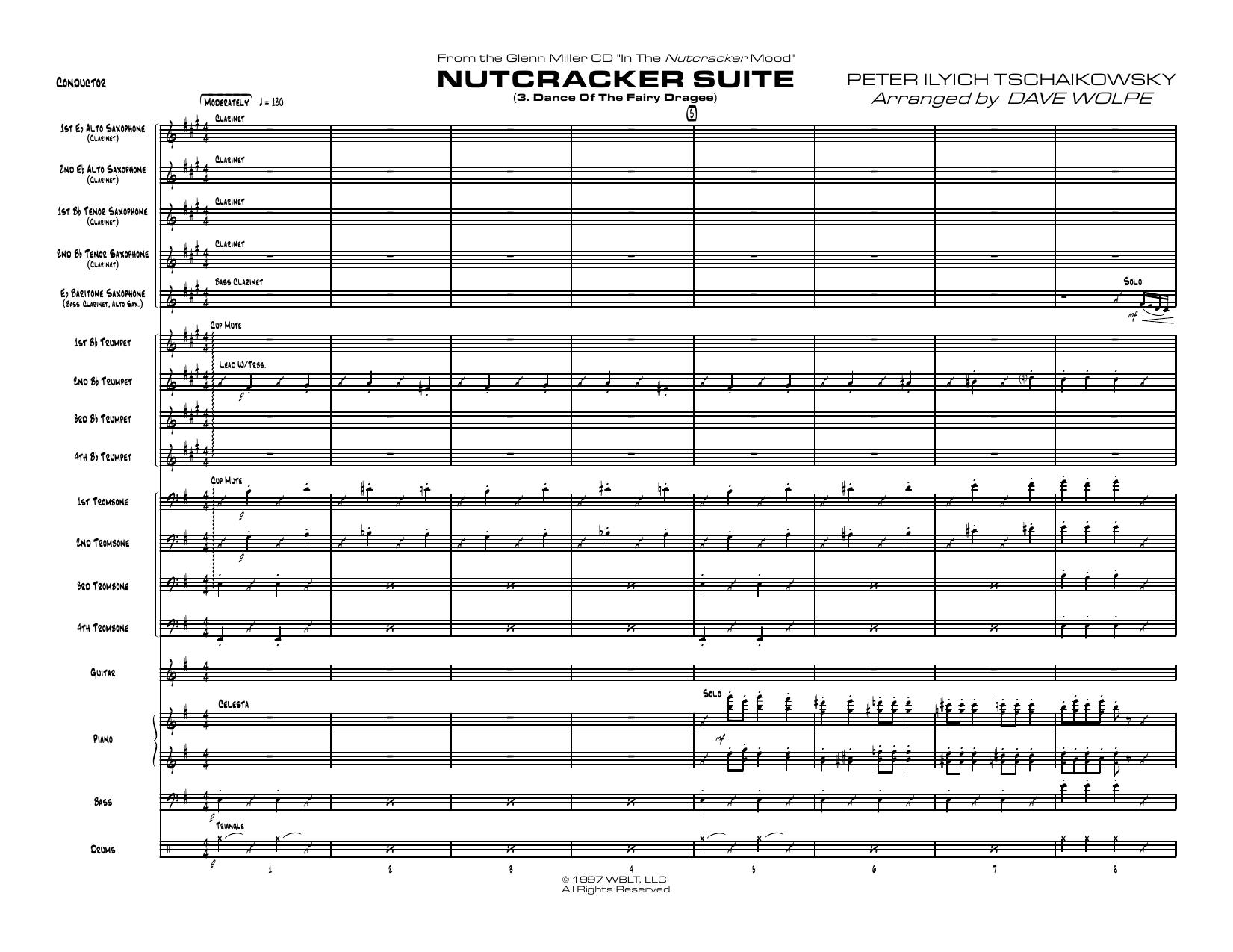
Nutcracker Suite - 3. Dance Of The Fairy Dragee - P. I. Tchaikovsky (D.Wolpe)
Composed by Pyotr Ilyich Tchaikovsky
Arranged by Dave Wolpe
- Ensemble: Big Band
- Pages: 41
- Instruments (17): 1st Eb Alto Saxophone (Clarinet), 2nd Eb Alto Saxophone (Clarinet), 1st Bb Tenor Saxophone (Clarinet), 2nd Bb Tenor Saxophone (Clarinet), Eb Baritone Saxophone (Bass Clarinet, Alto Sax.), 1st Bb Trumpet, 2nd Bb Trumpet, 3rd Bb Trumpet, 4th Bb Trumpet, 1st Trombone, 2nd Trombone, 3rd Trombone, Bass Trombone, Guitar, Piano (Celesta), Bass, Drums
- Difficulty: medium
- Content: Individual Parts
- Format: PDF Download (Instant)
- Price: $24.99
Pyotr Ilyich Tchaikovsky originally unveiled his timeless *Nutcracker Suite* in 1892, establishing "Dance of the Sugar Plum Fairy"—here titled "Dance Of The Fairy Dragee"—as one of the most enchanting miniatures in orchestral literature. Immortalized further by Duke Ellington and Billy Strayhorn's groundbreaking 1960 jazz interpretation on Columbia Records, Tchaikovsky's delicate, celesta-driven masterpiece has long proven remarkably fertile ground for big band adaptation. This crossing of classical ballet and American big band jazz transforms a staple of the holiday concert season into a sophisticated, swinging showcase that bridges 19th-century romanticism with mid-century jazz innovation. Master arranger Dave Wolpe reimagines Tchaikovsky’s iconic theme through a clever, buoyant swing lens, establishing a medium-tempo groove that balances playful elegance with driving rhythmic momentum. The arrangement opens with the instantly recognizable, descending melodic motif, though colored by rich, extended jazz harmonies that instantly signal a departure from the classical blueprint. Wolpe maintains the whimsical, sparkling character of the original while injecting an infectious walking bassline feel and subtle brass punctuation. As the charts builds, the mood shifts from coy and mysterious to an exuberant, full-ensemble celebration, capturing both the magic of the fairy tale and the sophistication of a classic studio-era swing chart. Known for his idiomatic, highly playable writing for scholastic and professional ensembles alike, Dave Wolpe approaches this classic with a deep respect for section blend and dynamic contrast. The legendary descending celesta ostinato is cleverly distributed across the woodwinds and muted brass before expanding into lush sax soli passages that highlight Wolpe's signature rich voicings. Rather than relying on over-the-top modern dissonance, Wolpe utilizes tasteful secondary dominants, 9th and 13th chords, and clever counterpoint to keep the harmony fresh. The arrangement features well-crafted transitional moments that lead organically into open solo sections, allowing individual improvisers to stretch out over familiar yet harmonically enriched changes before setting up a tight, cohesive ensemble shout chorus. Advanced high school, collegiate, and community big bands will find this chart an ideal balance of crowd-pleasing familiarity and legitimate technical reward. While the rhythmic figures require clean articulation and precise section togetherness—particularly in the lighter, exposed opening statements—the brass ranges remain accessible, making it an exceptionally effective programming choice for holiday concerts or pops performances. The interplay between aggressive swing sections and delicate, transparent scoring demands a high degree of dynamic control, ensuring that both the musicians and the audience experience a fresh, compelling perspective on a universally beloved classic. Success with this Dave Wolpe arrangement hinges on striking the right balance between classical precision and loose, swinging articulation. The tempo should remain a comfortable medium swing; pushing it too fast strips the chart of its inherent charm and playful bounce. Conductors should pay immediate attention to the dynamic markings in the opening statement, ensuring that the foundational woodwind and muted brass lines remain light, crisp, and never forced. The eighth-note feel must be consistently swung, avoiding heavy accents on beats one and three to maintain a floating, dance-like quality. Technically, the primary challenge lies in clean section blend during exposed soli passages and maintaining intonation through Wolpe's extended chord voicings. Saxophone players should focus on homogeneous tone quality, while the brass section must blend seamlessly whether playing open or utilizing standard cup/straight mutes where indicated. Rehearsals should initially isolate the rhythmic unison figures between the rhythm section and horns to lock in the articulation before layering on dynamics. The rhythm section acts as the primary engine: the drummer should keep a light ride-cymbal sizzle with crisp hi-hat chicks on beats two and four, avoiding heavy heavy-handed rock patterns that would compromise the swing aesthetic. Q: What instruments and parts are included in this big band arrangement? A: The instrumentation comprises a standard 18-instrument big band setup: 2 alto saxophones, 2 tenor saxophones, 1 baritone saxophone, 4 trumpets, 4 trombones, piano, guitar, bass, and drums, accompanied by a comprehensive 41-page conductor score. Q: What is the difficulty level of this chart? A: This arrangement is graded as medium, making it exceptionally well-suited for advanced high school, collegiate, and community jazz orchestras looking for accessible yet musically rewarding repertoire. Q: How does this arrangement fit into jazz history and style? A: Rooted in Tchaikovsky's 1892 classical ballet, this chart follows in the celebrated tradition of Duke Ellington's jazz suite adaptations, translating classical thematic material into a swinging, mid-century big band vernacular. Q: What makes Dave Wolpe's treatment of this piece unique? A: Wolpe uniquely blends Tchaikovsky's delicate, whimsical melodies with sophisticated extended jazz harmonies, clever counterpoint, and rich saxophone solis that retain the magic of the original while driving a hard swing groove. Q: What is the expected performance duration and tempo feel? A: The piece is set in a comfortable, infectious medium-swing tempo (4/4 time) and typically runs between 3 to 4 minutes, depending on the length of the improvised solo sections.
Questions and answers
- What is included in the Nutcracker Suite - 3. Dance Of The Fairy Dragee - P. I. Tchaikovsky (D.Wolpe) PDF?
- The verified current file contains a conductor score and individual parts across 41 pages.
- How many instruments or parts are listed for Nutcracker Suite - 3. Dance Of The Fairy Dragee - P. I. Tchaikovsky (D.Wolpe)?
- The verified instrumentation list contains 17 entries for this Big Band arrangement.
- Who is credited for Nutcracker Suite - 3. Dance Of The Fairy Dragee - P. I. Tchaikovsky (D.Wolpe)?
- Composer: Pyotr Ilyich Tchaikovsky. Arranger: Dave Wolpe.
- What difficulty is listed for Nutcracker Suite - 3. Dance Of The Fairy Dragee - P. I. Tchaikovsky (D.Wolpe)?
- The verified difficulty level is medium.
- Can I preview Nutcracker Suite - 3. Dance Of The Fairy Dragee - P. I. Tchaikovsky (D.Wolpe) before buying?
- Yes. The product page provides a preview generated from the current PDF file.
- How is Nutcracker Suite - 3. Dance Of The Fairy Dragee - P. I. Tchaikovsky (D.Wolpe) delivered?
- After successful payment, the digital PDF is made available for download. The displayed price is $24.99.
Musicians Also Search For
Nutcracker Suite - 3. Dance Of The Fairy Dragee - P. I. Tchaikovsky Dave Wolpe PDF • Nutcracker Suite - 3. Dance Of The Fairy Dragee - P. I. Tchaikovsky Dave Wolpe sheet music • Nutcracker Suite - 3. Dance Of The Fairy Dragee - P. I. Tchaikovsky arranged by Dave Wolpe • Dave Wolpe big band charts • Dave Wolpe jazz arrangements PDF • Nutcracker Suite - 3. Dance Of The Fairy Dragee - P. I. Tchaikovsky Pyotr Ilyich Tchaikovsky sheet music • Nutcracker Suite - 3. Dance Of The Fairy Dragee - P. I. Tchaikovsky Pyotr Ilyich Tchaikovsky big band arrangements • Pyotr Ilyich Tchaikovsky big band charts • Nutcracker Suite - 3. Dance Of The Fairy Dragee - P. I. Tchaikovsky big band arrangements • Nutcracker Suite - 3. Dance Of The Fairy Dragee - P. I. Tchaikovsky big band PDF download • Nutcracker Suite - 3. Dance Of The Fairy Dragee - P. I. Tchaikovsky jazz sheet music • big band sheet music download • Nutcracker Suite - 3. Dance Of The Fairy Dragee - P. I. Tchaikovsky conductor score PDF • Nutcracker Suite - 3. Dance Of The Fairy Dragee - P. I. Tchaikovsky individual parts download • Nutcracker Suite - 3. Dance Of The Fairy Dragee - P. I. Tchaikovsky sheet music PDF • buy Nutcracker Suite - 3. Dance Of The Fairy Dragee - P. I. Tchaikovsky sheet music • download Nutcracker Suite - 3. Dance Of The Fairy Dragee - P. I. Tchaikovsky PDF • Nutcracker Suite - 3. Dance Of The Fairy Dragee - P. I. Tchaikovsky jazz charts • best Dave Wolpe big band arrangements • Pyotr Ilyich Tchaikovsky arranged by Dave Wolpe • Nutcracker Suite - 3. Dance Of The Fairy Dragee - P. I. Tchaikovsky printable sheet music • big band repertoire PDF